
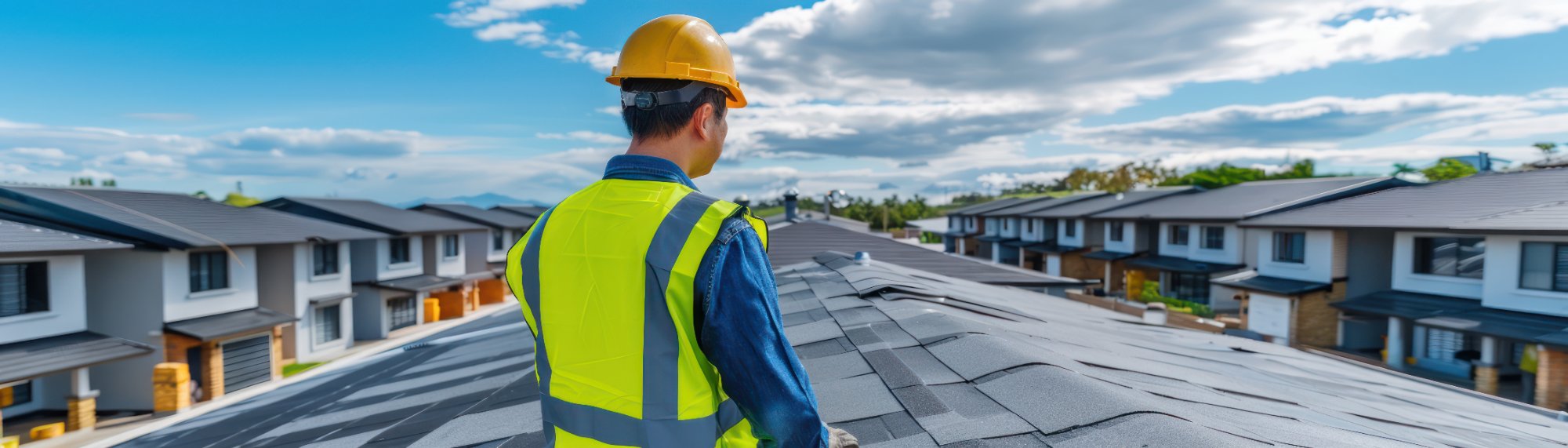
Bishopsgate Roof Surveys provide independent, professional roof inspections across this distinguished corner of Surrey, where some of the county's finest residential properties sit alongside Windsor Great Park. Our certified surveyors combine drone aerial photography with thermal imaging to assess every roof type found along these tree-lined avenues — from the grand Victorian and Edwardian houses on Bishopsgate Road itself, through the substantial period homes scattered around Englefield Green village, to the interwar detached housing on Coopers Hill, the student-era conversions near Egham Hill, and the luxury new-build residences within the gated Magna Carta Park development.
Fast, independent roof surveys from local experts.
The character of Bishopsgate and Englefield Green lies in its architectural variety. Bishopsgate Road — named after the historic gate through which bishops were permitted to enter Windsor Great Park — is lined with properties spanning three centuries of English building. Georgian lodges, Victorian mansions with ornate bargeboards and decorative ridge tiles, Edwardian family homes with handmade clay tile roofing, and contemporary residences all share this remarkable stretch of Surrey. Bishopsgate Roof Surveys exist because each of these building eras presents different roofing materials, different structural challenges, and different failure modes that demand specialist knowledge.
Whether you are purchasing one of the area's high-value period properties, concerned about persistent damp in a home sheltered beneath the Great Park's mature tree canopy, preparing evidence for a storm damage insurance claim, or simply wanting an honest view of an ageing roof before authorising expensive work, Bishopsgate Roof Surveys deliver the documented evidence you need to proceed with confidence.
Bishopsgate Roof Surveys were established on a straightforward principle: homeowners in this part of Surrey deserve an independent, unbiased assessment of their roof before committing to expensive repairs or completing a property purchase. Too many residents across Englefield Green and the wider Egham area have been steered into unnecessary work by contractors with a vested interest, or have discovered hidden defects only after exchanging contracts on a new home. Our purpose is to close that gap between guesswork and reliable information.
Every inspection follows a structured, repeatable methodology. We start at ground level, examining rainwater goods, fascias, soffits, and any defects visible from the perimeter. Our DJI Enterprise drone then photographs every elevation, ridge line, valley, hip, chimney stack, and dormer — reaching vantage points that scaffolding cannot safely achieve on Bishopsgate's taller Victorian villas and the steeply pitched rooflines found along Coopers Hill and Egham Hill. Where the survey package includes thermal imaging, our FLIR cameras map temperature differentials caused by trapped moisture beneath tiles and within the roof structure.
Properties in the Bishopsgate area occupy an unusually broad architectural spectrum. A Georgian lodge near the Great Park entrance has a fundamentally different roofing system from a 1930s detached on St Judes Road, and both differ again from the contemporary slate-effect coverings at Magna Carta Park. Bishopsgate Roof Surveys bring the breadth of knowledge this variety demands — because a single generic checklist would miss problems specific to each era and material.
We maintain complete independence. Bishopsgate Roof Surveys do not carry out roof repairs, do not recommend specific contractors, and hold no financial interest in any inspection outcome. When our report confirms a roof is in good order, that judgement carries genuine credibility. When we identify a defect, our costings reflect realistic market rates — not figures designed to alarm or to benefit a third party.
Nearby Areas with Similar Properties: The roofing challenges we see around Bishopsgate are mirrored across the north-west Surrey corridor. Homeowners in Egham and Virginia Water face comparable issues with ageing clay tiles, lead flashing deterioration, and the effects of heavy tree cover on roof surfaces. See our area-specific guides for tailored information.
Bishopsgate Roof Surveys are not roofers, builders, or contractors. We provide independent inspection and reporting only — ensuring every assessment is free from commercial bias.
Bishopsgate Roof Surveys are ready to inspect your property. Whether it is a period house on Bishopsgate Road, a family home in Englefield Green village, or a modern residence on the Magna Carta Park estate, our team provides the clarity you need.
What Bishopsgate Roof Surveys bring to homeowners, buyers, and landlords across the area
Many of Bishopsgate's most valuable properties are set behind mature hedging, electric gates, and extensive gardens that make conventional ladder access impractical or unsafe. The larger Victorian and Edwardian homes along Bishopsgate Road feature complex multi-pitch rooflines, deep valleys, decorative ridge work, and tall chimney stacks that ground-level inspection simply cannot assess. Our DJI Enterprise drone captures every elevation in high-definition detail, identifying cracked tiles, displaced slates, and flashing failures that would otherwise go unnoticed.
Bishopsgate's proximity to Windsor Great Park means many properties sit beneath or alongside dense tree canopy. Fallen leaves, moss growth, and retained moisture create conditions where leaks develop slowly and remain concealed for months. Our FLIR thermal cameras detect temperature variations caused by moisture tracking beneath tiles, behind flashings, and within the timber structure — exposing problems that neither visual inspection nor a standard homebuyer report would reveal.
Every Bishopsgate Roof Surveys report combines annotated drone photographs, thermal overlays where applicable, and itemised repair costings based on current labour and material rates. The document is designed for immediate use — whether presented to a solicitor during conveyancing, submitted to an insurer as supporting evidence for a claim, or handed to a roofing contractor as a detailed specification for remedial work.
Bishopsgate Roof Surveys carry full professional indemnity and public liability insurance. Our surveyors hold recognised certifications and CAA-approved drone pilot licences. Every inspection follows a standardised methodology developed across thousands of Surrey properties, delivering consistency whether we are assessing a Georgian lodge near the park entrance or an apartment within the Magna Carta Park development.
Bishopsgate and the surrounding Englefield Green area encompass a striking range of property ages and construction methods. Along Bishopsgate Road itself, Georgian and early Victorian houses sit on generous plots behind mature gardens, their roofs covered in natural slate or handmade clay tiles with lead-lined valleys and ornate chimney stacks carrying multiple pots. Moving towards the village centre, Edwardian terraces and semi-detached houses present plain clay tiles on steep pitches with bay window flashings prone to gradual degradation. The interwar housing on St Judes Road and around The Barons typically features concrete tiles and hip roofs, while the Magna Carta Park development introduces contemporary materials including engineered slate and standing-seam metal coverings.
Bishopsgate Roof Surveys have developed our expertise around these precise distinctions. We understand that a leak on a 200-year-old Georgian slate roof requires a different diagnostic approach from a failed membrane on a modern flat roof extension. That specificity is what separates a useful report from a generic observation.
From the grand period homes on Bishopsgate Road to the contemporary residences at Magna Carta Park, Bishopsgate Roof Surveys understand the roofing challenges specific to this area.
How Bishopsgate Roof Surveys have helped local homeowners and property buyers

A couple purchasing a substantial Victorian detached home on Bishopsgate Road — with an asking price above two million pounds — received a homebuyer report that described the roof as requiring "routine maintenance only." The property featured four chimney stacks, multiple roof pitches, and a rear parapet wall. Uncomfortable relying on such a brief assessment at that price point, the buyers contacted Bishopsgate Roof Surveys for a dedicated inspection.
Our drone footage revealed that the tallest chimney stack on the south-west corner had tilted approximately forty millimetres from vertical — not visible from ground level due to the surrounding tree line. Thermal imaging detected moisture ingress at the base of the stack where the lead flashing had separated from the brickwork. We also documented eleven cracked clay tiles on the north-facing slope and a section of failed mortar along the main ridge that was admitting rainwater.
Bishopsgate Roof Surveys costed the stabilisation, re-flashing, tile replacement, and ridge repointing at approximately sixteen thousand eight hundred pounds. The buyer's solicitor used our report to negotiate a price reduction matching the full repair estimate. The chimney was stabilised and re-flashed within two months of completion, preventing what could have developed into a serious structural problem over the following winter.

A homeowner near the village green had been told by a roofing contractor that their entire roof needed stripping and re-tiling at a cost of nineteen thousand pounds. The contractor cited "extensive moss damage and tile degradation across all elevations." The homeowner, uncertain whether such a comprehensive intervention was truly necessary, asked Bishopsgate Roof Surveys for a second opinion before committing.
Our drone inspection confirmed significant moss coverage — unsurprising given the property's position beneath overhanging oak trees that shade the rear roof slope for most of the day. However, detailed close-range photography revealed that the underlying clay tiles on the front and side elevations remained structurally sound. Only the north-facing rear slope showed genuine tile erosion, with surface delamination across approximately thirty-five percent of the tiles. The moss on the remaining elevations was cosmetic, not structural.
Bishopsgate Roof Surveys recommended a targeted rear-slope re-tile and professional moss treatment for the remaining elevations, costed at approximately eight thousand two hundred pounds — well under half the original quote. The homeowner followed our specification, and the front and side tiles continue to perform well three seasons later. A sensible maintenance programme saved over ten thousand pounds in unnecessary work.

Following winter storms in early 2025, a homeowner on Coopers Hill discovered water entering the master bedroom through the ceiling. Their insurer dispatched a loss adjuster who categorised the damage as "pre-existing wear" and refused the claim. The homeowner believed the damage was directly attributable to the storm and approached Bishopsgate Roof Surveys to document the evidence independently.
Our drone inspection identified eight displaced concrete tiles on the south-west facing slope — consistent with the recorded wind direction during the storm event. Two tiles had landed in the rear garden, confirming recent displacement. Thermal imaging mapped a clear moisture trail from the exposed battens through to the bedroom ceiling below. We also photographed a section of ridge tile that had fractured cleanly at the mortar joint, with fresh, unweathered edges indicating recent breakage rather than gradual deterioration.
The Bishopsgate Roof Surveys report — with timestamped photography, annotated thermal overlays, and a clear narrative linking the damage to the storm — was submitted as a formal dispute. The insurer reversed their decision within three weeks and approved the claim in full. Total repair costs of five thousand six hundred pounds were covered under the policy, and the homeowner avoided funding the repairs out of pocket.

The owner of a Grade II listed Georgian lodge near the Great Park entrance had commissioned a slate re-covering two years earlier. Despite the new slates, damp patches had appeared in the first-floor rooms and were gradually worsening. The roofing firm that had carried out the work insisted the slates were sound and attributed the damp to condensation. Unconvinced, the owner contacted Bishopsgate Roof Surveys.
Our thermal imaging revealed concentrated moisture in three distinct areas beneath the new slates — inconsistent with condensation, which would produce a more even distribution. Our internal loft inspection confirmed that the re-slating contractor had laid new slates over existing battens without replacing timbers that were already compromised by years of water ingress. Two principal rafters showed advanced softwood decay, and the original lead-lined valley gutter between two roof pitches had not been renewed during the works.
Armed with our report, the owner pursued a professional negligence claim against the original contractor. The documented evidence from Bishopsgate Roof Surveys — particularly the thermal imaging showing moisture paths beneath ostensibly new slate — proved central to the claim's success. Remediation including timber replacement and valley gutter renewal cost approximately twenty-one thousand pounds, recovered in full through the claim.
Need a professional roof survey for your Bishopsgate property? Get in touch with Bishopsgate Roof Surveys today for a free consultation.
Feedback from homeowners and buyers who have used Bishopsgate Roof Surveys
"Purchasing a large Victorian house on Bishopsgate Road, we were not prepared to rely on the homebuyer survey alone — the property had four chimney stacks and a complex rear roofline. Bishopsgate Roof Surveys found a leaning stack, failed hip flashings, and cracked tiles that the surveyor had overlooked. Their report saved us over sixteen thousand in negotiations. Absolutely first-rate."
"A stubborn damp problem above our bay window had defeated two roofers who both blamed different things. Bishopsgate Roof Surveys used thermal imaging to trace it to a hidden flat roof section behind the front parapet that neither tradesman had thought to examine. The repair was straightforward once we knew the source. Genuinely expert work."
"Our insurer called our storm damage claim 'gradual deterioration' and refused to pay. Bishopsgate Roof Surveys photographed clean fracture lines and fresh tile displacement that proved otherwise. The insurer reversed their decision within a month and covered the full repair. Without that report we would have been thousands out of pocket."
Our step-by-step inspection process — from booking to final report
Contact Bishopsgate Roof Surveys by phone or through the form below. We discuss your property, the reason for the survey, and recommend the appropriate inspection level. We then confirm a date and time that works around your schedule — typically within five to seven working days, or sooner for urgent requests.
On arrival, our surveyor walks the full perimeter of your property, assessing gutters, downpipes, fascias, soffits, and any visible defects from ground level. We note access constraints, overhanging vegetation, and neighbouring structures that may affect the roof. This stage establishes the baseline before the aerial inspection begins.
Our DJI Enterprise drone captures high-resolution photographs of every roof elevation, ridge, valley, hip, flashing, and chimney stack. Where your package includes thermal imaging, our FLIR camera records heat maps that reveal concealed moisture. The drone reaches areas that ladders and scaffolding cannot — particularly valuable on Bishopsgate's larger period properties with complex rooflines.
Within forty-eight hours, you receive a comprehensive written report. It includes annotated photographs, thermal overlays where applicable, a condition assessment for each roof element, itemised repair costings at current market rates, and a prioritised maintenance schedule. The report is formatted for immediate use by solicitors, insurers, or contractors.
Transparent pricing from Bishopsgate Roof Surveys — choose the inspection level that matches your property and your concerns
Bishopsgate Roof Surveys offer three tiers of inspection designed around different property types, levels of concern, and budgets. Each survey is carried out by the same certified team using the same professional methodology — the distinction lies in the depth of investigation and the technology employed. Whether you own a compact flat-roofed extension in the village centre or a multi-chimney Victorian residence on Bishopsgate Road, there is a package suited to your situation.
Essential visual roof assessment for Bishopsgate homeowners seeking a clear overview of their roof's current condition
Full drone and thermal imaging inspection — the most requested package for Bishopsgate buyers and homeowners
Complete structural roof assessment for Bishopsgate's larger detached homes, period properties, and listed buildings
Common questions answered by Bishopsgate Roof Surveys
Bishopsgate Roof Surveys cover the full extent of the Bishopsgate and Englefield Green area. Our regular inspection territory includes properties along Bishopsgate Road from the Windsor Great Park entrance through to the village centre, the residential streets radiating from Englefield Green itself, Coopers Hill, Egham Hill, St Judes Road, The Barons, and the lanes towards Wick and Priest Hill. We also attend properties in the Magna Carta Park development and the surrounding countryside towards Virginia Water and Egham.
Most inspections take between ninety minutes and three hours on site, depending on the property's size and roof complexity. The larger Victorian and Edwardian houses along Bishopsgate Road — with their multiple chimney stacks, hip and valley arrangements, and extensive lead work — tend toward the upper end of that range. Smaller properties in the village centre or the newer developments are assessed more quickly. Every client receives their completed report within forty-eight hours of the site visit.
Heritage and period properties represent a significant share of our Bishopsgate workload. We regularly inspect Georgian lodges, Victorian mansions with decorative ridge work and natural slate coverings, Edwardian family homes with handmade clay tiles, and cottages with traditional construction methods. Our drone technology is especially valuable on these buildings, where erecting scaffolding or leaning ladders against historic fabric carries a genuine risk of causing damage. Several of our Bishopsgate clients hold listed properties where a non-invasive survey method is not merely preferred but essential.
Every comprehensive and premium report from Bishopsgate Roof Surveys includes timestamped drone photography, thermal scan overlays where applicable, detailed damage narratives, and itemised repair costings at current market rates. Insurance providers require documented photographic evidence and written damage descriptions when assessing claims, and our reports are structured specifically to satisfy those requirements. We have supported successful claims for properties throughout the Bishopsgate area, including storm damage, accidental damage, and subsidence-related roof distortion.
The area's proximity to Windsor Great Park and its mature woodland means many roofs sit beneath heavy tree cover for much of the year. This accelerates moss and lichen colonisation, clogs gutters and valley gutters with leaf debris, and retains moisture against tile surfaces. On the older period properties along Bishopsgate Road, we frequently find cracked or slipped natural slates, deteriorating lead flashings around chimney stacks and parapet walls, failed valley linings, and eroded ridge mortar. The interwar housing on Coopers Hill and St Judes Road commonly presents concrete tile fatigue and softened hip mortar. Newer properties tend to show issues with flat roof membranes and sealed gutter systems where maintenance has been neglected.
Commercial and institutional inspections form part of our regular Bishopsgate schedule. We survey hospitality premises around Englefield Green and along Bishopsgate Road, converted period buildings now used as offices, school buildings, community facilities, and the range of commercial properties across the wider Runnymede borough. All flat roof systems including felt, GRP, EPDM, and single-ply membranes are within our scope, as are the pitched roofs covering many of the area's converted commercial and institutional buildings.
Have another question? Contact Bishopsgate Roof Surveys directly.
Bishopsgate Roof Surveys provide professional roof inspections across the area and wider Runnymede borough
The tree-lined avenue running from the Windsor Great Park entrance is home to some of Surrey's most distinguished residential properties. Georgian lodges, Victorian mansions, and Edwardian houses sit on generous plots, their roofs featuring natural slate, handmade clay tiles, lead valleys, ornate ridge work, and tall chimney stacks with multiple pots.
The village centre around the historic green features a charming mix of Victorian and Edwardian terraces, semi-detached family homes, period cottages, and some more recent infill development. Clay tile roofs, bay window flashings, and traditional chimney stacks are characteristic of the area.
The elevated ground between Englefield Green and Egham features substantial interwar and post-war detached housing alongside the Magna Carta Park development and properties associated with Royal Holloway. Concrete tiles, hip roofs, and more contemporary coverings are typical.
The residential streets south and east of the village green include a mix of Edwardian and interwar detached and semi-detached homes on mature plots. Plain clay tiles, concrete interlocking tiles, and original chimney stacks with ageing mortar are common across this neighbourhood.
The Forest Estate and the streets around Northcroft contain a mix of post-war housing and some later twentieth-century development. Concrete interlocking tiles, flat-roofed extensions, and relatively straightforward rooflines are typical, though many properties are now reaching the age where original coverings require attention.
Bishopsgate Roof Surveys operate across the wider Runnymede and north-west Surrey area. We regularly attend properties in the surrounding towns and villages that share similar housing stock and roofing challenges.
Bishopsgate Roof Surveys provide the independent, thorough roof inspections that this exceptional part of Surrey requires. Whether you are a buyer conducting due diligence on a Victorian property along Bishopsgate Road, a homeowner investigating persistent damp in an Edwardian house near the village green, a landlord safeguarding a portfolio property on Coopers Hill, or simply seeking an honest assessment of an ageing roof before committing to significant expenditure, our surveys provide the clarity you need.
Every inspection pairs certified expertise with advanced technology — drone aerial photography, thermal imaging, and comprehensive written reporting — to produce a complete, unbiased picture of your roof's condition. Bishopsgate Roof Surveys do not carry out repairs. We do not recommend contractors. We deliver the facts, the photographs, and the costings, and you make the decisions.
Every report is independent, detailed, and written to be acted upon — whether you are buying, selling, claiming, or simply protecting your investment.
Call us today or complete the form below to arrange your Bishopsgate roof survey.
Contact Bishopsgate Roof Surveys today to arrange your roof inspection
Monday - Friday: 7:30 AM - 9:30 PM
Saturday: 7:30 AM - 7:00 PM
Sunday: 9:00 AM - 5:00 PM
For urgent roof inspection needs in Bishopsgate, please call Bishopsgate Roof Surveys directly.
Call Now