
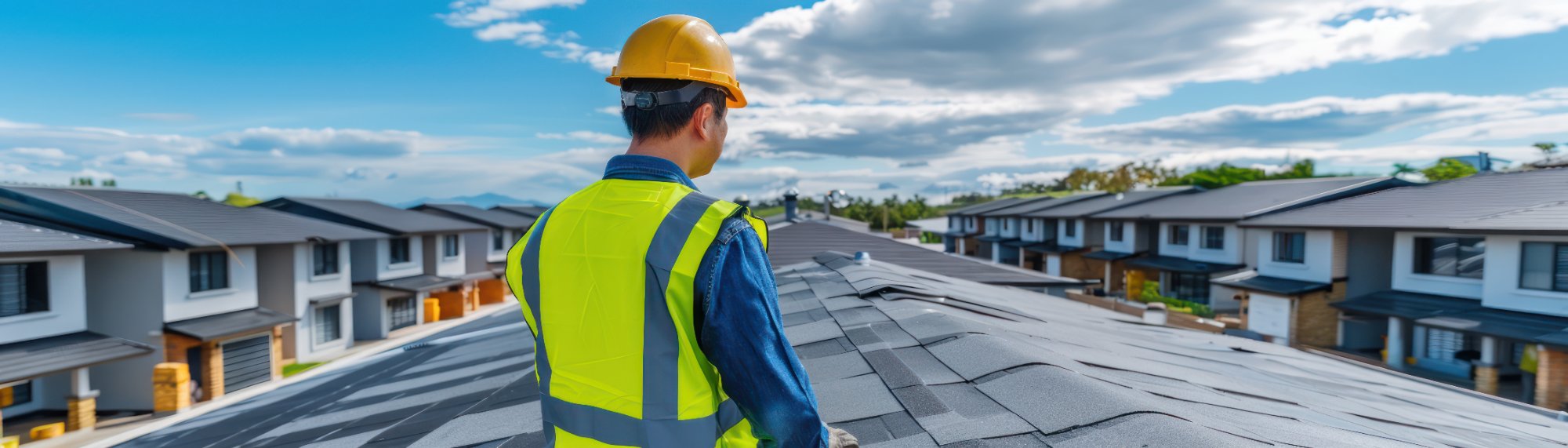
Feltham Hill Roof Surveys provide independent, certified roof inspections across this established residential area on the Surrey borders and its surrounding neighbourhoods. Our team combines drone aerial photography with thermal imaging technology to deliver accurate, impartial assessments for every property type found across the Feltham Hill district — from the generous interwar semis and detached family homes around Hanworth Park, through the 1950s and 1960s housing that lines Feltham Hill Road and Sunbury Road, to the post-war terraces of Lower Feltham and the more recent developments close to the Ashford and Kempton Park borders.
Fast, independent roof surveys from local experts.
The residential streets around Feltham Hill developed primarily during the interwar and post-war periods, when suburban expansion brought wave after wave of new housing along the main arterial routes towards Sunbury and Ashford. The result is a neighbourhood where 1920s clay-tiled semis sit alongside 1950s concrete-tiled terraces, 1960s flat-roofed bungalows, and more modern infill developments. Each generation used different materials and construction techniques, and each carries its own vulnerabilities. Feltham Hill Roof Surveys understand these differences intimately and tailor every inspection to the specific roof in front of us.
Whether you are buying a property near Hanworth Park, chasing a persistent leak in a 1950s terrace along Sunbury Road, preparing an insurance claim after storm damage, or simply wanting clarity on an ageing concrete tile roof before committing to expensive replacement, Feltham Hill Roof Surveys deliver the documented evidence you need to act with confidence.
Feltham Hill Roof Surveys exist because property owners in this part of the Surrey borders deserve more than guesswork when it comes to their roofs. Too often, homeowners along Feltham Hill Road and the surrounding streets have been quoted for extensive roof work based on a ten-minute ladder inspection, or have exchanged contracts on a purchase only to find problems that a thorough survey would have caught. Our mission is to close that gap with honest, technology-backed assessments that serve no commercial interest other than the truth.
Every inspection follows a structured, consistent methodology. We begin with a full ground-level perimeter walk, assessing rainwater goods, fascia boards, soffits, and any visible defects from below. Our DJI Enterprise drone then flies every elevation, capturing high-resolution photographs of ridges, hips, valleys, flashings, chimney stacks, and tile surfaces that are unreachable from ladders — particularly important on the steeply pitched roofs found on many of Feltham Hill's interwar detached homes. Where the survey tier includes thermal imaging, our FLIR cameras map temperature differentials that reveal concealed moisture within the roof structure.
Feltham Hill's housing is predominantly suburban — semi-detached and detached homes on moderate plots, many of which have been extended at the rear with flat-roofed additions over the decades. These extensions are often the weakest link in the roofing envelope, and they rarely receive the same attention during standard property surveys. Feltham Hill Roof Surveys inspect extensions with the same rigour as the main roof, because that is where many of the most costly problems hide.
Independence is not a marketing phrase for us — it defines how we operate. Feltham Hill Roof Surveys do not carry out repairs, do not recommend specific contractors, and hold no financial interest in the outcome of any inspection. When we report that a roof is sound, that conclusion carries weight. When we identify damage, the costings in our report reflect genuine market rates rather than inflated figures designed to create urgency.
Nearby Areas with Similar Properties: The suburban housing stock and roofing challenges we encounter across Feltham Hill are shared by many neighbouring areas on the Surrey borders. Homeowners in Ashford and Sunbury-on-Thames face comparable issues with ageing concrete tiles, flat roof failures, and interwar clay tile deterioration. See our area-specific pages for detailed local information.
Feltham Hill Roof Surveys are not roofers, builders, or contractors. We provide independent inspection and reporting only — ensuring every assessment is free from commercial bias.
Feltham Hill Roof Surveys are ready to inspect your property. Whether it is an interwar semi near Hanworth Park, a 1960s bungalow on Feltham Hill Road, or a modern development near the Ashford border, our team delivers the answers you need.
What Feltham Hill Roof Surveys bring to homeowners, buyers, and landlords across the area
Many properties across Feltham Hill sit on plots where rear access is tight and ladder placement is restricted by conservatories, extensions, and garden walls. Our DJI Enterprise drone eliminates these access problems entirely, capturing every ridge tile, hip junction, valley channel, flashing strip, and chimney stack in crisp high-definition imagery. For the extended semis around Hanworth Park and the larger detached homes along Feltham Hill Road, aerial inspection reveals defects that would otherwise require costly scaffolding to reach.
Concealed moisture is the silent threat running through much of Feltham Hill's housing stock. A cracked concrete tile on a 1950s terrace can allow rainwater to track along the felt underlay for months before any visible staining appears on a bedroom ceiling. Our FLIR thermal cameras detect the temperature signatures that trapped moisture creates, identifying problem areas beneath tiles, behind flashings, and within flat roof membranes — long before the damage becomes obvious or expensive to repair.
Every Feltham Hill Roof Surveys report is built to be acted upon. Annotated drone photographs, thermal overlays where applicable, a clear written narrative of every defect found, and itemised repair costings at current trade rates — all formatted to be shared directly with your solicitor during a property purchase, submitted as evidence for an insurance claim, or handed to a roofing contractor as a precise scope of work. No jargon, no ambiguity, no guesswork.
Feltham Hill Roof Surveys carry full professional indemnity and public liability insurance. Our surveyors hold recognised industry certifications and CAA-approved drone pilot licences. Every inspection follows a standardised, repeatable methodology refined across thousands of properties in the Surrey and West London area — whether we are assessing an interwar semi on a tree-lined avenue or a flat-roofed garage behind a post-war terrace.
The area around Feltham Hill does not have the dramatic period architecture of some Surrey towns, but what it does have is a dense concentration of mid-twentieth-century housing that is now approaching the age where roofing materials begin to fail. The plain clay tiles on 1930s semis around Hanworth Park are eighty to ninety years old. Concrete interlocking tiles laid on 1950s and 1960s properties have passed their expected fifty-year lifespan. Flat felt roofs on rear extensions installed in the 1970s and 1980s are well beyond their design life. These are not future concerns — they are present realities that Feltham Hill Roof Surveys encounter every working week.
Our clients value the fact that we approach each roof on its own terms. A concrete tile roof on a 1960s detached bungalow near Kempton Park raises different questions than a clay tile semi from the 1930s, and both differ from a modern GRP flat roof on a recent extension. Feltham Hill Roof Surveys adapt our inspection focus to the specific materials, age, and construction method of the property — because a checklist designed for one roof type will miss the problems that matter on another.
From the clay-tiled semis around Hanworth Park to the concrete-tiled terraces of Lower Feltham, Feltham Hill Roof Surveys understand the area's housing stock from the inside out.
How Feltham Hill Roof Surveys have helped local homeowners and property buyers

After a November storm, the owners of a 1930s semi near Hanworth Park discovered water streaming into the rear bedroom through a widening ceiling stain. They submitted a claim to their home insurer, who sent a loss adjuster. The adjuster spent twenty minutes on site without accessing the roof and concluded the leak resulted from "age-related deterioration" rather than storm damage. The claim was refused.
Feltham Hill Roof Surveys deployed our drone within forty-eight hours of the homeowner's call. The aerial imagery showed three plain clay tiles displaced from the rear slope in a pattern consistent with wind lift, with clean fracture edges and no weathering on the exposed surfaces — clear indicators of sudden displacement rather than gradual wear. Thermal imaging confirmed a concentrated moisture path from the displaced tiles directly down to the bedroom ceiling below. We documented everything with timestamped photography and weather data from the nearest recording station.
Our detailed report was submitted as a formal dispute to the insurer. The claim was reviewed by a senior assessor, who overturned the original decision within three weeks. The full repair cost of three thousand eight hundred pounds was covered under the policy. The homeowners told us the Feltham Hill Roof Surveys report was the single factor that reversed the outcome.

A retired couple living in a 1960s detached bungalow on Feltham Hill Road had noticed moss building up heavily across the north-facing roof slope. A leaflet from a door-to-door roofing firm quoted nineteen thousand pounds for a complete strip and re-tile of the entire roof. Unsure whether the work was genuinely necessary, they asked Feltham Hill Roof Surveys for an independent assessment before making any commitment.
Our drone inspection confirmed heavy moss growth on the north slope, but also revealed that the south-facing slope remained in good serviceable condition with minimal surface deterioration. On the north side, we identified twelve concrete tiles showing surface delamination where moisture had penetrated the aggregate coating and begun to break down the tile structure. The ridge mortar was severely eroded along the full length of the apex. However, the timber structure beneath — checked during our internal loft inspection — was dry and sound throughout.
Feltham Hill Roof Surveys recommended a targeted north-slope re-tile with new ridge bedding, at an estimated cost of eight thousand five hundred pounds — less than half the original quote. The south slope was assessed as having at least another ten years of serviceable life with basic maintenance. The couple commissioned the partial re-roof based on our specification and now have a clear maintenance schedule for the remaining elevations.

A first-time buyer had made an offer on a terraced house in Lower Feltham with a large rear kitchen extension covered by a flat felt roof. The standard homebuyer survey described the extension roof as "showing signs of wear consistent with its age" but gave no detail on the extent or urgency of any problems. With the extension forming a third of the habitable ground floor, the buyer wanted a proper assessment before proceeding to exchange.
Our inspection revealed that the flat roof was the original three-layer mineral felt system installed when the extension was built in the late 1970s. The felt had cracked and split at multiple joints, the upstand detail against the rear wall of the main house had separated entirely, and ponding water had pooled in two distinct low spots. Thermal imaging showed moisture had already penetrated into the decking boards beneath. The pitched main roof, by contrast, was in reasonable condition with only minor ridge pointing required.
Feltham Hill Roof Surveys costed a full flat roof replacement using a modern GRP fibreglass system at approximately five thousand six hundred pounds, including new decking where the thermal scan indicated timber degradation. Armed with our report, the buyer renegotiated the purchase price down by five thousand pounds and commissioned the flat roof replacement within a month of moving in. Without the Feltham Hill Roof Surveys inspection, the extent of the flat roof failure would not have been apparent until the first heavy rainfall.
Need a professional roof survey for your Feltham Hill property? Get in touch with Feltham Hill Roof Surveys today for a free consultation.
Feedback from homeowners and buyers who have used Feltham Hill Roof Surveys
"Purchasing a 1930s semi near Hanworth Park and the homebuyer survey barely mentioned the roof. Feltham Hill Roof Surveys found displaced hip tiles and a crumbling chimney flashing that would have cost us over six thousand to fix. Armed with their report, our solicitor secured a price reduction that covered the repairs entirely. Genuinely saved us from a costly mistake."
"Had a roofer tell us our entire bungalow roof needed replacing at a cost of nearly twenty thousand. Feltham Hill Roof Surveys showed that only one slope was failing and the rest was fine for years to come. Cut the bill in half and gave us a maintenance plan for the remaining elevations. Honest and thorough."
"Storm damage claim rejected by our insurer. Feltham Hill Roof Surveys provided the evidence — timestamped drone photos, thermal scan data, weather records — that got the decision overturned. The full repair cost was covered. If you are fighting an insurance company over roof damage, these are the people to call."
How Feltham Hill Roof Surveys reports support insurance claims, property purchases, and dispute resolution
Insurance claims for roof damage are among the most frequently disputed categories of home insurance. Loss adjusters often default to attributing damage to gradual wear rather than a specific insured event, and without strong documented evidence, homeowners find themselves absorbing repair costs that should rightfully be covered. Feltham Hill Roof Surveys produce reports designed to counter exactly this problem.
Every comprehensive and premium inspection includes timestamped drone photography showing the precise location and extent of damage, thermal imaging overlays that reveal moisture paths invisible to the naked eye, a detailed written narrative distinguishing storm-related damage from pre-existing wear, and itemised repair costings at current market rates. When an insurer sees this level of documentation, the conversation shifts from opinion to evidence.
We have supported dozens of successful insurance claims across the Feltham Hill area — from displaced tiles after autumn gales to flat roof membrane failures following prolonged heavy rainfall. In several cases, our reports have overturned initial claim rejections, recovering thousands of pounds for homeowners who were told their damage was not covered. Feltham Hill Roof Surveys reports are formatted to meet the specific evidential requirements that insurance assessors expect, because we understand how the claims process works.
Beyond insurance, our reports serve equally well during property purchases — where a solicitor needs hard evidence to negotiate a price reduction — and in landlord-tenant disputes, boundary disagreements involving shared rooflines, and situations where a homeowner needs to challenge a roofing contractor's assessment or quotation.
Feltham Hill Roof Surveys reports are structured to meet the evidential requirements of insurers, solicitors, and mortgage lenders — not just to describe damage, but to prove it.
Transparent pricing from Feltham Hill Roof Surveys — choose the inspection level that suits your property and your needs
Feltham Hill Roof Surveys offer three inspection tiers designed to match different property types, levels of concern, and budgets. Every survey is carried out by the same certified team using the same professional methodology — the difference lies in the scope of investigation and the technology deployed. From a compact flat-roofed extension in Lower Feltham to a substantial interwar detached home near Hanworth Park, there is a package designed for your situation.
Essential visual roof assessment for Feltham Hill homeowners needing a clear overview of their roof's current condition
Full drone and thermal imaging inspection — the most requested package for Feltham Hill buyers and homeowners
Complete structural roof assessment for Feltham Hill's larger detached homes, extended properties, and commercial premises
Common questions answered by Feltham Hill Roof Surveys
Feltham Hill Roof Surveys operate throughout the Feltham Hill area and its neighbouring districts. Our regular inspection areas include the residential streets along Feltham Hill Road, Sunbury Road, and the avenues surrounding Hanworth Park. We also cover Lower Feltham towards Kempton Park, the properties bordering Ashford to the south and west, and the housing stretching towards Sunbury Common. Beyond the immediate area, we attend properties across Hanworth village, Hampton borders, and into the wider district.
A standard residential inspection across the Feltham Hill area typically occupies between one hour and two hours on site. The larger semi-detached and detached homes around Hanworth Park — particularly those with rear extensions, converted loft spaces, and multiple roof pitches — tend towards the longer end of that range. Compact terraced houses and bungalows along the main roads are usually assessed more quickly. Every client receives their full written report within forty-eight hours of the site visit, regardless of property size.
Feltham Hill Roof Surveys produce reports that are structured specifically for insurance purposes. Every comprehensive and premium inspection includes timestamped drone photography, thermal imaging evidence where applicable, a detailed damage narrative that separates storm-related damage from pre-existing deterioration, and itemised repair costings at current market rates. We have supported numerous successful claims across the Feltham Hill area, including cases where initial claim rejections were overturned on the strength of our documented evidence.
The Feltham Hill area's housing stock spans several distinct building eras, and each brings characteristic roofing problems. On the 1920s and 1930s properties around Hanworth Park, we regularly encounter cracked plain clay tiles, degraded mortar bedding on ridges and hips, and perished lead flashings around chimney stacks. The post-war concrete tile roofs on 1950s and 1960s homes frequently present surface delamination, trapped moisture beneath heavy moss growth, and sagging felt underlay. Flat roof extensions — found on properties of every era — commonly suffer from ponding water, split membranes, and failed upstand joints against the main house wall.
For comprehensive and premium surveys, an internal loft inspection forms part of the standard process wherever access is available. Checking the roof timbers, insulation, ventilation, and underside of the roof covering from inside the loft reveals issues that cannot be detected from the outside alone — including early-stage timber decay, condensation problems, and the path of active leaks. If loft access is restricted or the property is tenanted, we conduct an external-only survey using our drone and thermal imaging equipment and note the limitation clearly in the report.
Flat roofs rank among our most frequent inspection requests in the Feltham Hill area, where decades of rear extensions have left a significant proportion of properties with flat-roofed kitchen, bathroom, or utility additions. We inspect all flat roof systems — traditional mineral felt, GRP fibreglass, EPDM rubber membrane, and single-ply systems — assessing membrane condition, falls and drainage, upstand details, edge trims, and the condition of the decking beneath. Our thermal imaging is particularly valuable on flat roofs, where trapped moisture beneath the covering is common but invisible to the eye.
Have another question? Contact Feltham Hill Roof Surveys directly.
Local knowledge that shapes every Feltham Hill Roof Surveys inspection
Feltham Hill sits at the southern edge of what was once the vast Middlesex countryside, transformed during the early to mid-twentieth century by London's relentless suburban sprawl. The area around Hanworth Park saw substantial development during the 1920s and 1930s, producing the generous semi-detached and detached family homes that still form the most desirable housing in the district. These properties typically carry plain clay tile roofs on steeply pitched frames, with prominent chimney stacks, bay window lead work, and hipped or half-hipped rear elevations.
The post-war years brought a second wave of building — terraces and smaller semis with concrete interlocking tiles, simpler rooflines, and the flat-roofed rear extensions that became standard during the 1960s and 1970s. Along Feltham Hill Road and Sunbury Road, the housing transitions between these eras almost street by street, creating a patchwork of roofing materials and construction methods that demands flexible, knowledgeable inspection.
More recently, infill developments and conversions have added modern builds with lightweight tiles, composite ridge systems, and GRP flat roofs. Feltham Hill Roof Surveys work across every generation of this housing, adapting our inspection focus to the particular vulnerabilities of each roof type and age.
The proximity of Heathrow Airport and the flat, exposed topography of this part of the Thames Valley means properties face wind patterns that accelerate across open ground — making ridge mortar erosion, tile lift, and flashing displacement more common than in more sheltered Surrey locations. It is a factor that Feltham Hill Roof Surveys account for during every inspection.
From interwar clay-tiled semis to post-war concrete terraces, each era brings distinct roofing challenges.
Feltham Hill Roof Surveys provide professional roof inspections across the area and its neighbouring districts
The residential streets surrounding Hanworth Park contain some of the area's most sought-after interwar housing. Generous semi-detached and detached homes from the 1920s and 1930s with plain clay tile roofs, prominent chimney stacks, and bay window lead work. Many have been extended with rear additions over the decades.
The main arterial routes running south from Feltham towards Sunbury and Ashford are lined with a varied mix of housing types. 1930s semis give way to 1950s terraces, 1960s bungalows, and modern apartment conversions — creating a diverse roofscape of clay tiles, concrete tiles, and flat roof systems.
The southern part of Feltham stretching towards Kempton Park and Sunbury Common features predominantly post-war terraced and semi-detached housing. Concrete interlocking tiles, flat-roofed rear extensions, and ridge mortar erosion are the most common inspection findings in this area.
Where Feltham Hill meets Ashford, the housing stock includes Edwardian semis on sought-after roads, interwar detached homes, and newer developments. A mix of clay tile, concrete tile, and modern lightweight tile roofs with varying levels of maintenance and condition.
The older village core of Hanworth and its surrounding residential streets contain a mix of period cottages, Victorian and Edwardian houses, and twentieth-century housing. Roof types range from handmade clay tiles on the oldest properties to concrete tiles and modern coverings on later additions.
Feltham Hill Roof Surveys operate across the wider district and into neighbouring Surrey areas. We regularly attend properties in the surrounding towns that share similar housing stock and roofing challenges.
Feltham Hill Roof Surveys provide the independent, professional roof inspections that this established suburban area needs. Whether you are a first-time buyer anxious about an ageing concrete tile roof, a homeowner battling an insurance company over storm damage, a landlord assessing a portfolio property before a tenancy renewal, or a retiree seeking honest advice on a bungalow roof that a contractor has declared beyond repair, our surveys deliver the documented evidence to support every decision.
Every Feltham Hill Roof Surveys inspection combines certified expertise with advanced technology — drone aerial photography, thermal imaging, and detailed written reporting — to give you a complete, unbiased picture of your roof's condition. We do not carry out repairs. We do not recommend contractors. We provide the facts, the photographs, and the costings, and you make the decisions.
Every report from Feltham Hill Roof Surveys is independent, detailed, and built to be acted upon — whether you are buying, selling, claiming, or simply protecting your property.
Call us today or complete the form below to arrange your Feltham Hill roof survey.
More feedback from property owners who have used Feltham Hill Roof Surveys
"Needed a survey on a 1950s terrace we were purchasing as a rental investment. Feltham Hill Roof Surveys flagged a valley gutter problem and perished flashing that would have cost several thousand to repair. We used their report to adjust our offer and factored the works into our renovation budget. Professional, prompt, and worth every penny."
"Our flat roof extension had been leaking intermittently for over a year and nobody could pinpoint the source. Feltham Hill Roof Surveys used thermal imaging to trace it to a failed upstand joint hidden behind the guttering. Repair was straightforward once we knew where the problem actually was. Wish we had called them sooner."
"Insurer tried to reject our claim after storm damage blew tiles off the front slope. Feltham Hill Roof Surveys documented everything with drone photos and weather data. Claim was approved in full three weeks later. Cannot recommend highly enough — their report made all the difference."
Contact Feltham Hill Roof Surveys today to arrange your roof inspection
Monday - Friday: 7:30 AM - 9:30 PM
Saturday: 7:30 AM - 7:00 PM
Sunday: 9:00 AM - 5:00 PM
For urgent roof inspection needs in Feltham Hill, please call Feltham Hill Roof Surveys directly.
Call Now