
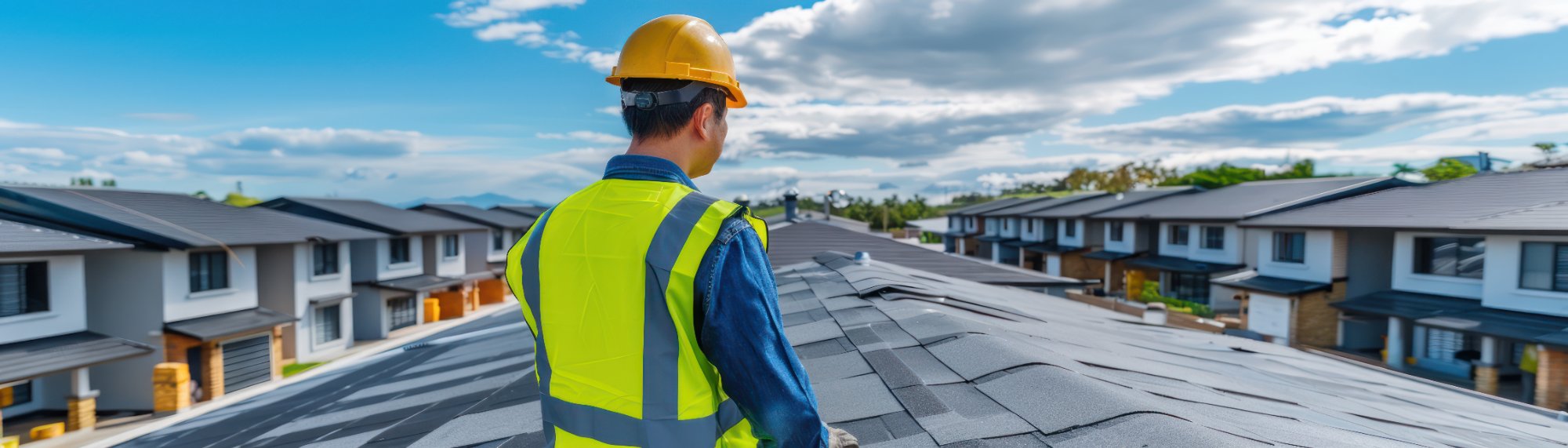
Hurst Green sits on the eastern edge of the High Weald Area of Outstanding Natural Beauty where the Wealden clay gives way to sandstone ridges and deep gill valleys. This scattered settlement pattern — part village, part dispersed hamlet — creates a distinctive roofscape of period farmhouses, timber-framed cottages, weatherboarded barns, and thatched dwellings dating back centuries, interspersed with mid-20th century infill and modern rural builds. Hurst Green Roof Surveys bring certified inspection expertise to every property type found across this landscape, from the handmade clay tile roofs of Grade II listed cottages along Chapel Hill to the concrete interlocking tiles of 1970s bungalows beside the A21 London Road.
Fast, independent roof surveys from local experts.
Our inspection service exists because rural East Sussex properties demand specialist assessment. The combination of older building stock, exposed ridgeline positions, surrounding woodland creating moss and algae challenges, and difficult site access makes generic homebuyer reports inadequate for decision-making. Hurst Green Roof Surveys deploy drone-assisted aerial photography and thermal imaging technology to deliver the detailed, accurate assessments that period farmhouses, converted agricultural buildings, and isolated rural dwellings require.
Whether you are purchasing a timber-framed cottage near Silver Hill, investigating a persistent leak in a converted barn, documenting storm damage for an insurance claim, or seeking clarity before committing to expensive re-roofing works on a period farmhouse, Hurst Green Roof Surveys provide the independent evidence base you need.
Hurst Green Roof Surveys was established on a fundamental principle: rural property owners deserve access to the same professional inspection standards available in urban centres. Too many homeowners across the Wealden parishes have been pressured into unnecessary roof replacements by contractors who arrive with a ladder, spend fifteen minutes on site, and pronounce the entire covering "beyond economical repair." Our role is to provide the honest, detailed assessment that allows informed decisions rather than expensive panic responses.
Every inspection follows a consistent methodology developed specifically for rural building stock. We begin at ground level, walking the property perimeter to assess rainwater disposal, fascia and soffit condition, and any immediately visible defects. Our DJI drone then captures high-resolution imagery of every roof plane, ridge, valley, hip, chimney stack, and dormer — including areas completely inaccessible from the ground on farmhouses set within working yards or properties accessed via bridleways unsuitable for scaffolding vehicles. Thermal imaging reveals moisture patterns hidden beneath tiles, within thatched roofs, and behind weatherboarding.
The Hurst Green area presents enormous variety within a small geographic footprint. A 16th century Wealden hall house with handmade peg tiles and a crown post roof structure demands entirely different assessment from a 1960s ranch-style bungalow with concrete tiles, and both differ again from a converted oast house with conical roof geometry and Kent peg tile covering. Hurst Green Roof Surveys work across this entire spectrum because the local building tradition requires that breadth of knowledge.
We operate with complete commercial independence. Hurst Green Roof Surveys do not undertake roof repairs, do not recommend specific contractors, and hold no financial interest in the outcome of any inspection. When we confirm a roof has substantial remaining service life, that assessment carries genuine credibility. When we identify problems requiring intervention, the repair costings in our report reflect current market rates for heritage-appropriate materials and specialist rural labour — not inflated figures designed to create urgency.
Properties in Nearby Wealden Villages: The roofing challenges we document in Hurst Green — handmade tile slippage, thatch deterioration, timber decay, and valley blockages — are shared by properties throughout the eastern High Weald. Homeowners in Robertsbridge and Etchingham face identical issues with period roofing materials and exposed rural locations. Our area guides provide specific information for your parish.
Hurst Green Roof Surveys are not roofers, thatchers, or builders. We provide independent inspection and reporting only — ensuring every assessment is free from commercial bias.
Hurst Green Roof Surveys are ready to inspect your property. Whether it is a period farmhouse, thatched cottage, converted barn, or modern rural build, our team delivers the clarity you need.
What Hurst Green Roof Surveys bring to rural property owners, buyers, and landlords
Rural properties around Hurst Green frequently sit within working farmyards, down private tracks unsuitable for scaffolding vehicles, or surrounded by mature trees that prevent safe ladder access. Our DJI Enterprise drone captures every ridge, valley, hip, dormer, and chimney stack in high-definition detail without the expense and disruption of scaffolding erection. On thatched properties, aerial assessment reveals ridge condition, fixings integrity, and thatch density patterns impossible to evaluate from ground level.
Moisture accumulation beneath period roofing materials can remain undetected for months until serious structural damage occurs. Our FLIR thermal cameras identify temperature differentials caused by water ingress beneath handmade clay tiles, within thatch layers, behind weatherboarding, and within roof timber structures. This technology is particularly valuable on converted barns and farmhouses where internal finishes conceal the underside of the original roof structure.
Every Hurst Green Roof Surveys report is a comprehensive document annotated with high-resolution drone photographs, thermal overlays where applicable, and itemised repair costings reflecting current market rates for heritage-appropriate materials and specialist rural labour. Reports are structured for direct submission to solicitors during property transactions, insurance providers processing claims, or conservation officers assessing listed building consent applications for Grade II properties common throughout the area.
Hurst Green Roof Surveys hold full professional indemnity and public liability insurance. Our surveyors carry recognised certifications and CAA-approved drone pilot licences. Every inspection follows a standardised methodology refined across hundreds of High Weald properties, ensuring consistency whether we are assessing a medieval timber-framed cottage or a modern barn conversion with laminated timber portal frames.
Hurst Green is not a uniform village — it is a collection of scattered hamlets, isolated farmsteads, and ribbon development along main routes, each with distinct building traditions. The period farmhouses concentrated around Chapel Hill and Silver Hill typically feature handmade clay peg tiles on steep pitches with multiple valleys, dormers, and massive brick chimney stacks. Vernacular cottages present tile-hung or weatherboarded elevations with crown post roof structures beneath. Post-war development along the A21 corridor and infill sites consists mainly of concrete interlocking tiles on simpler roof geometries with shorter design lifespans.
Hurst Green Roof Surveys have built our reputation on understanding these distinctions and the specific maintenance challenges each building type presents. We do not apply generic checklists — we adapt every inspection to the age, materials, construction method, and exposure conditions of the individual property. That local knowledge differentiates a report that provides genuine decision-making clarity from one that simply documents a roof's existence.
From 16th century Wealden hall houses to thatched cottages to modern barn conversions, Hurst Green Roof Surveys understand this landscape's roofing heritage.
How Hurst Green Roof Surveys have helped rural property owners and buyers

A couple purchasing a Grade II listed farmhouse near Silver Hill received a homebuyer report noting the property was "of its period" but offering little detail on the roof beyond confirming its presence. With an asking price approaching nine hundred thousand pounds and the knowledge that heritage roof repairs can be extraordinarily expensive, they commissioned Hurst Green Roof Surveys for a detailed assessment before exchange.
Our drone inspection documented serious ridge tile displacement across the main house and substantial sagging in the attached barn roof structure. Thermal imaging from above revealed concentrated moisture patterns suggesting timber decay beneath apparently sound handmade tiles. Internal loft access confirmed wet rot in four principal rafters and two purlins, with decay extending into the wallplate on the north elevation. The barn roof had visible light penetration through gaps in the clay tile covering.
Hurst Green Roof Surveys costed the remedial works at approximately eighteen thousand four hundred pounds for heritage-appropriate oak timber replacement and handmade tile reinstatement. The buyer's solicitor presented our detailed report and the vendor reduced the purchase price by the full repair estimate. The buyers proceeded with confidence, commissioning the works immediately after completion. Without our inspection, the structural timber decay would have progressed to a point requiring substantially more extensive — and expensive — intervention.

The owner of a thatched cottage near Chapel Hill noticed persistent damp staining on an upstairs bedroom ceiling despite the thatch having been partially repaired three years previously. Two thatchers inspected from ground level and gave contradictory diagnoses — one suggested complete re-thatching at over forty thousand pounds, the other recommended ridge replacement at eight thousand. The owner contacted Hurst Green Roof Surveys for an independent thermal assessment.
Our thermal imaging camera revealed a concentrated moisture pathway tracking from a small section of damaged ridge fixings down through the thatch layers to the exact location of the ceiling staining below. The drone confirmed the ridge wire was broken in one localised area, allowing rainwater to penetrate. The surrounding thatch was in reasonable condition with several years of remaining serviceable life. The repair need was targeted, not wholesale.
Hurst Green Roof Surveys estimated the targeted ridge repair at approximately two thousand eight hundred pounds. The owner commissioned the work based on our specification and the leak ceased immediately. Our thermal evidence saved thirty-seven thousand pounds compared to the complete re-thatch quotation and identified the precise problem that visual inspection alone could not pinpoint.
Need a professional roof survey for your Hurst Green property? Get in touch with Hurst Green Roof Surveys today for a free consultation.
Feedback from rural property owners and buyers who have used Hurst Green Roof Surveys
"Buying a 17th century farmhouse near Hurst Green we knew the homebuyer survey would give us nothing useful about the roof. Hurst Green Roof Surveys documented serious ridge problems and timber decay in the barn that would have cost over eighteen thousand to fix. The vendor reduced by the full amount. Absolutely outstanding professional service."
"Our thatched cottage had a leak that three thatchers could not agree on. Hurst Green Roof Surveys used thermal imaging to pinpoint moisture coming from a damaged ridge section invisible from the ground. The targeted repair was successful and cost a fraction of the complete re-thatch we had been quoted. Brilliant use of technology."
"Storm damage to our converted barn was rejected by the insurance company as 'wear and tear'. Hurst Green Roof Surveys provided timestamped drone evidence and thermal scans proving the damage was recent and storm-related. The claim was overturned within three weeks. Their report made all the difference to the outcome."
Transparent pricing from Hurst Green Roof Surveys — choose the inspection level for your property
Hurst Green Roof Surveys offer three tiers of inspection designed to match different property types, budgets, and levels of concern. Every survey uses the same certified methodology and professional equipment — the difference lies in the investigation depth and technology deployed. Whether you own a compact village bungalow or a sprawling period farmhouse with multiple outbuildings, there is a package suited to your needs.
Essential visual roof assessment for Hurst Green property owners needing a clear overview of current roof condition
Full drone and thermal imaging inspection — the standard package for Hurst Green buyers and rural homeowners
Complete structural roof assessment for period farmhouses, listed properties, and complex rural buildings
Common questions answered by Hurst Green Roof Surveys
The overwhelming majority of our Hurst Green workload comprises rural and semi-rural properties scattered across the Wealden countryside. We regularly inspect period farmhouses, converted agricultural buildings, thatched cottages, weatherboarded vernacular structures, and detached homes accessed via private lanes and bridleways where vehicle access can be challenging. Our drone technology proves particularly valuable in these locations where scaffolding erection is expensive, time-consuming, and sometimes impractical due to site constraints.
Inspection duration varies considerably based on property type and complexity. A standard village cottage or bungalow typically requires between ninety minutes and two hours on site. Larger period farmhouses with multiple outbuildings, barn conversions with complex roof geometries, or thatched properties requiring detailed ridge and hip assessment can take three to four hours. Regardless of site time, every client receives their complete written report within forty-eight hours of our visit.
Thatched properties are common throughout the Hurst Green parishes and we have extensive experience assessing them. Our drone captures the condition of ridgework, fixings, wire netting, and thatch density without disturbing or compressing the material. We identify areas of water damage, vermin intrusion, compression from snow loading, and assess when re-thatching will be required. Thermal imaging reveals hidden moisture accumulation beneath apparently sound thatch that visual inspection cannot detect.
The Wealden clay landscape and exposed ridgeline locations create specific recurring challenges. Handmade clay tile slippage on period properties, weatherboarding rot on vernacular buildings, valley gutter blockages from surrounding woodland shedding leaves and moss, algae and lichen growth on north-facing slopes, corroded cast iron rainwater goods, and thatch deterioration from persistent dampness are the most frequent issues. Post-war properties commonly present concrete tile delamination, ridge tile displacement from wind exposure, and flat roof failures on rear extensions.
Hurst Green Roof Surveys operate across the entire parish and surrounding hamlets. We regularly attend properties in isolated locations along the lanes towards Etchingham, Burwash, Robertsbridge and Salehurst. Our service area extends throughout the High Weald AONB where many properties sit within conservation areas or hold listed status. Remote locations present no operational difficulty — our equipment is vehicle-portable and our team is thoroughly accustomed to rural site conditions including restricted access and challenging terrain.
Listed properties form a substantial proportion of our Hurst Green workload. Our reports document existing condition with annotated photography, thermal evidence where moisture issues are suspected, and heritage-sensitive repair recommendations. Local authority conservation officers require detailed evidence when assessing listed building consent applications, and our reports are structured specifically to provide that documentation. We understand the restrictions and requirements that apply to Grade II and Grade II* properties which are common throughout this area of the High Weald.
Have another question? Contact Hurst Green Roof Surveys directly.
Hurst Green Roof Surveys provide professional roof inspections across the village and surrounding Wealden parishes
The village centre around Chapel Hill and the junction with Silver Hill contains a mix of period cottages, Victorian terraces, and mid-20th century infill. Handmade clay tiles, weatherboarding, and some render-over-timber-frame construction characterise the older buildings, while post-war properties present concrete tiles and simpler roof geometries.
Silver Hill and the network of lanes radiating from the village contain scattered period farmhouses, converted barns, thatched cottages, and detached properties set within large plots. Many are Grade II listed with handmade tiles, weatherboarding, or thatch covering timber-framed structures.
Properties along the A21 London Road include ribbon development from the 1960s and 1970s — mainly bungalows and detached houses with concrete interlocking tiles. Some earlier cottages survive interspersed with the newer builds, creating a varied roofscape along this main route.
The lanes towards Etchingham contain scattered farmhouses, converted oast houses, and period cottages typical of the eastern High Weald. Weatherboarding, handmade tiles, and some thatched roofs characterise this deeply rural area where access tracks and bridleways are common.
The heavily wooded High Weald landscape north of the village contains scattered properties accessed via private lanes. Period farmhouses, converted barns, and substantial detached homes sit within mature woodland, creating particular roofing challenges from shade, moss growth, and leaf litter accumulation.
Hurst Green Roof Surveys operate across the wider eastern High Weald and Rother district. We regularly attend properties in surrounding villages and hamlets that share similar building traditions and roofing challenges.
Hurst Green Roof Surveys provide the independent, professional roof inspections that this rural Wealden community deserves. Whether you are purchasing a period farmhouse, investigating a leak in a thatched cottage, documenting storm damage for an insurance claim, or seeking clarity before committing to expensive heritage roof repairs, our surveys deliver the answers you need.
Every inspection combines certified expertise with advanced technology — drone aerial photography, thermal imaging, and detailed written reporting — to give you a complete, unbiased assessment of your roof's condition. We do not carry out repairs. We do not recommend contractors. We provide the facts, the photographs, and the costings, and you make the informed decisions.
Every report is independent, detailed, and written to be acted upon — whether you are buying, selling, claiming, or protecting your rural property investment.
Call us today or complete the form below to arrange your Hurst Green roof survey.
Contact Hurst Green Roof Surveys today to arrange your roof inspection
Monday - Friday: 7:30 AM - 9:30 PM
Saturday: 7:30 AM - 7:00 PM
Sunday: 9:00 AM - 5:00 PM
For urgent roof inspection needs in Hurst Green, please call Hurst Green Roof Surveys directly.
Call Now