
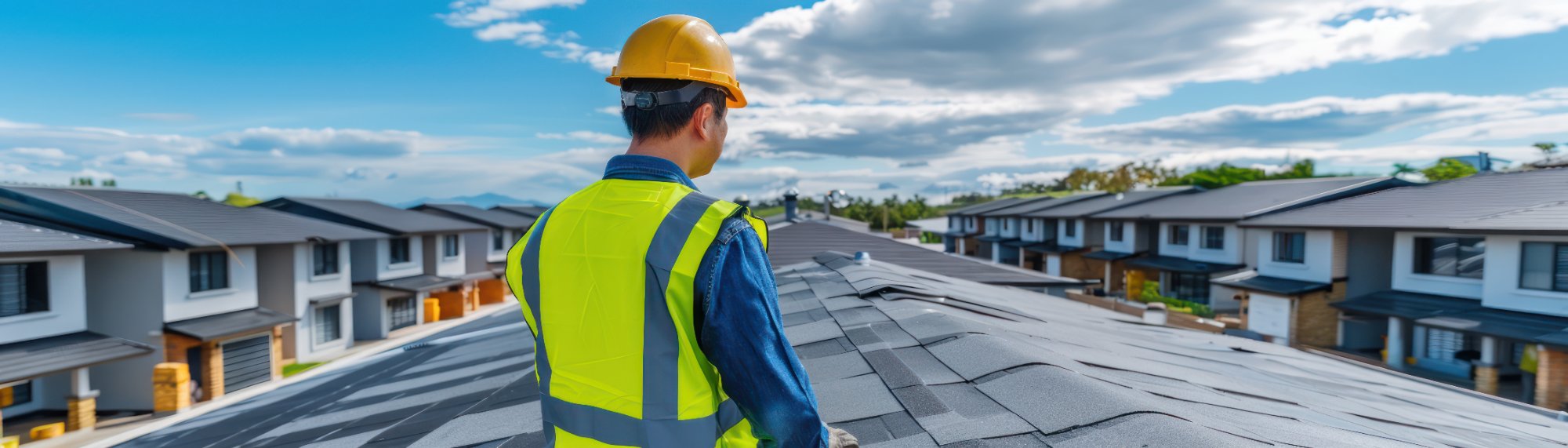
Bracknell Roof Surveys provide independent, professional roof inspections across this major Berkshire town and the wider Bracknell Forest borough. Designated as a New Town in 1949, Bracknell grew rapidly through the second half of the twentieth century, and its housing reflects every decade of post-war construction — from the original 1950s neighbourhood estates of Priestwood and Easthampstead, through the 1960s and 1970s developments at Bullbrook, Wildridings, and Harmans Water, the 1980s expansion into Great Hollands and Crown Wood, and the twenty-first century builds at Jennett's Park and The Parks. Our certified surveyors use drone aerial photography and thermal imaging to assess every roof type across this varied housing landscape.
Fast, independent roof surveys from local experts.
Each generation of Bracknell housing brought different roofing materials, construction methods, and characteristic defects. The early New Town estates used concrete interlocking tiles on timber-framed roofs with bituminous felt underlays that have long since exceeded their expected service life. Later phases introduced thinner profile tiles, dry ridge systems, and flat roof membranes on extensions and garages. The newest developments deploy modern materials including GRP valley troughs, UPVC soffits, and single-ply flat roofing — each with its own failure patterns. Bracknell Roof Surveys bring the equipment and the knowledge to inspect every one of them accurately.
Whether you are purchasing a property in Bracknell, tracking down the source of persistent damp, assessing storm damage after high winds sweep across the exposed town, or seeking an honest second opinion before committing to an expensive re-roofing contract, Bracknell Roof Surveys deliver the documented evidence you need to act with confidence.
Bracknell Roof Surveys were established on a straightforward principle: property owners deserve an independent, unbiased assessment of their roof before spending money on repairs or completing a purchase. Across Bracknell Forest, too many homeowners have accepted contractor quotes at face value — sometimes for work that was unnecessary — or discovered costly roof defects only after exchange of contracts. Our service fills the gap between uncertainty and informed decision-making for every type of Bracknell property.
Our survey methodology is built around technology that delivers results no ladder inspection can match. We begin with a full perimeter walk, assessing rainwater goods, fascias, soffits, and any visible defects from ground level. Our DJI Enterprise drone then captures high-resolution imagery of every elevation, ridge line, hip, valley, flashing, and soil vent pipe penetration — vantage points that are simply inaccessible from a ladder leaning against a two-storey gable end. Where thermal imaging is included, our FLIR cameras reveal moisture trapped beneath tiles and within the roof structure, long before it becomes visible as a damp patch on a bedroom ceiling.
Bracknell presents a particular challenge for roof surveyors because the town's development happened in distinct phases, each using different materials and construction standards. A 1950s Priestwood semi has a fundamentally different roof from a 1980s Crown Wood detached, and both differ again from a 2015 Jennett's Park townhouse. Bracknell Roof Surveys work across every era because the town demands that range of expertise — and because applying a generic checklist to such varied housing stock would miss the defects that matter most.
Independence is central to everything we do. Bracknell Roof Surveys do not carry out repairs, do not subcontract to roofing firms, and have no financial interest in the findings of any inspection. When our report says a roof is sound, that conclusion is worth something. When we identify a defect, the costings we provide reflect current market rates — not figures inflated to generate urgency or steer you toward a particular contractor.
Nearby Areas with Similar Properties: The post-war and modern housing challenges we encounter across Bracknell are shared by properties throughout east Berkshire. Homeowners in Wokingham and Ascot face comparable issues with ageing concrete tiles, flat roof failures, and modern material defects. See our area-specific guides for detailed information about your location.
Bracknell Roof Surveys are not roofers, builders, or contractors. We provide independent inspection and reporting only — ensuring every assessment is free from commercial bias.
Bracknell Roof Surveys are ready to inspect your property. Whether it is a 1950s semi in Priestwood, a 1980s detached in Crown Wood, or a modern build at Jennett's Park, our team delivers the answers you need.
What Bracknell Roof Surveys bring to homeowners, buyers, and landlords across the town
Bracknell's housing estates were designed with tightly spaced properties, shared access paths, and rear gardens that frequently prevent safe ladder placement. The two-storey gable ends common across Bullbrook and Wildridings are particularly difficult to assess from below. Our DJI Enterprise drone captures every ridge, valley, hip, flashing, and tile in high-definition detail — revealing cracked concrete tiles, lifted ridge mortar, and displaced hip irons that are completely invisible from ground level.
Concealed moisture is a persistent concern across Bracknell's post-war housing. The original bituminous felt underlays on 1950s and 1960s properties have often degraded, allowing water to track along rafters and battens without producing visible signs inside the house for months or even years. Our FLIR thermal cameras detect the temperature differentials caused by moisture beneath tiles, behind flashing joints, and within flat roof build-ups — identifying problems that no amount of visual inspection from a ladder would reveal.
Every Bracknell Roof Surveys report is a thorough document annotated with high-resolution drone photographs, thermal overlays where applicable, and clear itemised repair costings at current market rates. The report is structured to serve multiple purposes — shared with a solicitor during a property purchase, submitted to an insurer as evidence for a claim, or handed to a roofing contractor as a precise work specification so you receive accurate quotes based on documented defects rather than guesswork.
Bracknell Roof Surveys hold full professional indemnity and public liability insurance. Our surveyors carry recognised industry certifications and CAA-approved drone pilot licences. Every inspection follows a standardised methodology refined across thousands of properties, ensuring consistent and accurate results whether we are assessing a compact New Town terrace in Harmans Water or a substantial executive home on the outskirts of Warfield.
Bracknell is not one housing type — it is a town built in waves, and each wave left a different roofing legacy. The earliest New Town estates at Priestwood and Easthampstead used concrete interlocking tiles fixed to softwood battens over bituminous felt, often with minimal ventilation to the loft space. The 1970s developments at Wildridings and Hanworth introduced slightly different tile profiles and steeper pitches. The 1980s builds across Crown Wood and Great Hollands brought trussed rafter construction with thinner tiles and more flat-roofed rear additions. And the newest phases — Jennett's Park, The Parks, Amen Corner — use modern dry-fix ridge systems, GRP valleys, and engineered timber frames.
Bracknell Roof Surveys understand these differences because we have inspected them all. We do not apply a single checklist — we adapt every assessment to the specific materials, construction era, and known failure modes of the roof in front of us. That tailored approach is the difference between a report that identifies real problems and one that merely confirms a roof is present.
From the concrete tiles of Priestwood to the modern dry-fix systems at Jennett's Park, Bracknell Roof Surveys know this town's roofscape inside out.
How Bracknell Roof Surveys have helped local homeowners and property buyers

A first-time buyer had an offer accepted on a 1960s semi-detached in Bullbrook. The homebuyer report rated the roof as requiring only "routine maintenance." The buyer's father — himself a retired builder — was unconvinced by the condition of the visible tiles and recommended an independent roof survey before exchange.
Our drone inspection revealed seventeen cracked or displaced concrete interlocking tiles across the rear slope, with several exposing the bituminous felt beneath. Thermal imaging identified three distinct moisture paths running from the rear elevation towards the party wall. Our internal loft inspection confirmed that the original 1960s felt underlay had become brittle and was tearing away from the battens, allowing driven rain to reach the rafters. Two rafters on the rear slope showed early signs of wet rot where water had been pooling against the felt for an extended period.
Bracknell Roof Surveys estimated the rear slope re-tile — including felt renewal and replacement of the two affected rafters — at approximately twelve thousand eight hundred pounds. The buyer's solicitor used our report to renegotiate, and the vendor reduced the asking price by eleven thousand pounds. The work was completed within two months of the buyer moving in, preventing what would have become far more extensive structural damage.

A homeowner in Great Hollands had been battling recurring damp patches in their kitchen extension for over three years. Two roofing firms had inspected the flat roof, each time declaring that the felt covering needed replacing. The owner had the felt replaced twice at a combined cost exceeding five thousand pounds, yet the damp returned each winter.
Our comprehensive survey — including thermal imaging of the flat roof and the junction where the extension meets the main pitched roof — identified the real source of the problem. The abutment flashing where the flat roof met the main house wall had cracked along a two-metre length, allowing rainwater to run behind the lead step flashing and track down the inner face of the blockwork wall. The flat roof itself was, by this point, in perfectly good condition following the recent replacement. The issue had never been the flat roof covering at all.
Replacement of the abutment flashing and repointing of the junction cost just under one thousand two hundred pounds. The damp has not returned since. The Bracknell Roof Surveys report also documented the condition of the rest of the pitched roof, confirming ten to fifteen years of remaining service life on the main slopes — giving the homeowner confidence that no further significant expenditure would be needed in the medium term.

The owners of a 2012-built detached home at Jennett's Park had noticed water staining around a Velux roof window in their loft conversion. The NHBC warranty had expired, and the original developer was no longer responsive to complaints. A roofer who attended briefly suggested the entire roof slope needed stripping and re-tiling — a quote that exceeded sixteen thousand pounds.
Our drone inspection identified that the lead soaker flashing around the Velux window had been installed short — a snagging defect from original construction that had slowly allowed water ingress to increase over the years. Thermal imaging confirmed moisture was confined to the immediate area around the window, with no spread into the surrounding roof structure. The tiles themselves and the dry ridge system were performing correctly across all elevations.
The actual repair — replacing the undersize lead soakers and reseating four surrounding tiles — was completed for under two thousand pounds. Bracknell Roof Surveys saved the homeowner over fourteen thousand pounds in unnecessary work, and the detailed photographic evidence in our report gave them a record to reference should similar issues arise on any other roof penetration in the future.

A buy-to-let landlord with a mid-terrace property in Harmans Water asked Bracknell Roof Surveys to carry out a condition assessment as part of a planned maintenance review across their portfolio. The property had not reported any leaks, and the landlord assumed the roof was in reasonable order based on a visual check from the garden.
Our drone revealed that the entire ridge line — approximately seven metres — had lost its mortar bedding on both sides. Several ridge tiles were sitting loose, held in place only by their own weight and the friction of adjacent tiles. High winds would have been sufficient to dislodge them, creating both a water ingress risk and a serious falling debris hazard to anyone below. We also identified three cracked verge tiles on the gable end that were allowing driven rain to penetrate behind the barge board.
Ridge repointing and verge tile replacement was completed for three thousand four hundred pounds — a fraction of what emergency repairs and potential tenant injury claims could have cost. The Bracknell Roof Surveys report provided the landlord with a prioritised schedule for their other portfolio properties, allowing them to budget proactively rather than react to failures.
Need a professional roof survey for your Bracknell property? Get in touch with Bracknell Roof Surveys today for a free consultation.
Feedback from homeowners and buyers who have used Bracknell Roof Surveys
"Purchasing a 1960s semi in Priestwood, we wanted more detail than the standard homebuyer report could provide. Bracknell Roof Surveys identified cracked tiles and degraded felt that would have cost thousands to fix after moving in. Their report helped us renegotiate the price and plan the repairs properly. Could not have been more professional."
"Two years of recurring kitchen damp and two unnecessary flat roof replacements later, Bracknell Roof Surveys pinpointed the actual cause with thermal imaging — a failed abutment flashing that neither roofer had even checked. A twelve-hundred-pound repair solved what five thousand pounds of previous work had not. Outstanding."
"Told we needed a full re-roof at nineteen thousand. Bracknell Roof Surveys demonstrated that the main slopes were fine and only the ridges and valleys needed work. Actual repair bill came in just over six thousand. Their independence saved us a fortune and we now have a maintenance plan for the years ahead."
Six common situations where Bracknell Roof Surveys make a measurable difference
Standard homebuyer reports routinely describe Bracknell roofs as "satisfactory" because the surveyor assesses them from the ground with binoculars. Cracked concrete tiles on a rear slope, degraded felt beneath the covering, and loose ridge mortar are all invisible from that angle. A Bracknell Roof Surveys pre-purchase inspection reveals the full picture before you commit, giving your solicitor documented evidence to negotiate on price or request repairs as a condition of sale.
Damp patches on ceilings and walls are common in Bracknell properties, particularly those built before the 1980s. The source is often not directly above the visible stain — water travels along rafters, battens, and party wall junctions before emerging inside. Bracknell Roof Surveys use thermal imaging to trace the actual moisture path back to its point of entry, ensuring the repair targets the root cause rather than a symptom.
Bracknell's relatively open and flat terrain means properties are exposed to wind events that can dislodge tiles, lift ridge mortar, and shift flashing joints in a single night. After a storm, the visible damage from the ground often represents only a fraction of the total. Our drone and thermal survey documents every affected area with timestamped photography — the exact evidence format that insurers require when processing a weather-related claim.
Roofing contractors in the Bracknell area frequently quote for complete re-roofs after spending fifteen minutes on site with a ladder. Our experience shows that a significant proportion of these quotes overstate the work required. Bracknell Roof Surveys provide an independent, detailed assessment that distinguishes between areas needing immediate attention, areas that can wait, and sections that are performing well — often saving homeowners thousands in unnecessary expenditure.
Flat-roofed rear extensions are a defining feature of Bracknell's housing stock. Nearly every New Town property from the 1950s through to the 1980s has one — covering a kitchen, bathroom, or utility room. These flat roofs have a limited lifespan, and many are now well past it. Bracknell Roof Surveys assess the membrane condition, check for ponding, inspect upstand details and abutment flashings, and determine whether a repair, overlay, or full replacement is the appropriate response.
Bracknell has seen substantial new-build development over the past fifteen years. As NHBC warranties on the earliest Jennett's Park and Crown Wood Phase 2 properties begin to expire, a professional roof survey captures any defects while claims can still be pursued. We regularly identify short lead flashings, poorly bedded dry ridge components, and membrane installation errors that were missed during the original snagging process.
The defects Bracknell Roof Surveys encounter most frequently across the town's housing estates
The concrete interlocking tiles used across Bracknell's 1950s to 1970s estates have a typical service life of forty to sixty years. Many are now reaching or exceeding that limit. Surface delamination, hairline cracking, and loss of the granular coating are widespread across Priestwood, Bullbrook, Wildridings, and Harmans Water. Once the surface seal is compromised, tiles absorb moisture, become heavier, and place additional stress on the battens and fixings beneath.
Mortar-bedded ridge tiles are a constant source of problems on Bracknell properties over twenty-five years old. Thermal cycling — the daily expansion and contraction as temperatures rise and fall — gradually cracks and loosens the mortar, leaving ridge tiles sitting unsecured. In high winds, dislodged ridge tiles are both a water ingress risk and a serious safety hazard. We encounter failed ridge mortar on a substantial proportion of our Bracknell inspections.
The sheer number of flat-roofed extensions across Bracknell means flat roof failures are among our most common findings. Original felt coverings have a fifteen to twenty year lifespan, and many have been patched rather than replaced — creating a patchwork of repairs that eventually fails comprehensively. Common defects include blistering, cracking at upstand junctions, ponding caused by inadequate falls, and failed lap joints where sheets overlap.
Where extensions meet the main house wall, lead or mortar flashings seal the junction against water ingress. Across Bracknell's housing stock, these flashings are a frequent failure point — lead that has pulled away from the chase, mortar fillet flashings that have cracked, or stepped flashings that were installed too short during construction. These defects allow water to run down the inner face of the wall, producing damp that is often misdiagnosed as rising damp or condensation.
The bituminous felt underlay used on Bracknell's original New Town housing was not designed to last seven decades. On properties across Priestwood, Easthampstead, and Bullbrook, this felt has become brittle, torn, and is often separating from the battens it was stapled to. In its degraded state, it no longer functions as a secondary weather barrier, meaning that any tile displacement allows rainwater direct access to the roof timbers — accelerating decay that can remain hidden for years.
Properties with hipped or multi-pitch rooflines — common among the larger detached homes in Crown Wood, Great Hollands, and the newer Warfield developments — rely on valley troughs to channel water where two roof slopes meet. Older lead valleys corrode over decades, while the GRP and fibreglass troughs on newer properties can crack if poorly supported. A failed valley directs water into the roof structure at the point of highest flow, making it one of the more damaging defects we identify.
Common questions answered by Bracknell Roof Surveys
Bracknell Roof Surveys operate across the entire town and the wider Bracknell Forest borough. We regularly inspect properties in Priestwood, Bullbrook, Harmans Water, Wildridings, Easthampstead, Great Hollands, Hanworth, Crown Wood, Forest Park, Birch Hill, and the newer developments at Jennett's Park and The Parks. We also attend properties in the surrounding villages of Binfield, Warfield, and Winkfield.
A standard inspection on a typical Bracknell property takes between one and two hours depending on the roof size and number of elevations. The larger detached homes in Warfield and Binfield may require closer to two and a half hours due to their more complex rooflines. Properties with flat roof extensions — very common across the New Town estates — add roughly thirty minutes to the assessment. Every client receives their full written report within forty-eight hours of the site visit.
Bracknell's housing stock is predominantly post-war, and the most frequent issues reflect that era. Concrete interlocking tile fatigue is widespread on homes built between the 1950s and 1970s across Priestwood, Bullbrook, and Wildridings. Ridge and hip mortar erosion is endemic on properties over thirty years old. Flat roof failures on rear kitchen and bathroom extensions are extremely common. We also encounter failing valley troughs on the later 1980s and 1990s housing in Crown Wood and Great Hollands, and flashing defects where extensions meet the main roofline.
Every comprehensive and premium report includes timestamped drone photography, thermal imaging evidence, damage narratives, and itemised repair costings. Insurance companies require documented proof rather than verbal descriptions, and our reports are formatted to satisfy those requirements directly. We have supported successful claims for storm damage, fallen trees, and impact damage across the Bracknell Forest area — particularly following the high wind events that periodically sweep across the town's exposed terrain.
Modern developments represent a growing share of our Bracknell workload. The homes at Jennett's Park, The Parks, and the recent builds around Warfield and Amen Corner use modern materials including thin-edge concrete tiles, GRP valley troughs, UPVC dry ridge systems, and single-ply flat roof membranes. These materials have their own failure modes and warranty considerations that differ significantly from the older New Town housing stock. Our surveyors are experienced across both eras and know what to look for on each type.
Completely. Bracknell Roof Surveys do not carry out roof repairs, do not employ roofers, and hold no financial interest in the outcome of any inspection. When we confirm that a roof is sound, that assessment carries genuine credibility. When we identify defects, our costings reflect fair market rates rather than inflated figures designed to pressure a quick decision. Our independence is the foundation of every report we produce — it is what makes our findings trustworthy to solicitors, insurers, and homeowners alike.
Have another question? Contact Bracknell Roof Surveys directly.
Bracknell Roof Surveys provide professional roof inspections across the town and wider borough
The earliest New Town neighbourhoods, built predominantly in the 1950s and early 1960s. Semi-detached and terraced housing with concrete interlocking tiles, original felt underlays approaching the end of their serviceable life, and flat-roofed rear extensions that have been repaired and patched multiple times.
Developed through the 1960s and 1970s as the New Town expanded, these neighbourhoods feature a mix of semi-detached and detached properties with concrete tile roofing. Many are now experiencing tile fatigue, ridge mortar failure, and the consequences of decades-old felt underlay degradation.
A mix of 1960s and 1970s housing including terraces, maisonettes, and semi-detached homes. Common roofing challenges include eroded ridge mortar, cracked verge tiles on gable ends, and flat roof coverings on single-storey rear extensions that have exceeded their intended lifespan.
Built predominantly during the 1980s, these neighbourhoods feature detached and semi-detached family homes with trussed rafter roofs, thinner profile concrete tiles, and a high proportion of flat-roofed rear extensions. Valley trough defects and flashing failures at extension junctions are common findings in this area.
Bracknell's twenty-first century housing at Jennett's Park, The Parks, and the Amen Corner developments use modern materials including dry-fix ridge systems, GRP valleys, and engineered timber frames. These properties present different inspection requirements — warranty compliance, snagging defect identification, and modern material failure modes.
Bracknell Roof Surveys provide the independent, professional roof inspections that this rapidly developed Berkshire town requires. Whether you are a first-time buyer anxious about a 1960s roof in Bullbrook, a homeowner investigating persistent damp on a flat roof extension in Wildridings, a landlord maintaining a portfolio property in Harmans Water, or an owner of a modern home at Jennett's Park approaching the end of its NHBC warranty period, our surveys deliver the clarity you need.
Every inspection combines certified expertise with advanced technology — drone aerial photography, thermal imaging, and detailed written reporting — to give you a complete, unbiased picture of your roof's condition. Bracknell Roof Surveys do not carry out repairs. We do not recommend contractors. We provide the facts, the photographs, and the costings, and you make the decisions.
Every report is independent, detailed, and written to be acted upon — whether you are buying, selling, claiming, or simply protecting your property.
Call us today or complete the form below to arrange your Bracknell roof survey.
Contact Bracknell Roof Surveys today to arrange your roof inspection
Monday - Friday: 7:30 AM - 9:30 PM
Saturday: 7:30 AM - 7:00 PM
Sunday: 9:00 AM - 5:00 PM
For urgent roof inspection needs in Bracknell, please call Bracknell Roof Surveys directly.
Call Now