
West Sussex · London and the South East
Woolbeding Roof Leak Investigation
Wondering about the leaking roof at a property in Woolbeding? We carry out roof leak investigations in Woolbeding and across West Sussex, with plain-English findings.
- Damp ceilings under a flat roof
- Leaks at a dormer or roof window
- Condensation that looks like a leak
What happens on the day
We work from the outside in: outside views come first, then the roof space if there’s safe access. In total, it takes about 1–2 hours for a house, while a commercial roof takes nearer three to four hours. Rural addresses near Woolbeding can be hard to find from a postcode alone, so a few directions are welcome. After that, the survey runs as it would anywhere.
- You get in touch with details of the leak and any photos.
- Inside, we check the damp area and the roof space above it.
- We check the likely entry points outside, like flashings, valleys, chimneys and gutters.
- We use moisture detection, and thermal imaging where it’s useful.
- Your report sets out where the water is most likely getting in, with photos and recommendations.
Getting ready for the survey
- If you’re buying, check with the agent that we can get in
- Have any questions written down, so nothing gets missed
- Note where any stains or damp appear
Getting a price
We survey roofs on any day of the week. To find a date that works for you, ring 07833 053749 or send us an email.
Related advice
Roof leak investigation in Woolbeding: what you get
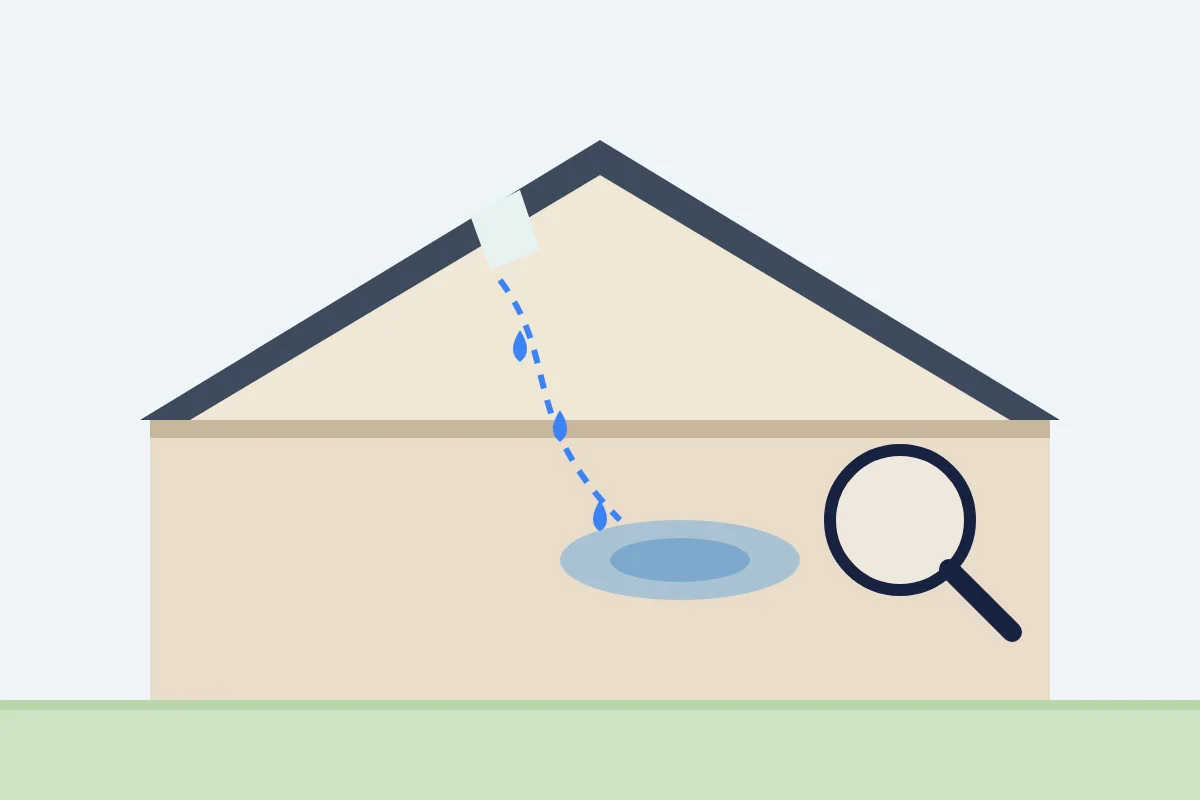
Water is good at hiding where it gets in. Water often travels along timbers or underlay before it finds a way down, so the stain on your ceiling is seldom right under the hole. We follow it back towards where it starts. Patching the spot above the stain often misses the real cause. Tracing the route first means any work can be aimed at the right place. If you’ve noticed staining around the chimney inside and leaks at a dormer or roof window, a survey will tell you what’s going on.
Being in a small place like Woolbeding makes no difference to how a leak or storm damage is looked at: we simply plan the journey and access ahead. It is useful to know where the water appears, in what weather, and what you’ve seen outside, plus any earlier repairs. Photographs of the stain and of the roof from outside are helpful too.
With the Standard Survey, you also get moisture detection, a structural check and a follow-up consultation. The Premium Survey adds thermal imaging, drone inspection where it applies, structural analysis and an in-person consultation.
- Location
- Woolbeding (GU29)
- Region
- West Sussex
- Price
- From £150 inc. VAT
- Report
- Emailed report with photos and recommendations
- Appointments
- Monday to Sunday, daytime
- Cover
- Professional indemnity and public liability
- Phone
- 07833 053749
- Page updated
- 27 October 2026
Rented homes, blocks and businesses
A roof problem in a let property affects your tenants as well as the building. A survey shows what needs attention, so you can plan the work.
Letting agents often book on a landlord’s behalf, with the report sent to whoever needs it. We agree a time with the tenant beforehand.
What you can safely check yourself
During heavy rain, look at the gutters from ground level or a window. Water spilling over the edge can point to a blockage or a sagging run.
Look up at the roof after a storm, from the ground: broken slates or tiles in the garden, gaps along the ridge or loose lead are signs to note. Leave anything above ground level to a survey.
Wind, rain and roofs in Woolbeding
In Sussex, older roofs are often handmade clay tile, frequently with tile-hanging on the walls below. Some old buildings in Sussex have Horsham stone slab roofs. Knowing the roof type helps narrow down where water may be getting in. The wider area around Woolbeding has a long history of building, with Cowdray House about 1.3 miles south-east. If you own one of the older houses, expect a mix of original materials and later repairs on the roof, and a listed home or one in a conservation area may need consent for changes of material.
If you look after a building such as Stedham Primary School, on a building that size, finding the source of a drip means looking well beyond the stain. A roof leak in a hotel or guest house around Woolbeding means lost rooms as well as repairs, so it pays to find faults before guests do. If you live in an older home near The Parish Church of All Hollows, the leak may come from a chimney, a valley or tired lead rather than the covering itself.
Woolbeding is about 6 miles south of Haslemere, in West Sussex. We carry out roof leak investigations in Woolbeding for houses, flats, blocks and commercial buildings, with a written report and photographs every time. Woolbeding is one of the places in West Sussex we cover for roof leak investigations. You can also see our page for Portsmouth.
All of GU29 is within our area for roof leak investigations, from the main roads to the quietest streets. We also cover the places around Woolbeding: Stedham (1 mile west), Midhurst (1 mile south-east), Easebourne (1 mile east), Iping (1 mile west) and Bepton Common (1 mile south). Larger places within reach include Bognor Regis (15 miles south), Chichester (11 miles south), Emsworth (13 miles south-west), Storrington (14 miles east), Billingshurst (13 miles east) and Portfield (11 miles south).
Around Woolbeding
We work in homes and buildings around St Margaret's Convent and Midhurst Rother College and the streets around them. Nearby you will also find Lodsworth Castle (3.9 miles east) and Midhurst Museum (1.2 miles south-east). Green spaces nearby include Iping and Stedham Commons and Wheeler's Down.
Why get it checked now?
A leak that returns after a repair normally means the real source wasn’t found. A careful investigation looks at every likely route, not just the obvious one. It gives the next repair a far better chance. Outbuildings and barns around Woolbeding are easy to forget, but a failed roof there can spoil what’s stored inside. It is worth including them in a survey before a winter does the damage.
There are three survey packages: the Basic Survey from £150, the Standard Survey from £250 and the Premium Survey from £400, with VAT included. What your roof costs depends on its size, access and what you want to find out.
Why choose Independent Roof Survey in Woolbeding
- 98% of clients satisfied
- A sub-250g drone, flown with a CAA Flyer ID and Operator ID
- PI and public liability insurance
- Two decades and more of roof surveys
Take a look at what a roof survey costs and our case studies.
Questions from Woolbeding
Will you come out to Woolbeding?
Yes, smaller places are covered as well as towns. We work right across London and the South East. Let us know about access, parking and anything unusual about getting there when booking.
Do you cover Woolbeding?
Yes. We survey roofs across London and the South East, and Woolbeding is part of that. Just ring 07833 053749 or email us and let us know about the property, and we’ll talk through which survey suits.
Do you need to get into the loft?
If the survey needs it and the loft space can be reached safely, yes. Please clear anything stored under the hatch, and if the loft can’t be reached safely, the report says so.
Is thermal imaging part of a leak investigation?
We use thermal imaging where it helps, and it is part of the Premium Survey. It shows temperature differences, not water itself, so we confirm its findings with moisture readings.
Can you give me structural calculations?
No. Our survey isn’t a structural engineer’s report. We’ll recommend an engineer if we see signs that call for one.
Is the repair included in the leak investigation?
This service finds and reports the cause, not to carry out the repair. The report gives any roofer a clear brief.
Can every leak be traced?
We can’t promise it. Water can travel a long way, and some leaks only show in particular storms. Where the source is not certain, we list the likely routes in order.
Before and after the survey
A survey works best with a little help from you, before and after. Some tips:
- Make sure the loft is accessible
- Mention any plumbing above the damp area
- Let us know what has already been tried
- Write down the wind direction and rain when it leaks
Where we find more than one possible route, we say which is most likely and why. We say which items need prompt attention, so you know what to deal with first.
After a storm, check the roof from the garden and the street. Slipped slates, lifted ridge tiles and debris on the ground are signs to act on. Prompt repairs stop gaps turning into leaks.
Different roofs, different checks
Lead flashings
Mortar fillets are sometimes used instead of lead. They crack as the roof and wall move, letting rain run behind the joint.
Flat roof upstands and outlets
Upstands seal the edge of a flat roof where it meets a wall. If it’s too low, cracked or poorly dressed, water gets behind it.