
West Sussex · London and the South East
Roof Leak Investigation in Lower Horncroft
Tracing where water is getting into your roof in Lower Horncroft. More than 5,000 surveys completed across London and South East England.
- Water coming in around a roof light or dormer
- Damp ceilings under a flat roof
- Ceiling stains that grow after rain
Lower Horncroft: your questions answered
Do you cover Lower Horncroft?
Yes. We cover the whole of London and South East England, and Lower Horncroft is part of that. Just phone 07833 053749 or email us and tell us about the property, and we’ll talk through which survey suits.
Is Lower Horncroft within the area you cover?
Yes, smaller places are covered as well as towns. We cover the whole of London and South East England. Let us know about access, parking and anything unusual about getting there as you book.
Do you use thermal imaging to find leaks?
Thermal imaging is used where it is useful, and it is included in our Premium Survey. It picks up temperature patterns rather than water, so we confirm its findings with moisture readings.
When does the report arrive?
Each package has its own report time. Basic: within 48 hours. Standard: 24 to 48 hours. Premium: the same day. Mention any deadline as you book.
How do I book a survey in Lower Horncroft?
Simply call 07833 053749 or use the contact form with the address. After a few questions, we confirm the price and fix a day.
How do you tell a leak from condensation?
Condensation can look very like a leak. Drips from nail tips, damp underlay over a wide area and poor loft ventilation point towards condensation. We look at the pattern, take moisture readings and tell you which is more likely.
Do you test for asbestos?
No. We can flag materials that might contain asbestos, but confirming it is a job for a specialist asbestos surveyor. Buildings built or refurbished before 2000 may contain it.
Roof leak investigation in Lower Horncroft
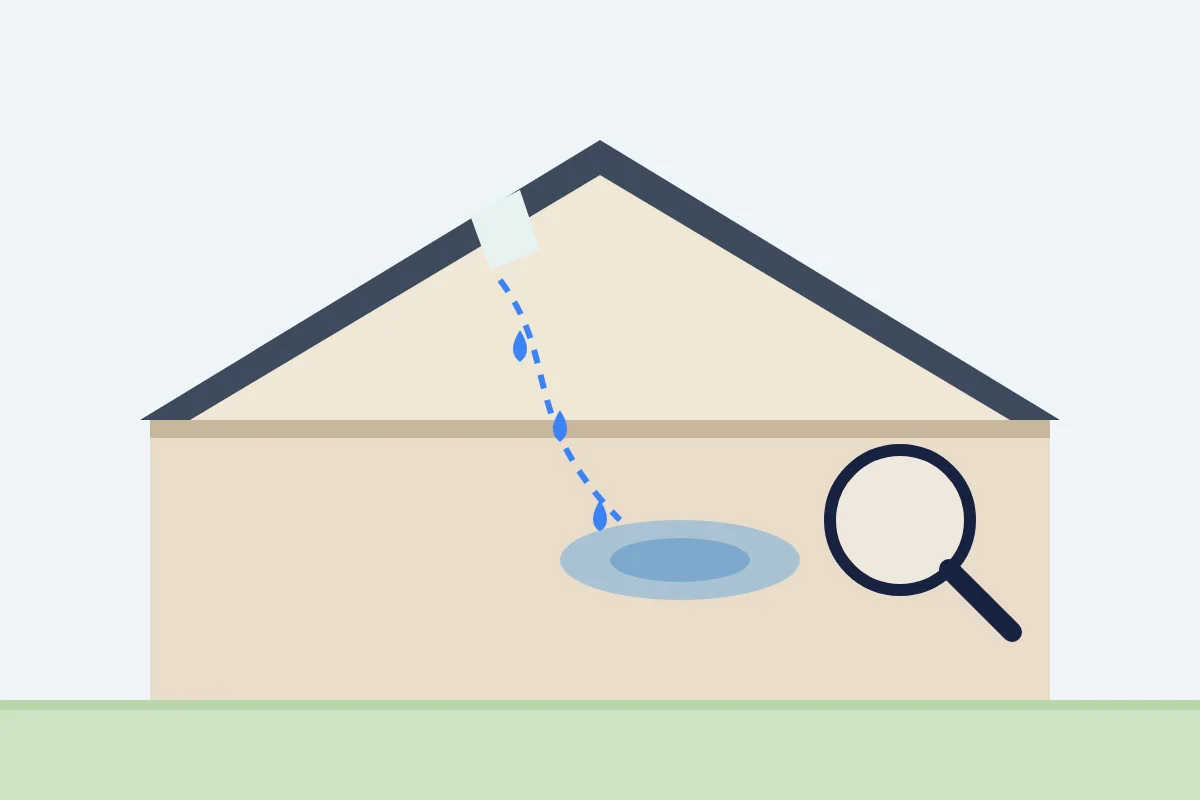
Roof leaks rarely show up where you’d expect. It can run along a rafter, a batten or the underlay before it drips, so the stain on your ceiling is seldom right under the hole. We follow it back towards where it starts, one likely route at a time. Patching the spot above the stain frequently misses the real cause. Finding the route first lets the repair go where it is needed. We are often asked to look into staining where a gutter or parapet meets the wall and water marks that spread in wet weather, on lead flashings, valleys and parapet gutters and the roof space.
In a village or hamlet like Lower Horncroft, older cottages and farmhouses often have roofs that have been patched over many years. That makes it hard to tell new damage from old wear, which matters if you are thinking of an insurance claim. We check everything that’s safely in view and set out what we find. Damp in old walls and timbers is slow to dry, so the sooner the cause is found the better.
Where we cannot see part of the leaking roof, the report says so. You will know exactly what was inspected and what wasn’t.
- Location
- Lower Horncroft (RH20)
- Region
- West Sussex
- Price
- From £150 inc. VAT
- Reports
- Emailed report with photos and recommendations
- Appointments
- Weekdays, Saturdays and Sundays
- Cover
- PI and public liability insurance
- Phone
- 07833 053749
- Page updated
- 27 October 2026
Places near Lower Horncroft
Other services in Lower Horncroft
What happens on the day
We don’t take risks to get a closer look. We inspect whatever is safely visible, and if part of the roof cannot be seen, the report says so. The survey typically takes between one and two hours for most homes, though a hard-to-trace leak can take longer. Around Lower Horncroft, older homes can have small or awkward roof spaces, so it is useful to know whether there is a loft hatch and how easy it is to reach. Only areas that can be reached safely are inspected.
- We start with your notes and photos of the leak.
- Inside, we look at the stain and the ceiling around it.
- From the loft space, we trace the water’s route where there is safe access.
- We inspect the likely entry points outside, from ground level, windows and the roof where safe.
- We email a written report showing where the water most likely gets in.
Getting ready for the survey
- If you’re buying, check with the agent that we can get in
- Move anything stored under the loft hatch
- If the roof is shared, arrange access with whoever manages the building
Booking a survey
Surveys can be booked for weekdays, Saturdays or Sundays. To arrange a day that suits you, ring 07833 053749 or send us an email with the address and the days you’d prefer.
Related advice
What a survey costs
Our packages start from £150, including VAT. The price for your roof depends on:
- The use of thermal imaging or a drone
- Building height and the viewpoints available
- Extensions, dormers and garages with roofs of their own
- Whether you choose the Basic, Standard or Premium Survey
We offer three survey packages: the Basic Survey from £150, the Standard Survey from £250 and the Premium Survey from £400, with VAT included. The price for your roof depends on its size, access and what you need to know.
What to let us know when you contact us
You don’t need to know any roofing terms. It is enough to let us know:
- Pictures of the roof from a safe spot, if you have them
- Your postcode, so we can check access and travel
- What kind of property and roof it is
- Where water is showing inside, if it is
Buyers should book once an offer has been accepted, so there is time to use the report before exchange. Otherwise, simply phone 07833 053749 or drop us an email whenever suits you.
When to book a survey in Lower Horncroft
A chimney stack has lots of places for rain to get in. Water can enter through crumbling mortar, cracked flaunching, worn flashings or uncapped pots. The damp may appear on a chimney breast, a ceiling or in the loft.
Look out for signs like these:
- A leak that comes and goes with the weather
- Leaks at a dormer or roof window
- Brown rings on upstairs ceilings
- Staining where a gutter or parapet meets the wall
Take a building like Fittleworth CofE Village School: water through a big roof can travel a long way before it drips, so the search covers more than the obvious spot.
Choosing a roof surveyor
- How they’ll see the roof: from ground level, the loft, the roof or by drone
- How long the report takes to arrive
- What the report includes, and whether it has photos
- Their drone registration, if they fly one
When you need someone else
Some things cannot be seen without opening up the roof, so a survey has limits:
- Structural calculations (that’s a structural engineer’s job)
- An intermittent leak that shows no trace on the day
- Water from pipes, tanks or heating systems
If you’re not sure which survey you need, ring 07833 053749 or drop us an email and we will give you a straight answer. What a survey covers and doesn’t.
Roof types and parts we check
- Valleys and parapet gutters
- Lead flashings
- Slate and tile slopes
- Flat roof details
- The roof space
- Rooflights and dormers
- Chimney stacks
Practical tips
Getting the most from a roof leak investigation starts before we arrive and carries on afterwards. Some tips:
- Stay off ladders and the roof
- Protect furniture and flooring under the leak
- Take dated photos of the leak
- Write down the wind direction and rain when it leaks
The report gives whoever carries out the work a clear starting point. The photos show the defects and where they are, rather than at the stain.
Have leaves and moss cleared from gutters, valleys and outlets, especially in autumn. Blocked outlets on parapet and flat roofs cause many leaks. Leave the clearing to someone with the right equipment.
DIY checks: what’s safe
Look up at the roof after a storm, from the ground: broken slates or tiles in the garden, gaps along the ridge or loose lead are signs to note. Leave anything above ground level to a survey.
During heavy rain, look at the gutters from the ground or a window. Overflowing water can point to a blockage or a sagging run.
Roof leak investigations around Lower Horncroft
In Sussex, older roofs are often handmade clay tile, frequently with tile-hanging on the walls below. A few old Sussex buildings still carry heavy Horsham stone slabs. Different coverings let water in at different points, which shapes where the search starts. With Bignor Roman Villa about 2.2 miles south-west, Lower Horncroft sits in an area with a long building history. Older roofs in the wider area can hide decades of patch repairs, so the detail matters.
If you live in an older home near Church of St Agatha, the leak may come from a chimney, a valley or tired lead rather than the covering itself. If you own a rental within reach of Pulborough station, a tenant living with a leak needs the cause found, not just the stain painted over.
Lower Horncroft is about 10 miles north of Littlehampton, in West Sussex. Lower Horncroft is one of many places we visit across West Sussex, for houses, flats and commercial buildings. Across West Sussex, we cover Lower Horncroft and the places around it. Our Crawley page covers surveys nearby.
Postcode districts we cover here for roof leak investigations: RH20. Nearby, we also carry out roof leak investigations in Coates (1 mile west), Fittleworth (1 mile north), Watersfield (1 mile south), Coldwaltham (1 mile south-east) and Bedham (1 mile north). Within a short drive, we also cover Horsham (13 miles north-east), Worthing (11 miles south-east), Bognor Regis (12 miles south-west), Chichester (12 miles south-west), Littlehampton (10 miles south) and Shoreham-by-Sea (15 miles south-east).
Near you in Lower Horncroft
Locally, jobs take us to homes and businesses close to The Swan Hotel and Lodge Hill Residential Centre. The closest station to Lower Horncroft is Pulborough station, about 2.3 miles east of the centre. Well-known places in the area include Coates Castle (0.9 miles west) and Coultershaw Heritage Site (2.4 miles north-west). Green spaces nearby include Amberley Wildbrooks RSPB Reserve and Bignor Hill.