
Oxfordshire · London and the South East
Yarnton Roof Leak Investigation
Tracing where water is getting into your roof for Yarnton, from an experienced roof surveyor. Every survey comes with a written report and photographs.
- Brown rings on upstairs ceilings
- Water coming in around a roof light or dormer
- Drips from nail tips in a cold loft
Yarnton questions
Does a conservation area affect roof work in Yarnton?
Check Historic England’s online list first, then ask the council about conservation areas and any Article 4 direction. The answer matters most when a change of material is on the cards.
Is Yarnton in the area you cover?
Yes, Yarnton is within the area we cover. We cover the whole of London and South East England. Just call 07833 053749 or email us and let us know about the property.
Will you go up on the roof?
Only if it’s safe. We check everything that can safely be seen: from ground level, from windows, from inside the roof space, from the roof where it is safe and by drone where applicable. Anything we can’t see is noted in the report.
How long have you been surveying roofs?
More than 5,000 surveys over 20+ years, across London and South East England.
Will you fly a drone over my roof?
Where it helps and the rules allow, yes. Our sub-250g drone is flown by a CAA-registered operator with a Flyer ID and Operator ID, and the airspace and weather are checked before every flight.
What does a roof survey cost?
Our price is from £150, including VAT. Our Basic Survey starts from £150, the Standard Survey from £250 and the Premium Survey from £400, all inc. VAT.
Can every leak be traced?
Not always, and we’ll be honest about that. Some leaks hide well, particularly those that need wind-driven rain. Where the source is not certain, we list the likely routes in order.
About our roof leak investigation in Yarnton
We use moisture detection and thermal imaging where they help. Moisture readings show which materials are wet. Thermal imaging shows temperature differences that can point to wet areas, not water itself, so we confirm what it suggests with moisture readings. Moisture detection is included in the Standard Survey, and thermal imaging in Premium. Thermal imaging works best after a sunny day, on a dry roof with little wind. We survey rooflights and dormers, lead flashings and chimney stacks, and the problems we’re asked to look at most are damp underlay across a wide area and staining where a gutter or parapet meets the wall.
Somewhere as small as Yarnton, older roofs have often been repaired many times. That makes it hard to tell new damage from old wear, and the difference matters, especially to an insurer. The report says what was seen and what it points to. Older walls and timbers hold water for a long time, so it’s worth finding the cause soon.
You can share the report with anyone who needs it: a seller or estate agent, an insurer, a roofer, a builder or a managing agent, whichever applies.
- Location
- Yarnton (OX5)
- Wider area
- Oxfordshire
- Cost
- From £150 inc. VAT
- Your report
- Emailed report with photos and recommendations
- Survey days
- Weekdays and weekends
- Cover
- PI and public liability insurance
- Phone
- 07833 053749
- Last updated
- 27 October 2026
What else we do in Yarnton
Do you need a roof leak investigation in Yarnton?
Chimneys can let water in by several routes. Water can enter through crumbling mortar, cracked flaunching, worn flashings or uncapped pots. The damp may appear on a chimney breast, a ceiling or in the loft.
People normally book a survey after spotting one of these:
- Water coming in around a roof light or dormer
- Wet patches on loft insulation
- Drips from nail tips in a cold loft
- A leak that comes and goes with the weather
If you look after a building like William Fletcher Primary School, tracing a leak on a big roof starts with where the water appears and works back.
Before booking any roof surveyor
- What’s outside the scope of the survey
- What experience they bring
- Is there a chance to talk the report through?
- Their insurance cover
Rented homes, blocks and businesses
Where a roof is shared: access has to be agreed with whoever owns or manages the building. Tell us about it when booking and we will plan the visit with that in mind.
We survey roofs for landlords and agents as well as householders. A written report with photographs gives you a clear record of the leaking roof, useful for planning maintenance.
Yarnton roofs and the weather
Older buildings in west Oxfordshire often have Cotswold stone slate roofs, and some Oxfordshire villages still have thatch. Older houses in the South East often have slate or clay tile roofs, while many later estates have concrete tiles. Different coverings let water in at different points, which shapes where the search starts. With Blenheim Palace about 3.2 miles north-west, Yarnton sits in an area with a long building history. Older roofs in the wider area can hide decades of patch repairs, so the detail matters, and any change of roofing material on a listed home needs checking with the council first.
Landlords with a home close to Oxford Parkway station may find that a clear finding on where water gets in helps you brief a roofer right away. The streets around a church like Church of St Bartholomew are often among the oldest in a place, and if your home is one of the older ones nearby, the leak may come from a chimney, a valley or tired lead rather than the covering itself.
Yarnton is about 5 miles north-west of Oxford, in Oxfordshire. We provide roof leak investigations for homes and businesses in Yarnton and nearby. Yarnton is one of the places in Oxfordshire where we work for roof leak investigations.
Surveys in OX5 work the same way as everywhere else we cover. You’ll find streets such as Dashwood Avenue, Spencer Avenue and Merton Way. Other places close to Yarnton include Begbroke (1 mile north-west), Worton (1 mile west), Thrupp (2 miles north), Bladon (2 miles north-west) and Shipton-on-Cherwell (3 miles north). We also work in nearby towns like Oxford (5 miles south-east), Didcot (14 miles south), Bicester (9 miles north-east), Abingdon-on-Thames (9 miles south), Witney (8 miles west) and Carterton (12 miles west).
Near you in Yarnton
Around Yarnton, our work takes us to homes and buildings near The Red Lion pub and Gosford Hill School, among other places. The closest station to Yarnton is Oxford Parkway station, roughly 1.4 miles east of the centre. Nearby you will also find Acland Hospital (3.8 miles south-east) and Oxford Castle (4.3 miles south-east). Green spaces nearby include Harcourt Hill and Hook Meadow and The Trap Grounds.
What we cannot see
Without opening up the roof, some things stay hidden, and that sets some limits:
- The repair itself (the investigation finds and reports the cause)
- Whether rotten timbers meet design loads
- What’s under the covering or behind the plaster
If in doubt, ring 07833 053749 or email us and we will recommend the right survey before you book. The full list of what we check.
Roofs we survey in Yarnton
- Flat roof details
- Valleys and parapet gutters
- Lead flashings
- The roof space
- Rooflights and dormers
- Slate and tile slopes
- Chimney stacks
What we look for on each type of roof
Slate and tile slopes
A gap in the coverings exposes the underlay. Older felt may hold for a while, but it tears with age.
Parapet and box gutters
Parapet and box gutters sit behind walls or inside the roof. When their outlets block, water rises over the lining and runs indoors.
What you can safely check yourself
Look up at the roof after a storm, from ground level: broken slates or tiles in the garden, gaps along the ridge or loose lead are signs to note. Leave anything above ground level to a survey.
Fresh stains on ceilings or walls after rain are worth noting. Take a photo and write down when you saw it, which helps when we check the roof.
What we do, step by step
Where it’s relevant and can be reached safely, the loft space is checked as well as the outside. Inside, we look for staining, damp, gaps and signs of movement, as far as the space allows. All in, the survey typically takes roughly 1–2 hours at most homes, rising to roughly 3–4 hours on a commercial building. For a village or hamlet like Yarnton, the journey is planned beforehand: tell us about narrow lanes, gates, long drives and where we can park. On the day, we inspect whatever is safely visible, inside and out.
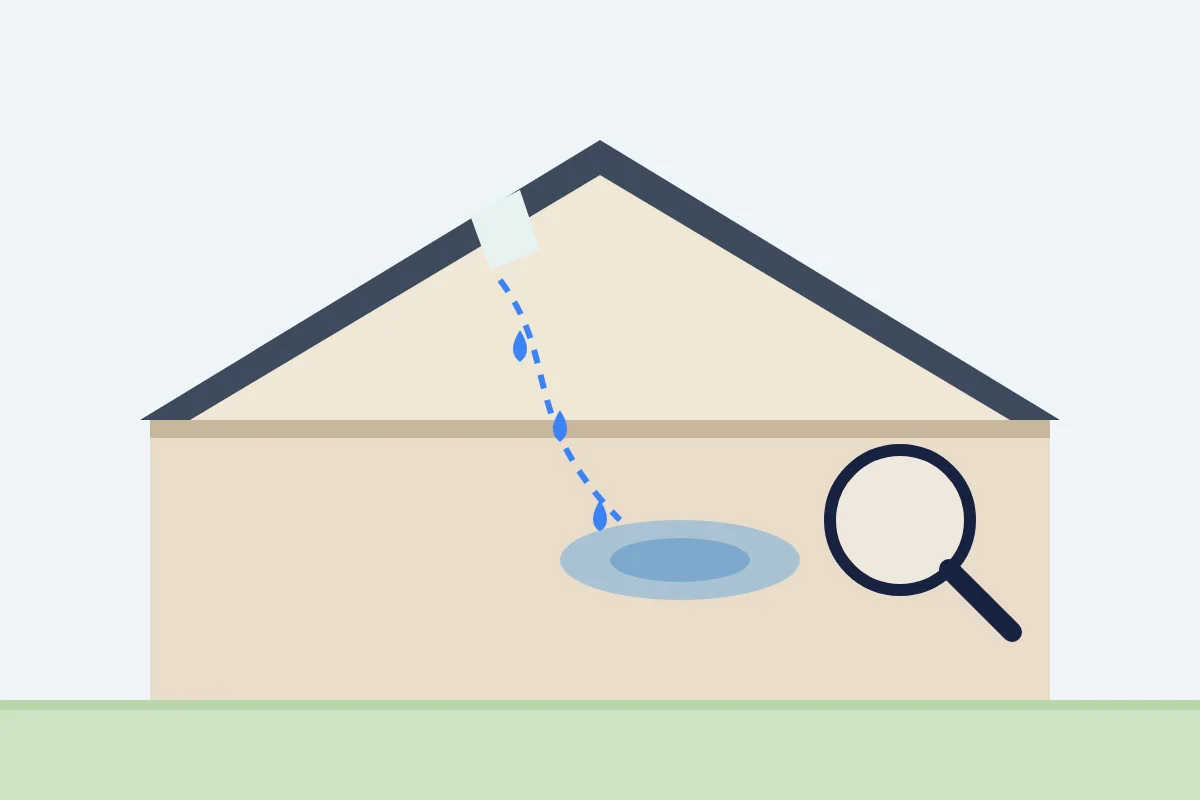
- You let us know where the water shows and when it appears.
- The visit starts indoors, at the stain and in the loft.
- We check the likely entry points outside, such as flashings, valleys, chimneys and gutters.
- We use moisture detection, and thermal imaging where it’s useful.
- Your report sets out where the water is most likely getting in, with photos and recommendations.
Before we arrive
- If the roof is shared, arrange access with whoever manages the building
- Have keys ready for side gates, garages or roof access doors
- If it is not your property yet, arrange access through the agent
How to book
If you have photos of the roof, send them over. Take them safely from the ground or a window. To get started, call 07833 053749 or use the contact form.