
East Sussex · London and the South East
Drone Roof Survey in Glyndebourne
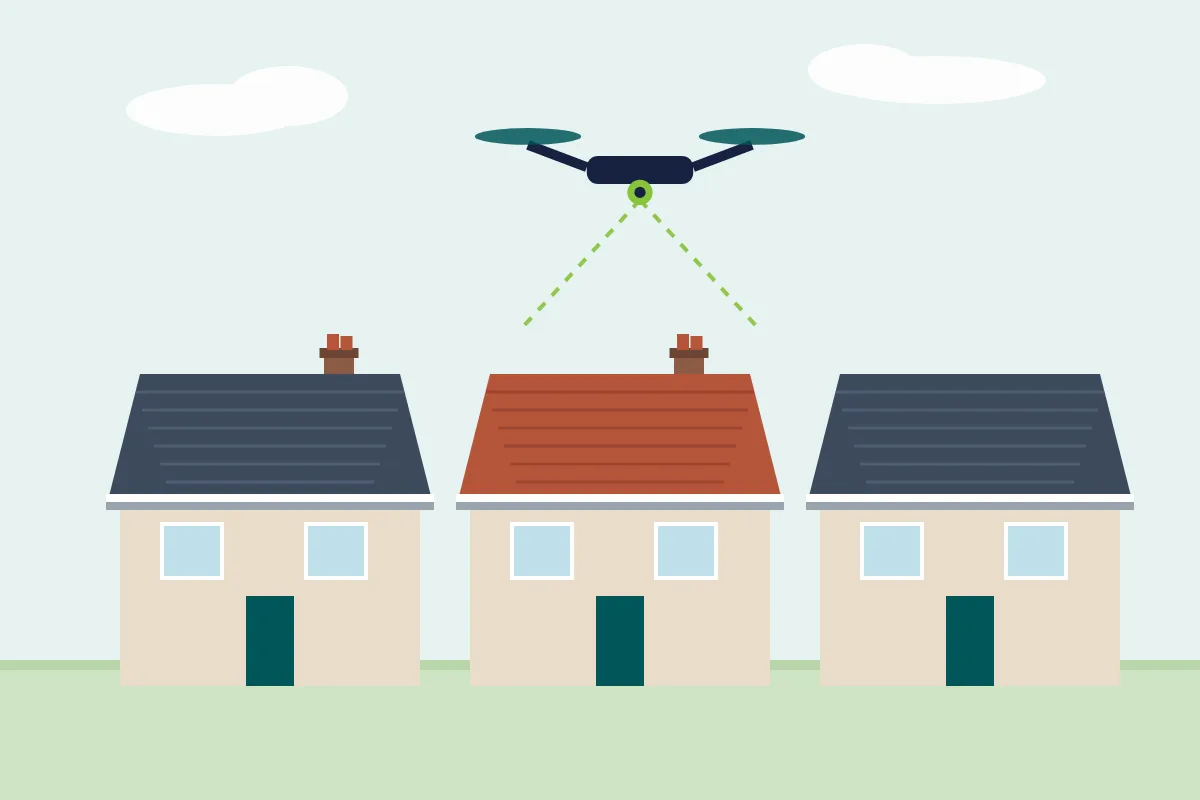
Close-up drone photographs of roofs that are hard to reach for Glyndebourne, from an experienced roof surveyor. You get a clear written report with photographs.
- Moss and weeds taking hold up top
- Slipped or missing slates on a high roof
- Ridge and hip pieces working loose
About our drone roof survey in Glyndebourne
Prices start from £400, including VAT. A drone inspection, where applicable, is also part of our Premium Survey, along with structural analysis, a same-day report and an in-person consultation. There is a 12-month follow-up as well. If a drone will not help on your roof, we will say so. You get a written report with the close-up photos from the flight. If you are worried about cracked mortar along the ridge and ponding and splits on a high flat roof, a survey will tell you what’s going on.
Older buildings in small places like Glyndebourne may be listed or in a conservation area. Neither a drone survey nor a thermal survey involves any work on the roof, so it’s a gentle way to see the condition of an old roof. Check with the council before planning any work on a listed building or one in a conservation area.
Where we cannot see part of the roof, the report says so. You will know exactly what was inspected and what wasn’t.
- Place
- Glyndebourne (BN8)
- Wider area
- East Sussex
- Cost
- From £400 inc. VAT
- Your report
- Written, with photos, emailed to you
- Appointments
- Monday to Sunday, daytime
- Insured
- PI and public liability insurance
- Call
- 07833 053749
- Page updated
- 27 October 2026
FAQs for Glyndebourne
Is my home in Glyndebourne listed or in a conservation area?
Check Historic England’s online list first, then ask the council about conservation areas and any Article 4 direction. It matters most if you’re planning to re-roof in a different material.
Are there drone restrictions around Glyndebourne?
The answer turns on the exact location and the conditions on the day. Before any flight, we check the Drone Safety Map for airspace restrictions, including zones around airports and prisons. The flight also waits for calm, dry weather.
How long have you been surveying roofs?
Over 5,000 surveys so far, across 20+ years of surveying roofs, and 98% of clients are satisfied.
Is it a structural engineer’s report?
No. Our survey is not a structural engineer’s report, and it does not include calculations. We’ll recommend an engineer if we see signs that call for one.
How quickly is the report sent?
Report times are set by the package. Basic: within 48 hours. Standard: 24 to 48 hours. Premium: the same day. If you have a deadline, like an exchange date, let us know when you book.
Will you check the loft?
If the survey needs it and the roof space can be reached safely, yes. Please clear anything stored under the hatch, and if the loft can’t be reached safely, the report says so.
Do you test for asbestos?
No. We don’t carry out asbestos surveys or testing. If we see materials that could contain asbestos, such as cement roof sheets or soffits on buildings from before 2000, we flag them, and recommend a specialist asbestos surveyor checks them before they’re disturbed.
Flying and imaging in Glyndebourne
Handmade clay tiles and tile-hung upper walls are typical of older Sussex houses. A few old Sussex buildings still carry heavy Horsham stone slabs, and the county’s older buildings include oast houses and Wealden hall houses. Where a roof is steep, tall or hard to see from ground level, drone photos and thermal images add detail. About 0.1 miles north-west lies Glyndebourne, a reminder of how long the area around Glyndebourne has been built on. Older homes in the wider area often have features worth a closer look, such as lead valleys, tall stacks and roofs that have been patched over the years, and any change of roofing material on a listed home needs checking with the council first.
If you look after a building such as Ringmer Primary and Nursery School, a view from above covers a wide roof far faster than walking it.
Glyndebourne is about 3 miles east of Lewes, in East Sussex. Glyndebourne is part of the area we cover across London and South East England. Our area takes in places right across East Sussex, from the larger towns to small villages. We also survey roofs in Brighton.
We survey roofs across the BN8 postcode area for drone roof surveys. Neighbouring places we cover for drone roof surveys include Glynde (1 mile south), Ashton Green (1 mile north-east), Ringmer (1 mile north), Cliffe (2 miles west) and Firle (2 miles south-east). Within a short drive, we also cover Eastbourne (12 miles south-east), Seaford (7 miles south), Lewes (3 miles west), Hailsham (8 miles east), Crowborough (13 miles north) and Uckfield (7 miles north).
Local landmarks in Glyndebourne
Locally, jobs take us to homes and businesses close to Ringmer Community College and Sixth Form and Science and Technology Policy Research, among other places. The nearest railway station is Glynde station, about 1.2 miles south. A little further out are Lewes Castle (2.5 miles west) and Museum of Agricultural Bygones (1.7 miles north-east). Not far away are Southerham Farm and Cliffe Hill.
The survey, step by step
We check the roof from outside and, where it’s relevant and there’s safe access, from inside the loft space too. Inside, we look for staining, damp, gaps and signs of movement. The whole visit typically takes about one to two hours for a house, rising to roughly 3–4 hours on a commercial building. Around Glyndebourne, older homes can have small or awkward roof spaces, so it’s useful to know whether there’s a loft hatch and how easy it is to reach. We only go where it is safe.
- You give us the address so we can check the airspace.
- If permission is needed, we ask for it ahead of the visit.
- Before the flight, we check the conditions and the take-off spot.
- The drone captures close-up photos of the coverings, chimneys, valleys and gutters.
- You receive a written report with photos and recommendations.
Preparing for the visit
- For a flat or shared roof, check access with whoever owns or manages the building
- Have any questions written down, so nothing gets missed
- Keep pets inside or away from the areas we are looking at
Book a survey
Once you know what you need, call 07833 053749 or email us. We’ll suggest a package, agree the price and find a date.
Read more
Signs you need a drone roof survey in Glyndebourne
Hidden gutters and valleys are easy to overlook. Leaves, silt and plant growth build up unseen, until water overflows inside. A drone shows them clearly from above.
Things that often lead to a survey include:
- Eroded pointing on a chimney stack
- Debris building up in hidden gutters
- Worn lead at chimneys and walls
- Coverings that have slipped high up on the roof
The streets around a church like St Mary's Church are often among the oldest in a place, and if you own one of the older houses nearby, tall stacks and steep slopes are easier to judge with close-up aerial photos than from the pavement.
What to check before booking
- Whether you get a written report with photos
- How they plan to inspect the roof safely
- Whether VAT is added on top
- What happens after the report arrives
Useful tips for Glyndebourne property owners
You do not need to be a roofer to help. What helps most:
- Give us the full address so we can check the airspace
- Allow for a change of day in poor weather
- Clear a spot on the drive or lawn
- Keep pets indoors during the flight
If you need work done, roofers can work from the photos. They’ll see exactly where each defect is.
Do not block the vents at the eaves. Poor airflow lets condensation build up. Check insulation doesn’t block the airflow.
Roof by roof
Flat roofs on tall buildings
Outlets, edges and roof plant are common problem areas. They’re all captured in close-up, as far as the flight allows.
Steep slate and tile slopes
On slate roofs, slipped slates often point to corroded nails. Close-up photos show how widespread it is.
Towns and villages near Glyndebourne
Other services in Glyndebourne
What a drone roof survey does not cover
We only report whatever is safely visible on the day, so some things are outside what a survey can do:
- Flying in a flight restriction zone without the airport’s permission
- The underside of the roof (that needs an inside check)
- Roofs and gardens beyond the one we are surveying
If in doubt, ring 07833 053749 or email us and we’ll point you to the right survey. What a survey covers and doesn’t.
Roofs we survey in Glyndebourne
- Valleys and parapet gutters
- Chimney stacks
- Fragile roofs
- Flat roofs on upper floors
- Tall and steep roofs
- Large and complex roofs
DIY checks: what’s safe
The one thing to avoid is getting up close. Roofs are fragile and slippery. That part is for a survey.
It helps to keep a record: when leaks happen, ground-level photos and any past roof work. Send it with your enquiry, as it helps us focus the survey.