
Hertfordshire · London and the South East
Drone roof survey in High Cross, Hertfordshire
Wondering about the roof at a property in High Cross? We carry out drone roof surveys in High Cross and across Hertfordshire.
- Tired mortar and pots at the top of a stack
- Plant growth and moss on the roof
- Slates or tiles shifted by high winds
About our drone roof survey in High Cross
Drones need reasonable weather. We don’t fly in strong wind or a downpour, because the drone has to stay safely under control. If the weather turns, we will agree another day or inspect what we can by other means. The forecast is checked ahead of the visit and again on the day. Light wind and dry weather give the clearest close-up photos. Waiting for a better day is better than a rushed flight. We survey chimney stacks, tall and steep roofs and flat roofs on upper floors, and people most often book us about storm damage on steep or tall roofs and loose ridge and hip tiles.
In a small place like High Cross, open ground can mean strong wind. A small drone can’t fly safely in high wind or heavy rain, and thermal imaging works best with little wind. The visit is planned around the forecast, along with the journey and access. If the day turns windy or wet, the visit can be moved.
Most points in the report come with a picture, so you can see each defect rather than just read about it. Anything out of sight on the day is listed as such.
- Location
- High Cross (SG11)
- Region
- Hertfordshire
- Price
- From £400 inc. VAT
- Report
- A written report with photos, by email
- Survey days
- Weekdays, Saturdays and Sundays
- Insurance
- PI and public liability insurance
- Telephone
- 07833 053749
- Last updated
- 27 October 2026
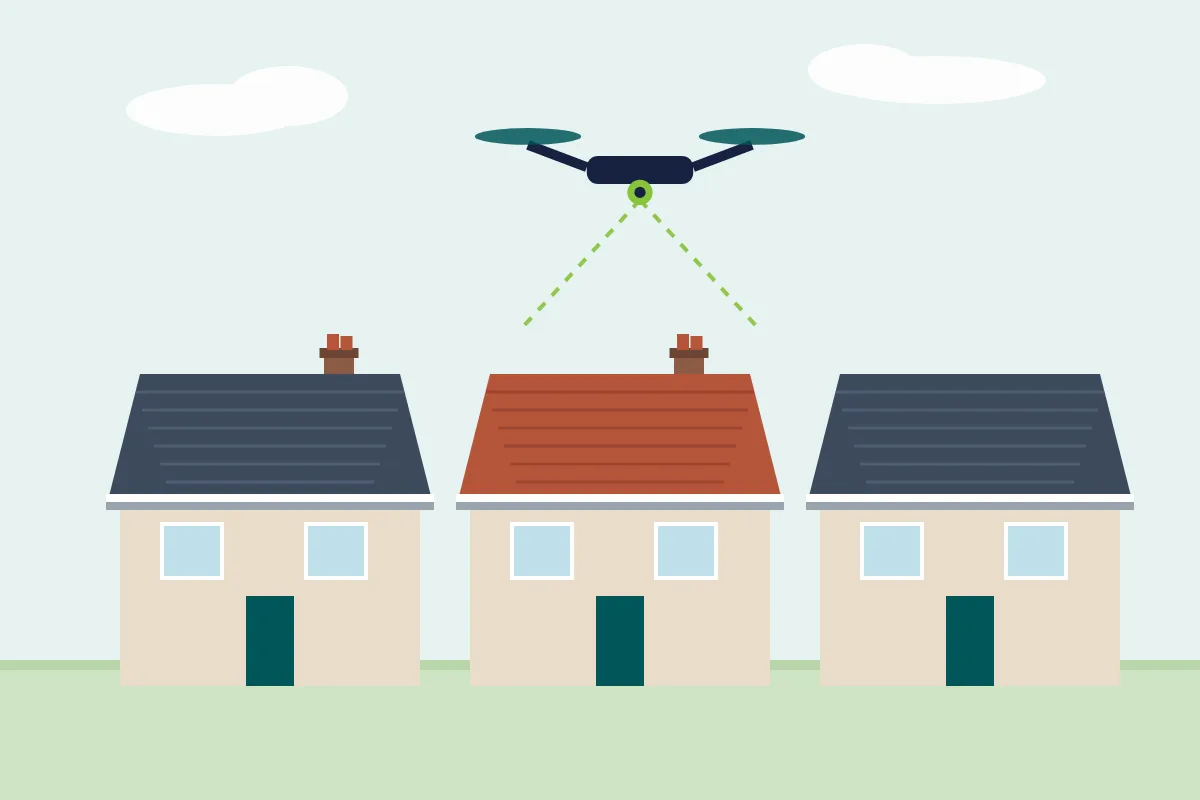
Drones, thermal imaging and High Cross roofs
The wider area around High Cross has a long history of building, with Much Hadham Palace about 4.2 miles east. Older roofs in the wider area can hide decades of patch repairs, so the detail matters, and the council can say whether a home is in a conservation area. Older houses in the South East frequently have slate or clay tile roofs, while many later estates have concrete tiles. A drone or thermal camera adds most on the steep, tall and hidden parts of roofs like these.
Anyone responsible for a site like Thundridge Church of England Primary School will know that a view from above covers a wide roof far faster than walking it. If you own one of the older houses in the streets near Church of St John the Evangelist, older roofs can be steep and hard to see from the street, which is where close-up aerial shots and thermal images help.
High Cross is about 2 miles north of Ware, in Hertfordshire. We survey roofs in High Cross and the rest of Hertfordshire. Our area takes in places right across Hertfordshire, from the larger towns to small villages. There’s also a page for Chelmsford.
Every address in SG11 is within our area for drone roof surveys, from the main roads to the quietest streets. We cover properties on North Drive, Chestnut Grove and Poplar Close and the roads around them. We also cover Wadesmill (1 mile south-west), Standon Green End (1 mile north), Thundridge (1 mile south), Cold Christmas (1 mile south-east) and Barwick (1 mile north-east). Further out, we also cover Stevenage (8 miles north-west), St Albans (15 miles south-west), Bishop's Stortford (8 miles east), Welwyn Garden City (8 miles south-west), Harpenden (14 miles west) and Hitchin (13 miles north-west).
Landmarks near High Cross
Around High Cross, our work takes us to homes and buildings near The White Horse Inn. The closest station to High Cross is Ware station, roughly 2.8 miles south. A little further out are Museum of Street Lighting (3.4 miles south) and Hertford County Hospital (4.6 miles south-west). The countryside around High Cross includes King's Meads.
Places near High Cross
More services for High Cross
Rented homes, blocks and businesses
For a freeholder or residents’ company, a roof report is a sound basis for a maintenance plan.
Roof problems in a rented home affect tenants as well as the building. A survey shows what needs attention, so you can plan the work around your tenants.
DIY checks: what’s safe
It helps to keep a record: when leaks happen, ground-level photos and any past roof work. Share it with us when booking, as it helps us focus the survey.
If you have a loft with safe access, take a look inside. Use a torch and stay on the joists or boards, and look for staining, damp timber or daylight coming through.
What happens on the day
Every roof is different, but as a rough guide the survey takes about one to two hours at a house, including the airspace and weather checks before take-off. If you have questions on the day, just ask. For a village or hamlet like High Cross, the journey is planned ahead of time: let us know about narrow lanes, gates, long drives and where we can park. On the day, we inspect whatever is safely visible, inside and out.
- First comes the address, plus a note of what worries you about the roof.
- We check the airspace and seek any permission needed.
- We assess the conditions and the take-off spot first.
- Close-up photos are taken of each slope, chimney, valley and gutter, with the drone always in view.
- The findings, photos and recommendations reach you by email.
Preparing for the visit
- Mention any parking restrictions on your street
- If the roof is shared, arrange access with whoever manages the building
- Clear the way to the loft hatch
Getting a price
Our phone lines are open seven days a week, including Saturdays and Sundays. For a price or to book, ring 07833 053749 or email us.
Advice
What we look for on each type of roof
Steep slate and tile slopes
Steep roofs are risky to walk on. From the air, every course of slates or tiles can be seen, showing slipped, cracked and missing pieces.
Ridges and hips
Some ridges are fixed with mortar, others with dry-fix systems. Their condition is noted in the report.
Leave it or get it looked at?
Leaving a high roof unchecked means relying on what you can see from below. Close-up photos show what’s really there, slope by slope. It’s far easier to plan work when you can see the problem. Where a roof is exposed, as many are in small places like High Cross, driving rain gets into any weakness, and older walls, once damp, take a long time to dry.
Thermal imaging and drone inspection (where it applies) come with the Premium Survey, which starts from £400, including VAT. We’ll tell you which package suits the questions you have.
Why book us in High Cross
- 98% of customers satisfied
- Photos and a written report every time
- Covered by professional indemnity and public liability insurance
- 20+ years’ experience
See our cost guide or our case studies.
What a drone roof survey does not cover
In fairness, a roof survey has limits:
- A flight on a day when the weather is not safe
- Structural calculations (that is a structural engineer’s job)
- What’s under the slates, tiles or felt
Not sure which survey suits your roof? You can phone 07833 053749 or use the contact form and we will tell you. The full list of what we check.
What we look at
- Flat roofs on upper floors
- Tall and steep roofs
- Chimney stacks
- Large and complex roofs
- Valleys and parapet gutters
- Fragile roofs
FAQs for High Cross
Is drone flying allowed in High Cross?
It depends on the exact address and the weather on the day. Before any flight, we check the Drone Safety Map for airspace restrictions, including zones around airports and prisons. The flight also waits for calm, dry weather.
Do you cover smaller places like High Cross?
We do. A small place gets exactly the same survey as a big one.
How long is the visit?
Most surveys take between one and two hours for most houses, though large, tall or awkward roofs take more time. The report follows by email.
Will I get photos?
Yes. Photos are taken throughout the survey, and the report uses them to show each finding alongside our recommendations.
Do I need to be at home?
Not always. An outside-only look can be arranged beforehand, but anything inside needs someone there to give access.
What will the report tell me?
It works through the roof part by part, in writing and with photos, finishing with recommendations. The most urgent items are made clear.
How long have you been surveying roofs?
Over 5,000 surveys so far, over more than 20 years.