
West Sussex · London and the South East
Storm Damage Roof Report in Crawley Down
An independent record of roof damage after a storm across Crawley Down, using drones and thermal imaging where it applies. Call or email for a price.
- Gutters pulled loose in the wind
- Loose or broken chimney pots and cowls
- Loose or torn flashings
Storm damage roof reports for homes and businesses in Crawley Down
High winds usually affect the parts of a roof that are already exposed or loose. Slates and tiles slip or blow off, ridge and hip tiles lift, flashings pull away and flat roof coverings can tear. Trees and branches can also hit roofs in a storm. Our report records what has happened to your roof, with photos. Where we also see signs of older wear, the report records that too. If you’ve noticed holes or cracks caused by debris and damaged ridges and hips, we can find out what’s behind it, whatever the roof.
Houses in smaller places like Crawley Down can stand more in the open, where driving rain gets into any gap at a ridge, verge or flashing. A leak that only appears in certain weather often points to an exposed detail. Tell us when it happens when you get in touch. Gutters and downpipes on the exposed side are worth a look as well.
The written findings come by email, easy to pass on to a roofer, an agent or an insurer. Basic reports come within 48 hours, Standard within 24–48 hours and Premium on the day.
- Location
- Crawley Down (RH10)
- Region
- West Sussex
- Prices
- From £150 inc. VAT
- Report
- A written report with photos, by email
- Survey days
- Monday to Sunday, daytime
- Insured
- PI and public liability insurance
- Telephone
- 07833 053749
- Updated
- 27 October 2026
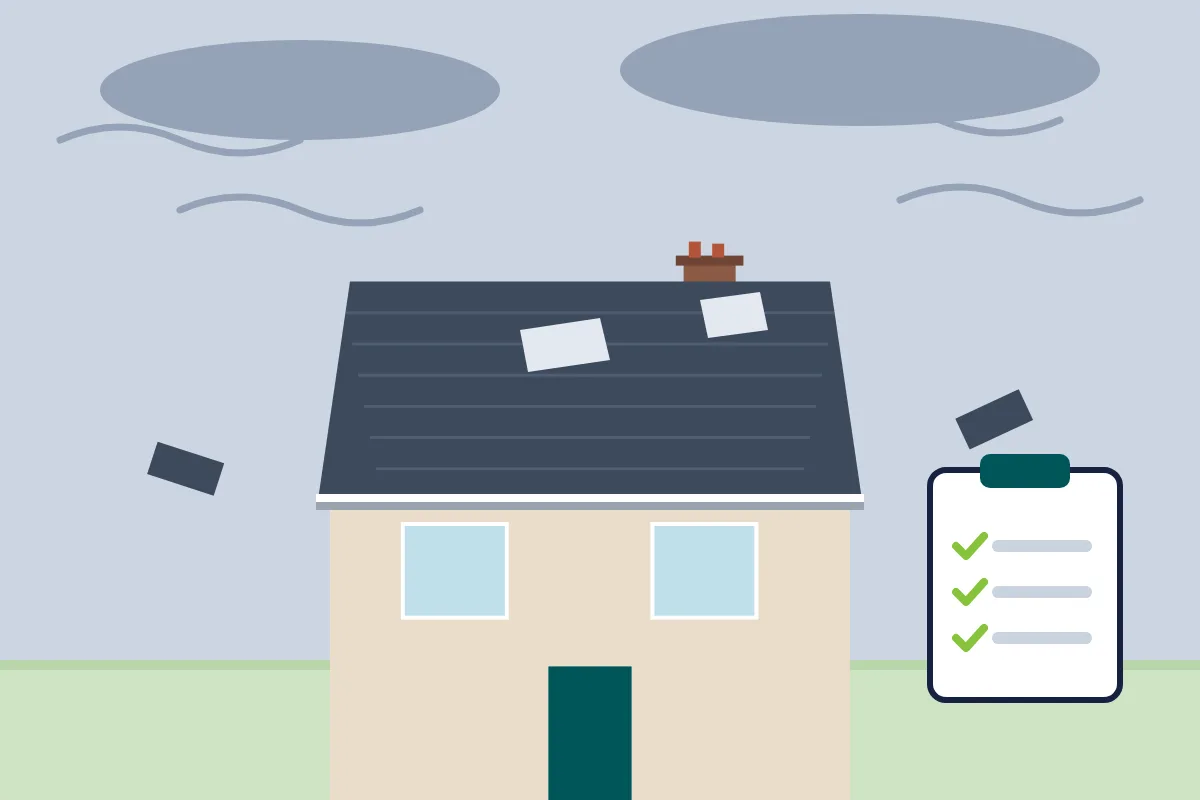
Do you need a storm damage roof report in Crawley Down?
Strong winds lift loose or poorly fixed slates and tiles, ridge pieces and flashings. Driving rain then gets in through the gaps. Most people book a report soon after a storm, when they’ve seen damage or water has come in.
Problems we come across frequently include:
- Flat roof edges peeled back
- Damage from fallen branches or debris
- Loose or broken chimney pots and cowls
- Lifted or missing ridge and hip tiles
If you own one of the older houses in the streets near All Saints Parish Church, leaks on older roofs frequently start at lead flashings, valleys or around old chimney stacks.
Before you book anyone
- What follow-up you get after the report
- Whether the roof space is looked at, where there is one
- Whether any drone flown is registered with the CAA
- How they’ll see the roof: from the ground, the loft, the roof or by drone
What you can safely check yourself
You can learn a lot from ground level. With binoculars, look for slipped or missing slates and tiles, gaps along the ridge and leaning chimneys. Never climb onto the roof to look.
Inside, the loft is a good place to look, with care. Use a torch and stay on the joists or boards, checking for stains, damp wood or chinks of daylight.
Before and after the survey
A few practical points come up again and again on our surveys. They apply to most roofs:
- Keep a note of the date of the storm
- Keep any slates, tiles or debris that fall, if it is safe to do so
- Photograph the damage safely from below
- Get a roofer to make the roof safe if needed
You’ll need a roofer’s quote for the repairs. The report gives them a clear list of the damage.
After a storm, look at the roof from the street or garden. Binoculars help you spot slipped slates or lifted ridges. Don’t go up a ladder to look.
What a storm damage roof report doesn’t cover
We only report whatever is safely visible on the day, so some things are outside what a survey can do:
- Areas we can’t see safely
- A decision on your insurance claim
- Estimates of repair costs
If in doubt, phone 07833 053749 or use the contact form and we’ll suggest the right survey before booking. The full list of what we check.
What we check
- Gutters and fascias
- Flashings
- Ridges and hips
- Flat roofs
- Slate and tile slopes
- Chimney stacks
Storm damage roof reports in Crawley Down: local notes
The wider area around Crawley Down has a long history of building, with Saint Hill Manor about 2.4 miles south-east. On older houses around here, roofs often carry the marks of earlier repairs, from replaced slates to new lead. Handmade clay tiles and tile-hung upper walls are typical of older Sussex houses. Horsham stone slab roofs survive on some old Sussex buildings. Where water gets in depends a good deal on what the roof is made of and how it’s detailed.
If you let a flat or house near East Grinstead station, tracing a leak quickly matters when a tenant is living with it.
Crawley Down is about 3 miles west of East Grinstead, in West Sussex. We cover Crawley Down and the rest of West Sussex. We cover towns and villages across West Sussex, from the larger towns to small villages.
Every address in RH10 is covered for storm damage roof reports. We cover properties on Station Road, Forest Close and Burleigh Way. Close by, we survey roofs in Furnace Wood (1 mile north), Snow Hill (1 mile north), Turners Hill (1 mile south), Domewood (1 mile north) and Felbridge (2 miles north-east). Larger places within reach include Crawley (5 miles west), Horsham (11 miles west), Haywards Heath (9 miles south), Burgess Hill (12 miles south), East Grinstead (3 miles east) and Broadfield (6 miles west).
Around Crawley Down
Typical jobs here are in homes near Imberhorne School and the streets around them. The closest station to Crawley Down is East Grinstead station, about 2.5 miles east. Well-known places in the area include Queen Victoria Hospital (3.5 miles east) and Effingham Park Motor Museum (1.4 miles north-west). Green spaces nearby include Hedgecourt Lake.
How we price storm damage roof reports
The price reflects the time and kit the roof needs. The main factors are:
- Chimneys, valleys, parapets and other details
- Any need for thermal images or a drone flight
- Height and safe access
- The type of building, from a house to a block or an office
The cost of a survey depends on the roof: its size, its height, how many sections it has and how it can be reached and seen safely. Storm damage roof report starts from £150, including VAT.
What to tell us when you get in touch
You don’t need to know any roofing terms. Just tell us:
- Pictures from the garden or a window, if you have them
- Anything about access we should know
- What’s prompted the survey
- The style of property, from a terrace to a block
Photos help, if you have them. Pictures from ground level or a window are fine, and please don’t climb up for a closer look. To send them or to book, call 07833 053749 or email us.
Also near Crawley Down
Also in Crawley Down
How it works
You do not need to do much on the day. Show us any stains, drips or problem areas you know about, and we’ll take it from there. The survey itself takes about one to two hours at most homes, rising to roughly 3–4 hours on a commercial building. Some parts of a survey depend on the weather, so a visit to Crawley Down is booked with the forecast in mind: the parts that need calm, dry weather are planned around it.
- We start with what you’ve seen and any temporary repairs.
- We check inside, including the loft where there’s access, for water damage.
- We view the roof from safe positions.
- Storm damage and older wear are recorded separately where we can.
- You receive the written report with photographs.
How to prepare
- Keep pets in another room
- For a flat or shared roof, check access with the building owner or managing agent
- If it is not your property yet, arrange access through the agent
Getting a price
If you’re buying, it’s useful to book soon after your offer is accepted, so there is time to use the report before exchange. For any other survey, just phone 07833 053749 or email us when you’re ready.
Advice
Common questions in Crawley Down
Do you cover Crawley Down?
Yes, Crawley Down is one of the places we work. The survey and report are the same in Crawley Down as anywhere else.
Is my home in Crawley Down listed or in a conservation area?
We can’t confirm that for you, but Historic England’s list and your council can. Both listing and conservation areas can limit changes of roofing material.
Will my insurer pay out if I get a storm damage report?
That is not something we can promise. Insurers decide claims on their own policy wording. Our report gives you an independent record of the damage and its likely cause.
I live in a flat. Can you survey the roof?
Yes, as long as access is agreed. Roofs over flats are frequently shared, so the freeholder or managing agent needs to agree access. We can only inspect what we’re given access to.
Is it the same as a RICS Level 2 or Level 3 survey?
No. We check the roof, not the whole building, and it isn’t a RICS Level 2 or Level 3 survey. Many buyers have both.
Will you walk on the roof?
Only when it is safe. Most of what we need can be seen from safe viewpoints, the loft and, where applicable, a drone, and the report notes anything we couldn’t see.
Can I challenge a declined storm claim?
The first step is a complaint to your insurer. After that, the Financial Ombudsman Service may be able to look at it. An independent report can add to your evidence, but we can’t say how it will turn out.