
Bracknell Forest · London and the South East
Tickleback Row Flat Roof Survey
Surveys of flat roofs on homes, extensions and commercial buildings for Tickleback Row, from an experienced roof surveyor. You get a clear written report with photos.
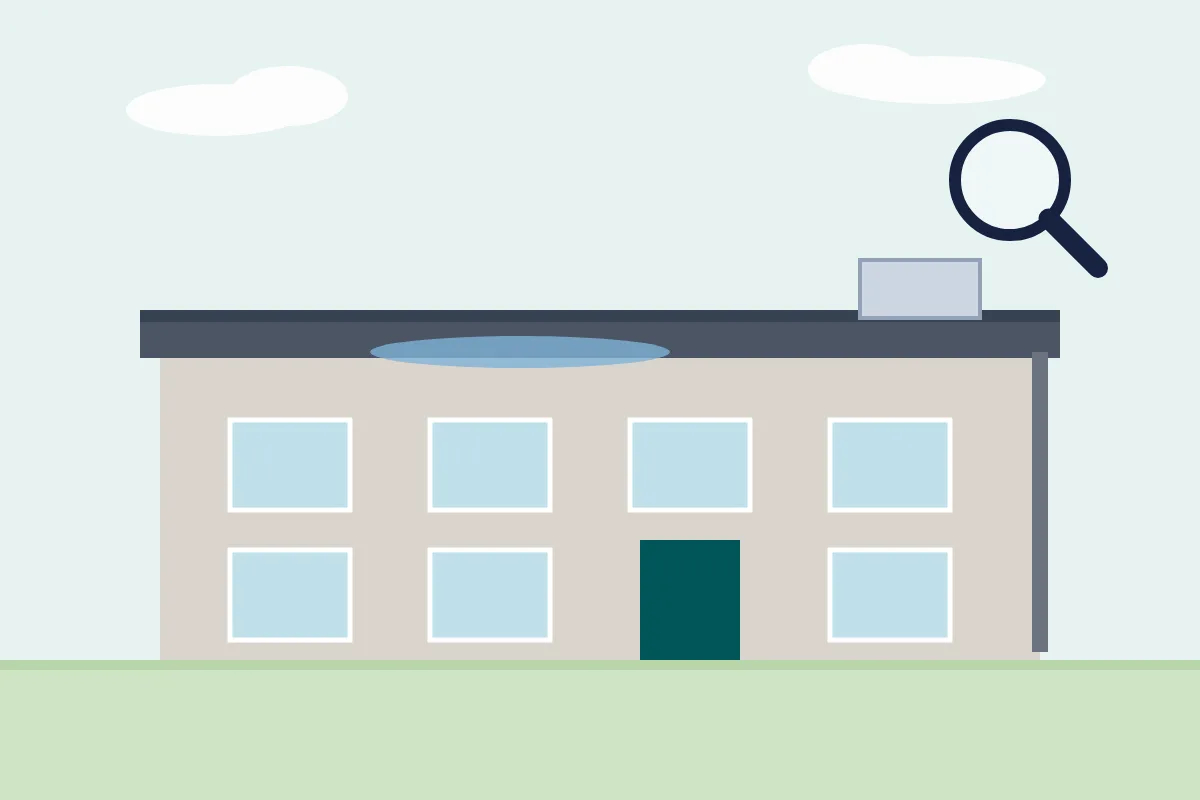
- Splits, cracks and crazing
- Standing water left after rain
- Signs of deflection in the roof deck
Flat roof survey in Tickleback Row
We inspect a flat roof from wherever it can safely be seen: from the roof itself where that’s safe, from windows and nearby vantage points, and from inside where there’s access. We don’t walk on fragile rooflights or fragile roof sheeting. Where any area cannot be viewed safely, we say so in the report, so you know exactly what was covered. We survey felt flat roofs, GRP fibreglass and single-ply membranes, and people most frequently book us about outlets that hold water back and standing water left after rain.
Older buildings in small places like Tickleback Row may be listed or in a conservation area, which can shape what a new flat roof may look like. Check with the council before planning any change of material. Knowing the roof’s condition is the starting point. Changes that affect a listed building’s special interest need listed building consent.
With the Standard Survey, you also get moisture detection, a structural check and a follow-up consultation. The Premium Survey goes further, with thermal imaging, drone inspection where it applies, structural analysis and an in-person consultation.
- Where
- Tickleback Row (RG42)
- Wider area
- Bracknell Forest
- Cost
- From £150 inc. VAT
- Report
- A written report with photos, by email
- When we survey
- Weekdays, Saturdays and Sundays
- Insured
- PI and public liability insurance
- Telephone
- 07833 053749
- Last updated
- 27 October 2026
Flat roof surveys around Tickleback Row
St Leonard's Hill, about 4.7 miles east, is one of the historic houses in the wider area around Tickleback Row. Older homes in the wider area often have features worth a closer look, such as lead valleys, tall stacks and roofs that have been patched over the years. Across the South East, older homes tend to have slate or clay tiles, and many later ones concrete tiles. Alongside them, flat-roofed extensions, dormers, garages and commercial units are common almost everywhere.
If you look after a building like Garth Hill College, large flat roofs, common on schools and other public buildings, need their outlets, upstands and coverings checked regularly. Landlords with a home close to Bracknell station may find that the flat roof over a let home is worth a look before it becomes a tenant complaint.
Tickleback Row is about 3 miles north of Bracknell, in Bracknell Forest. Surveys in Tickleback Row work the same way as everywhere we cover: a careful inspection, photos and a written report. Our Bracknell Forest coverage includes Tickleback Row. Reading is in our area too.
Flat roof surveys in RG42 are booked the same way as anywhere else. Neighbouring places we cover for flat roof surveys include Moss End (1 mile east), Jealott's Hill (1 mile north), Warfield (1 mile east), Hawthorn Hill (1 mile north-east) and Newell Green (1 mile south). We also work in nearby towns such as Bracknell (3 miles south), Sandhurst (7 miles south), Great Hollands (3 miles south), Forest Park (3 miles south), The Warren (3 miles south-east) and Harmans Water (3 miles south).
Local landmarks in Tickleback Row
The nearest railway station is Bracknell station, roughly 2.3 miles south. Nearby you’ll also find The Lexicon (2.1 miles south) and Heatherwood Hospital (3.9 miles south-east). Not far away are Holt Copse & Joel Park and Weycock Hill.
What happens on the day
Once we’ve finished looking, we write up our findings in a report with photographs. On timing, most surveys take about one to two hours for a house; commercial roofs usually need 3–4 hours. Older roofs in small places like Tickleback Row can have low, tight loft spaces, so tell us about the loft hatch and any ladder. Only areas that can be reached safely are inspected.
- You send us the address and, for commercial roofs, an idea of the roof’s size.
- Inside, we look for signs of water under the roof where we can reach.
- The roof is inspected from every safe viewpoint, without walking on fragile surfaces.
- Each defect is photographed and its likely cause noted.
- The report explains the condition and recommends what to do first.
Before we arrive
- Jot down any questions you want answered
- Let us know about parking before the day
- Note where any stains or damp appear
Arrange a survey
Every survey is priced before it’s booked, so you know the cost up front. Our price is from £150, including VAT. For a price for your roof, ring 07833 053749 or send us an email.
Related advice
Surveys for landlords and agents in Tickleback Row
Landlords and letting agents in Tickleback Row book surveys as well as homeowners. The report gives you a dated record of the flat roof, with photos, useful for planning maintenance.
Shared roofs need a little more planning: access has to be agreed with whoever owns or manages the building. Mention it when you get in touch and we’ll plan the survey around it.
Signs you need a flat roof survey in Tickleback Row
The surface of a flat roof heats up and cools down far more than the rooms below. That movement pulls at seams, laps and the joints between boards, which can open splits and cracks over the years. Older coverings that have lost their flexibility are the most likely to suffer.
It is worth booking a survey if you’ve seen:
- Standing water left after rain
- Edge trims that have lifted or split
- Cracked or split membrane
- Failed seals around rooflight kerbs
The streets around a church such as Church of St Michael and All Angels are often among the oldest in a place, and if your house is among the older ones nearby, flat-roofed rear additions and dormers added over the years are worth checking.
Before you book any roof surveyor
- What experience they bring
- Which limits apply to the survey
- What follow-up you get after the report
- What the report includes, and whether it has photographs
Practical tips
Nothing here needs a ladder. Our suggestions:
- Ask whoever fits equipment on the roof to make good the covering
- Keep records of when the roof was laid and what work has been done
- Keep people off the roof unless they need to be there
- Watch the ceilings below the flat roof for stains
The report is emailed to you, ready to share with a roofer, the seller or a managing agent. Each defect is described in plain words and shown in a photo, so others can follow it without going up to look.
Clear leaves and silt from outlets and gutters, above all in autumn. A flat roof that drains well wears much more slowly.
What happens if roof problems are left?
Standing water on a flat roof rarely sorts itself out. Most often it means blocked outlets, poor falls or a deck that is dipping, and each wet season wears the covering further. Finding the cause now keeps more options open. Matching old materials, like handmade tiles or stone slates, can take time to source. That is one more reason to find defects before they become urgent.
Price depends partly on the package: Basic from £150, Standard from £250 or Premium from £400, all including VAT. The roof’s size, height and access matter as well.
Why choose Independent Roof Survey in Tickleback Row
- Every finding written up with photos
- Independent findings on the roof’s condition
- Over 5,000 surveys carried out
- Drones and thermal imaging where it applies
See how roof surveys are priced and what we found on two real jobs.
DIY checks: what’s safe
What you can’t do safely is get up close. Slates, tiles, flat roofs and rooflights can give way, and falls from height are serious. That’s where a survey comes in, using safe viewpoints and a drone where applicable.
A lot can be seen from the ground. Binoculars help you spot slipped slates or tiles, gaps along the ridge and a leaning stack. Please don’t climb up for a closer look.
Common questions in Tickleback Row
Do you cover smaller places like Tickleback Row?
Yes, Tickleback Row is covered. Our area covers London and South East England, and smaller places are part of that. The journey is planned ahead, so it’s useful to know about access.
Does a conservation area affect roof work in Tickleback Row?
Your council is the best source, with Historic England’s list for listed buildings. Both listing and conservation areas can limit changes of roofing material.
I live in a flat. Can you survey the roof?
Yes, once whoever controls the roof agrees access. On a shared roof we can only inspect the parts we’re allowed to reach, and the report makes that clear.
Does the survey cover asbestos?
We don’t test for asbestos. Where a roof has materials that might contain asbestos, such as old cement sheeting, the report flags them and recommend a specialist asbestos surveyor.
Can you survey any kind of flat roof?
Felt, mastic asphalt, EPDM rubber, GRP fibreglass and single-ply membranes are all part of the work. The report names the covering and explains its condition.
Can you tell me how long my flat roof will last?
We don’t give a fixed number of years, because it depends on upkeep, weather and how the roof was laid. Our report describes the condition and what needs doing, and when.
Does the weather affect the survey?
A survey can usually go ahead in light rain, and it can even help show where water is getting in. Heavy rain or strong wind can ground a drone and make the roof unsafe, so we will agree a new date if the weather is not suitable.