
Medway · London and the South East
Roof Leak Investigation in Cooling Street
We carry out roof leak investigations in Cooling Street and the rest of Medway. Surveys run on any day of the week.
- Ceiling stains that grow after rain
- Leaks at a dormer or roof window
- Damp on a chimney breast
What you can safely check yourself
Keep a simple record: when leaks happen, ground-level photos and any past roof work. Send it with your enquiry and it will help the survey.
During heavy rain, look at the gutters from the ground or a window. Water spilling over the edge can point to a blockage or a sagging run.
Roof leak investigation in Cooling Street: what you get
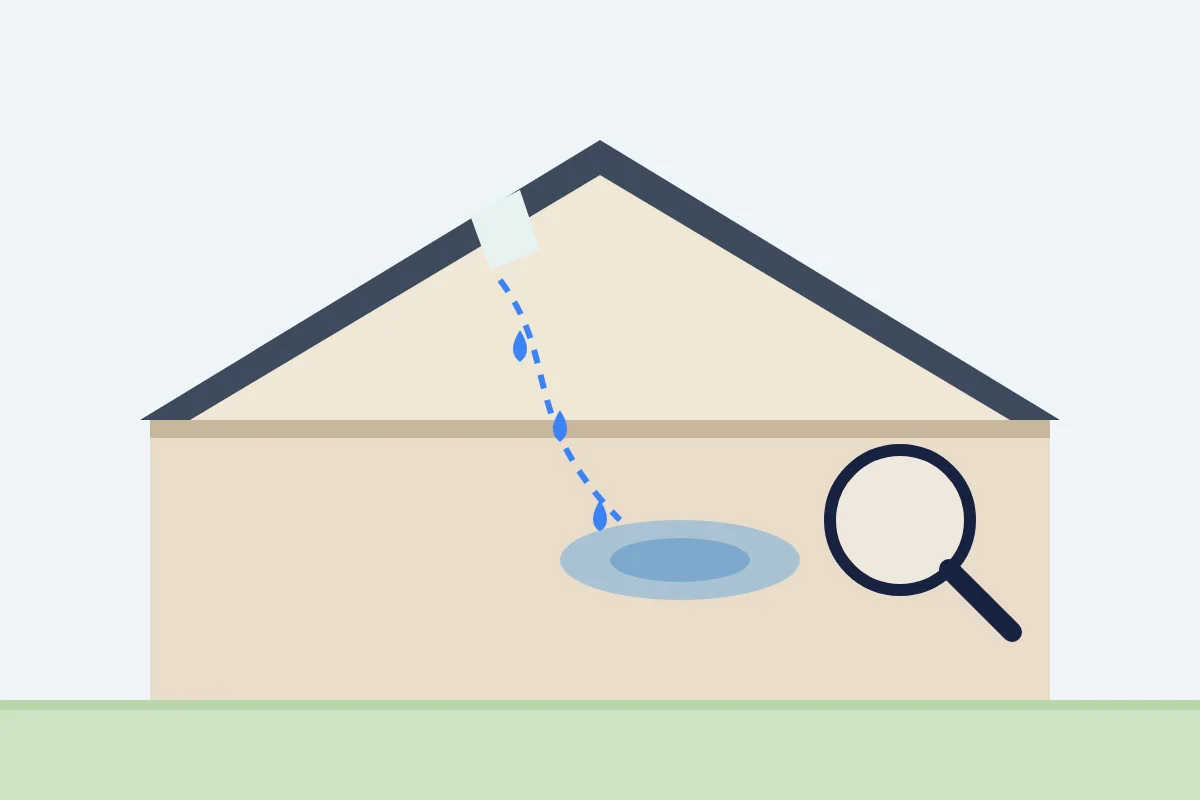
Roof leaks rarely show up where you’d expect. It can run along a rafter, a batten or the underlay before it drips, so the stain on your ceiling is seldom right under the hole. We follow it back towards where it starts. A repair aimed only at the stain can miss the cause entirely. Tracing the route first means any work can be aimed at the right place. We survey the roof space, lead flashings and valleys and parapet gutters, and people most frequently book us about damp underlay across a wide area and damp on a chimney breast.
In a village or hamlet like Cooling Street, older cottages and farmhouses often have roofs that have been patched over many years. That makes it hard to tell new damage from old wear, and the difference matters, particularly to an insurer. We look at whatever is safely visible and set out what we find. Older walls and timbers hold water for a long time, so it’s worth finding the cause soon.
How fast the report arrives depends on the package: the Basic Survey within 48 hours, the Standard Survey in 24 to 48 hours and the Premium Survey on the same day.
- Place
- Cooling Street (ME3)
- Wider area
- Medway
- Cost
- From £150 inc. VAT
- Report
- Emailed report with photos and recommendations
- When we survey
- Monday to Sunday, daytime
- Insurance
- Professional indemnity and public liability
- Phone
- 07833 053749
- Page updated
- 27 October 2026
Common roof problems in Cooling Street
Flat roofs fail with age and wear. A felt roof often lasts around 15 to 20 years, and splits, blisters and lifting laps let water in. Upstands and outlets are common weak points.
Signs worth acting on include:
- Staining around the chimney inside
- Damp ceilings under a flat roof
- Damp underlay across a wide area
- Damp walls below an overflowing gutter
If you let a flat or house near Higham station, a clear finding on where water gets in helps you brief a roofer straight away.
Choosing a roof surveyor
- Whether any drone flown is registered with the CAA
- Is there a chance to talk the report through?
- How soon the report will arrive
- What experience they bring
Landlord and commercial surveys in Cooling Street
Businesses and commercial landlords can book us too, from shops and offices to industrial units. Bigger roofs take more time, so they’re priced to suit.
Roof problems in a rented home affect tenants as well as the building. A survey shows what needs attention, so you can plan the work.
Places near Cooling Street
Also in Cooling Street
Cooling Street roofs and the weather
The coast is about 3 miles or less from Cooling Street, and being near the sea means more wind and salt than a roof inland would face. Strong wind lifts anything already loose, and driving rain gets in wherever it can, while salt slowly corrodes metal fixings and flashings. Temple Manor, about 3.9 miles south, is one of the historic houses in the wider area around Cooling Street. Period homes nearby can have lead valleys, tall chimneys and a patchwork of past repairs.
Anyone responsible for a site like Cliffe Woods Primary School will know that on a building that size, finding the source of a drip means looking well beyond the stain. If you live in an older home near St James' Church, the leak may come from a chimney, a valley or tired lead rather than the covering itself.
Cooling Street is about 4 miles north of Rochester, in Medway. Whether the building in Cooling Street is a house, a flat or a commercial unit, the roof can be surveyed on a weekday or at the weekend. Across Medway, we cover Cooling Street and the places around it. For surveys nearby, see our Maidstone page.
We work across the ME3 postcode area for roof leak investigations and the streets around it. We also cover the places around Cooling Street: Cooling (1 mile north-east), Chattenden (2 miles south-east), Wainscott (2 miles south), Lower Upnor (2 miles south) and High Halstow (2 miles east). Larger places within reach include Gillingham (6 miles south-east), Chatham (6 miles south), Rochester (4 miles south), Rainham (7 miles south-east), Strood (4 miles south) and Luton (5 miles south).
Around Cooling Street
Around Cooling Street, our work takes us to homes and buildings near The Hundred of Hoo Academy, among other places. For rail, the closest station is Higham station, roughly 2.2 miles south-west. Nearby you will also find Huguenot Museum (3.7 miles south) and French Hospital (3.8 miles south). Not far away are Gad's Hill and Rede Common.
FAQs for Cooling Street
Will you come out to Cooling Street?
Yes. Cooling Street is within the area we cover, which takes in towns, villages and rural addresses. Our area covers London and South East England. Just mention lanes, gates or anything else about the route when you book.
Does being near the coast affect roofs in Cooling Street?
Yes, coastal weather is harder on roofs: there is more wind, and more salt in the air. Ridges, verges, flashings and fixings are where it normally shows, and Cooling Street is within about 3 miles of the coast.
Can thermal imaging help find my roof leak?
It can, when the conditions are right. The best results come after a sunny day, on a dry roof with little wind. Wet insulation holds heat longer than dry, which can show up on the image. Its findings are confirmed with a moisture check.
What’s in the survey report?
It sets out what we found, why it matters and what we recommend, backed by photographs. It also says if any part of the roof couldn’t be seen safely, so you know exactly what was covered.
Can you always find the source?
Not always, and we’ll be honest about that. Some leaks hide well, particularly those that need wind-driven rain. If we can’t be sure, the report ranks the possible sources.
Can you tell me if my roof has asbestos?
No. Asbestos surveys and sampling are not something we do. The report may flag materials that could contain asbestos on buildings built or refurbished before 2000.
Is this a RICS survey?
No. It’s a specialist roof survey, not a RICS Level 2 or Level 3 building survey. It focuses on the roof and can sit alongside a RICS survey.
Roof by roof
Flat roof upstands and outlets
Each flat roof relies on its outlets to drain. A blocked outlet leaves water standing, which tests every joint. We check outlets and the covering around them.
Chimney stacks
We look at the outside of the stack and the breast inside, not a flue, gas or sweep inspection.
What we do, step by step
We photograph the roof as we go, so the report shows exactly what we saw. Close-ups come from the safest viewpoint available. A typical visit takes an hour or two for most homes, though a hard-to-trace leak can take longer. Somewhere like Cooling Street needs a little journey planning: let us know about lanes, gates and parking. The roof is looked at from the ground, from windows, from the loft where there’s safe access and from the roof where it is safe.
- You let us know where the water shows and when it appears.
- We look at the stain, the ceiling and the loft above it.
- Likely entry points outside are checked, from flashings and valleys to gutters and outlets.
- Moisture readings and thermal imaging are used where they help.
- We email a report with photographs, the likely entry point and recommendations.
Preparing for the visit
- Check the loft hatch can be reached
- Jot down any questions you want answered
- Leave side gates unlocked
Getting a price
Prices start from £150, including VAT. The exact figure depends on the roof and the package, and you can ring 07833 053749 or use the contact form to find out.
Read more
Tips from our surveys
A little preparation and a few simple habits help. Some pointers:
- Stay off ladders and the roof
- Let us know what has already been tried
- Record whether it leaks in every downpour or only some
- Clear the loft hatch so we can get in
Keep the report after the work is done. If the leak returns, it’s a useful record of what was found.
Look at the roof from the ground after strong winds. Pieces of slate or tile in the garden mean something has moved. Small faults dealt with quickly rarely become leaks.