
Reading · London and the South East
Kidmore End Roof Leak Investigation
Roof leak investigations across Kidmore End, backed by more than 20 years’ experience. Every survey ends with a written report and photos.
- Water dripping from rafters or underlay
- Brown rings on upstairs ceilings
- Damp on a chimney breast
Why get it checked now?
Leaks tend to get worse, not better. Wind lifts loose slates further and gaps widen. Tracing it now lets you plan the work rather than react to it. Where a roof is exposed, as many are in small places like Kidmore End, driving rain gets into any weakness, and older walls, once damp, take a long time to dry.
Every price we give includes VAT. Prices start from £150, including VAT. We confirm the exact price before booking.
Why book us in Kidmore End
- Customer satisfaction of 98%
- Two decades and more of roof surveys
- Thermal imaging and drones used where they help
- Plain-English reports with photos
Read what a roof survey costs and what we found on two real jobs.
How a roof leak investigation works in Kidmore End
Moisture readings and thermal imaging are used where they’re useful. Moisture detection confirms where timbers, plaster or insulation are damp. A thermal camera shows patterns of temperature rather than water, so we confirm what it suggests with moisture readings. Thermal imaging is part of the Premium Survey, and moisture detection comes with Standard. Thermal imaging works best after a sunny day, on a dry roof with little wind. Common reasons to book are water that shows only in certain storms and staining around the chimney inside, on valleys and parapet gutters, rooflights and dormers and lead flashings.
Many homes in small places like Kidmore End face open ground, so storms hit ridges, verges and chimneys hard. Damp in old stone, brick or timber walls is slow to dry out, which makes finding the cause quickly worthwhile. A written record also helps if you need to explain it to anyone else.
The Standard Survey adds moisture detection, a structural check and a follow-up consultation. The Premium Survey adds thermal imaging, drone inspection where applicable, structural analysis and an in-person consultation.
- Where
- Kidmore End (RG4)
- Wider area
- Reading
- Price
- From £150 inc. VAT
- Your report
- A written report with photos, by email
- Survey days
- Weekdays, Saturdays and Sundays
- Cover
- Professional indemnity and public liability
- Telephone
- 07833 053749
- Last updated
- 27 October 2026
Also near Kidmore End
More services for Kidmore End
What affects the cost of roof leak investigations
To price your survey, we look at:
- Whether thermal imaging or a drone is needed
- How tall the building is and how easy the roof is to see
- Extra roofs, like extensions, dormers or garages
- Chimneys, valleys, parapets and other details
Thermal imaging and drone inspection (where it applies) come with the Premium Survey, from £400 inc. VAT. We will tell you which package suits the questions you have.
What we need to know
There’s no need for technical words. It is enough to tell us:
- What’s prompted the survey
- Where water is showing inside, if it is
- Pictures from the garden or a window, if you have them
- How the loft is reached, if there is one
Most bookings start with a short call: call 07833 053749 or email us. The price is agreed before a date is set.
What we look for on each type of roof
Flat roof upstands and outlets
Outlets drain a flat roof. A blocked outlet leaves water standing, which tests every joint. Outlets and the area around them are looked at.
Slate and tile slopes
‘Nail fatigue’ is a common cause of slipped slates. Even a single gap can let water in, especially in driving rain.
Leaks and storm damage in Kidmore End
Across the South East, older homes tend to have slate or clay tiles, and many later ones concrete tiles, and flat-roofed additions turn up almost everywhere. Knowing the roof type helps narrow down where water may be getting in. About 2.3 miles south-west lies Mapledurham House, a reminder of how long the area around Kidmore End has been built on. Period homes nearby can have lead valleys, tall chimneys and a patchwork of past repairs, and a listed home or one in a conservation area may need consent for changes of material.
If you look after a shop, office or commercial unit, for instance near Broad Street Mall, a quick answer on where water is coming in keeps a business running. If you look after a building such as Kidmore End Church of England Primary School, tracing a leak on a big roof starts with where the water appears and works back. If your home is one of the older ones in the streets near Church of St John the Baptist, leaks on older roofs often start at lead flashings, valleys or around old chimney stacks.
Kidmore End is about 2 miles north-west of Caversham, in Reading. Kidmore End gets the same service as everywhere else we work: a close look at what can safely be seen, photographs and a clear written report. Across Reading, we cover Kidmore End and the places around it.
Surveys in RG4 work the same way as everywhere else we cover. Whether your property is on Butlers Orchard, Coopers Pightle and Wood Lane or a nearby road, we can help. If you’re just outside Kidmore End, we cover Sonning Common (1 mile north-east), Peppard Hill (1 mile north), Kingwood Common (2 miles north), Rotherfield Peppard (2 miles north-east) and Shepherd's Green (3 miles north-east). We also work in nearby towns like Norcot (4 miles south), West Reading (4 miles south), Tilehurst Within (4 miles south-west), Shinfield (7 miles south), Arborfield Garrison (10 miles south-east) and Horncastle (4 miles south).
Around Kidmore End
Typical jobs here are in homes near Pack Horse Public House, The Warwick School and Maiden Erlegh Chiltern Edge, among other places. Kidmore End’s nearest station is Tilehurst station, roughly 2.9 miles south-west of the centre. A little further out are Royal Berkshire Regiment Museum (3.4 miles south) and Battle Hospital (3.4 miles south). For a walk, there is Sonning Hill and Hartslock.
What a roof leak investigation does not cover
Our findings are based on what we can see safely on the day, so there are some things a survey can’t cover:
- Whether rotten timbers meet design loads
- Leaks from plumbing, tanks or pipework rather than the roof
- Defects hidden under coverings or inside walls without opening up
If you are not sure which survey you need, ring 07833 053749 or send us an email and we’ll give you a straight answer before booking. What our survey covers.
What we look at
- Valleys and parapet gutters
- Flat roof details
- Slate and tile slopes
- The roof space
- Lead flashings
- Chimney stacks
- Rooflights and dormers
What we do, step by step
We don’t take risks to get a closer look. Everything that can safely be seen is inspected, and anything we cannot see is noted in the report. The survey typically takes about 1–2 hours for most houses, and more on a big or complicated roof. For a village or hamlet like Kidmore End, the journey is planned beforehand: let us know about narrow lanes, gates, long drives and where we can park. The roof is looked at from the ground, from windows, from the loft where there is safe access and from the roof where it is safe.
- We start with your notes and photos of the leak.
- We examine the damp area and the rooms near it.
- From the loft space, we trace the water’s route where there’s safe access.
- Outside, we check flashings, valleys, chimneys, gutters and flat roof details from every safe viewpoint.
- We email a written report showing where the water most likely gets in.
Before we arrive
- For flats, check roof access has been agreed
- Mention any parking restrictions on your street
- If you’re buying, let the agent know when we are coming
Book a survey
Once you know what you need, ring 07833 053749 or use the contact form. From there it is a case of choosing a package, agreeing the price and fixing a day, weekday or weekend.
Read more
Practical tips
There’s plenty you can do without going near the roof. Here’s what helps most:
- Make sure the loft is accessible
- Keep a photo record of the damp patch
- Mention earlier attempts to fix the leak
- Leave roof access to professionals
Your report arrives by email, with photos of what we found. It sets out where we believe the water is getting in, how it’s travelling and what needs attention. Basic reports come within 48 hours, Standard within 24 to 48 hours and Premium the same day.
After a storm, check the roof from the garden and the street. Pieces of slate or tile in the garden mean something has moved. Small faults dealt with quickly rarely become leaks.
Common questions in Kidmore End
Is my home in Kidmore End listed or in a conservation area?
Check Historic England’s online list first, then ask the council about conservation areas and any Article 4 direction. It matters most if you are planning to re-roof in a different material.
Is Kidmore End in the area you cover?
Yes, Kidmore End is one of the places we work. The survey and report are the same in Kidmore End as anywhere else.
Does the report include photographs?
Yes, plenty. Each finding is shown in a picture where possible, which makes the report easy to follow.
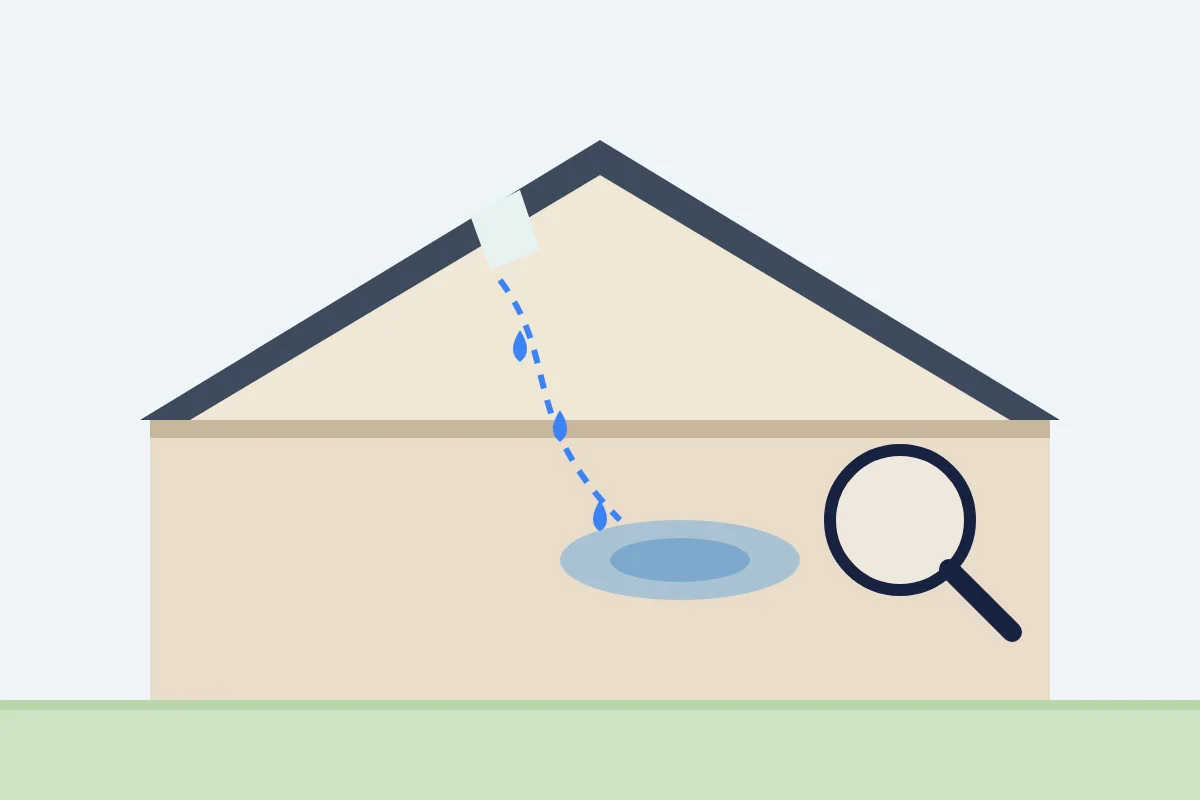
Why doesn’t the damp patch line up with the hole?
Water follows the easiest path, not the shortest. On a flat roof it can travel under the covering before it shows. Following that route is what our investigation does.
Is it a structural engineer’s report?
No. We note visible signs such as sagging or deflection, but we’re not structural engineers and don’t carry out calculations. Where an engineer is needed, we say so in the report.
Is it a leak or condensation?
Many apparent leaks turn out to be condensation. A leak usually shows in one area and follows rain, while condensation is frequently widespread and worst on cold days. The report explains which it looks like and what to do.
Is it the same as a RICS Level 2 or Level 3 survey?
No. We are experienced roof surveyors, and our survey covers the roof rather than the whole building. If you need a full building survey, you’ll need a RICS survey as well.