
Greater London · London and the South East
Flat roof survey in South Street, Greater London
Flat roof surveys across South Street, backed by more than 20 years’ experience. Every survey ends with a written report and photographs.
- Outlets that hold water back
- A sagging deck under the covering
- Cracked or split membrane
Rented homes, blocks and businesses
A roof problem in a let property affects your tenants as well as the building. A survey helps you spot issues early and plan the work around your tenants.
Managing agents and residents’ management companies use roof surveys to plan maintenance. Recommendations are set out by urgency where it matters, which helps when budgeting.
Flat roof survey in South Street: what you get
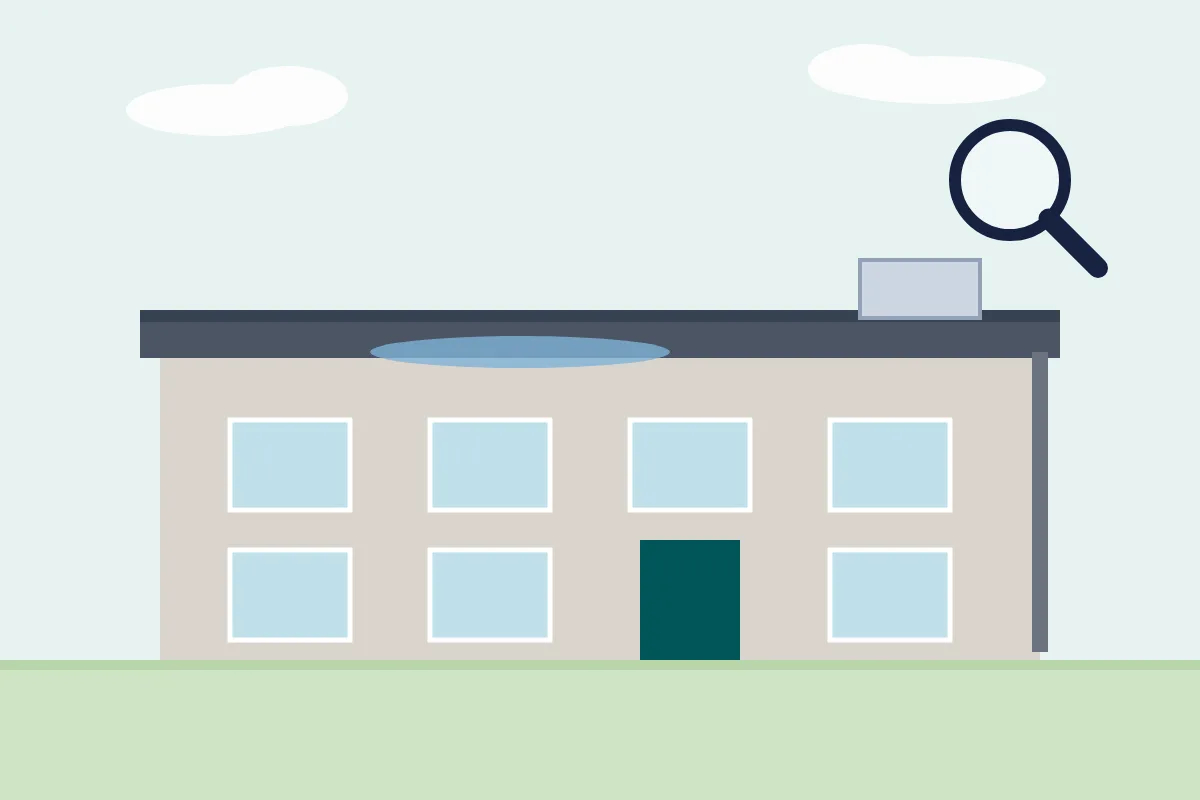
Ponding is frequently the first sign that something on a flat roof is not right. It can mean the falls were never right, an outlet is blocked or the deck has started to sag. The survey notes any ponding, the state of each outlet and any dips that hint at a sagging deck. Where the deck may be a structural issue, our report says a structural engineer should look at it. Typical surveys look at blocked or damaged outlets and blistering in felt or asphalt, on GRP fibreglass, felt flat roofs and EPDM rubber.
Commercial and residential blocks across London often have big flat roofs with plant, rooflights and access walkways. Every penetration and upstand is a place where a membrane can fail. In South Street, roof access is agreed with the building manager or owner beforehand. Rooflights, plant supports and pipe entries are common places for a membrane to fail.
The report records the flat roof as we found it on the day. It is useful straight away, and a good reference for later, for example when you want to check whether anything has changed.
- Location
- South Street (TN16)
- Wider area
- Greater London
- Prices
- From £150 inc. VAT
- Your report
- Emailed report with photos and recommendations
- Survey days
- Monday to Sunday, daytime
- Insured
- Professional indemnity and public liability
- Telephone
- 07833 053749
- Page updated
- 27 October 2026
How the survey works
It is useful to start with what’s prompted the survey: buying, a leak, storm damage, new work or just wanting to know where things stand. It helps us focus on what matters most to you. Most visits take about one to two hours for a house; commercial roofs usually need 3–4 hours. Surveys in South Street can be booked for any day of the week. It helps if you can point us to a visitor permit or a nearby bay, and to clear a path to the loft hatch. A back bedroom window can be the best vantage point for a rear addition, so we may ask to use one.
- First you give us the address, what the roof covers and any leaks you’ve noticed.
- We look at the roof from wherever it can be seen safely.
- The covering, falls, upstands, outlets, edge trims and rooflights are checked and photographed.
- Inside, we look for damp and staining under the roof where there is access.
- We send a written report with photos, the defects we found and what we recommend.
Before the survey
- Check the loft hatch can be reached
- Leave side gates unlocked
- Show us where any leaks or stains appear
Booking a survey
To arrange a survey, phone 07833 053749 or drop us an email and tell us the address and what’s prompted the survey. You’ll know the price before anything is booked.
Advice
What we look for on each type of roof
Felt and built-up roofs
On felt, the upstands and edge details often fail before the main surface. We check each one and photograph any that have split or pulled away.
EPDM rubber
Lifting at the edges and loose areas of membrane are common EPDM problems. We record any we can see, with photographs.
What we cannot see
Every survey has limits, and we’d rather be clear about that before you book. Keep these in mind:
- Asbestos testing, which needs a specialist asbestos surveyor
- An exact number of years the roof has left
- Hidden layers beneath the covering
If you’re not sure which survey you need, call 07833 053749 or drop us an email and we’ll give you a straight answer. What a survey covers and does not.
What we check
- Upstands and outlets
- Single-ply membranes
- Felt flat roofs
- GRP fibreglass
- Mastic asphalt
- EPDM rubber
Local flat roofs in South Street
Outer London has plenty of Victorian and Edwardian terraces with slate roofs, but also a great many interwar semis, often with hipped roofs in clay or concrete tiles. On a semi of that age, the small roofs over the bays, the hip tiles and any later dormer each need their own look. Mixed in with those pitched roofs are a good many flat ones, over rear extensions, dormers, garages and shops. With Titsey Place about 2.1 miles south-west, South Street sits in an area with a long building history. Older roofs in the wider area can hide decades of patch repairs, so the detail matters.
The streets around a church like Church of St Mary the Virgin are frequently among the oldest in a place, and if your home is one of the older ones nearby, the joins between later flat roofs and the old walls are where problems typically start. Landlords with a home close to Oxted station may find that the flat roof over a let home is worth a look before it becomes a tenant complaint.
South Street is about 4 miles north-east of Oxted, in Greater London. South Street is one of many places we visit across Greater London, for homes and businesses alike. South Street is one of the towns and villages in Greater London we cover for flat roof surveys. For surveys nearby, see our London page.
We survey roofs across the TN16 postcode area for flat roof surveys. We also cover Tatsfield (1 mile west), Force Green (2 miles south-east), Titsey (2 miles south-west), Westerham (2 miles south-east) and Moorhouse Bank (3 miles south). Within a short drive, we also cover London (15 miles north-west), Stockwell (14 miles north-west), Orpington (6 miles north), Wimbledon (14 miles north-west), Kennington (15 miles north-west) and New Cross (13 miles north).
Local landmarks in South Street
The nearest railway station is Oxted station, roughly 3.7 miles south-west. Well-known places in the area include Tandridge Priory (3.2 miles south). For a walk, there’s West Kent Golf Course nature reserve and Betsom's Hill.
Your questions about flat roof surveys in South Street
Is South Street in the area you cover?
Yes, South Street is one of the places we work. The survey and report are the same in South Street as anywhere else.
Will parking be an issue for a roof survey in South Street?
It can be, so it is useful to let us know about permits, visitor bays or off-street space as you book. The visit is then planned around what’s available.
How experienced are you?
We have completed more than 5,000 surveys, over more than 20 years.
What do I do with the report?
We email you the written report with photos and recommendations. It is yours to share with a seller, insurer, roofer or managing agent, whichever applies.
Will you check the loft?
If the survey needs it and the roof space can be reached safely, yes. A clear path to the hatch helps.
How fast do I get the report?
Basic reports arrive within 48 hours, Standard reports in 24–48 hours and Premium reports on the same day. Each one is emailed.
Can you survey in bad weather?
Light rain is usually fine; heavy rain and wind are different. In strong wind or a downpour, a drone can’t fly and access may not be safe, and we’d agree another day.
Tips that help
Here are a few things we’d tell any owner:
- Never stand on rooflights or fragile sheeting
- Ask contractors to protect the roof if they work on it
- Watch the ceilings below the flat roof for stains
- Clear roof outlets and gutters each autumn
Many people send the report to two or three roofers for quotes. With each roofer working from the same list, comparing quotes is simpler. It’s your choice who carries out the work and when.
Try not to let a flat roof become a walkway. Where someone does need access, ask them to use boards or a protected route, and remind them never to step on rooflights or fragile sheets.
Do you need a flat roof survey in South Street?
Water that doesn’t drain sits on the roof and speeds up wear. It usually comes from poor falls, a blocked outlet or a deck that has dipped. Where trees are close by, leaves and silt can block an outlet within a single autumn.
People typically book a survey after spotting something like this:
- Loose or cracked edge trims
- Outlets choked with leaves and silt
- Pools of water lying on the roof
- Dips that suggest the deck is deflecting
For a London address like South Street, it’s useful to know about controlled parking before the day.
What to check before booking
- Whether the inside of the roof is included
- What happens after the report arrives
- Are they insured for the work?
- How they’ll see the roof: from the ground, the loft, the roof or by drone