
Southampton · London and the South East
Roof Leak Investigation in Hounsdown
A careful look at the leaking roof at your property in Hounsdown, with photos and a written report.
- Staining around the chimney inside
- Water coming in around a roof light or dormer
- Ceiling stains that grow after rain
When you need someone else
Our findings are based on what we can see safely on the day, so there are some things a survey can’t cover:
- Leaks that only appear in weather we cannot recreate
- Defects hidden under coverings or inside walls without opening up
- Structural calculations (that is a structural engineer’s job)
Not sure which survey suits your roof? You can call 07833 053749 or send us an email and we will tell you. The full list of what we check.
Roofs we survey in Hounsdown
- Slate and tile slopes
- Valleys and parapet gutters
- Lead flashings
- Rooflights and dormers
- The roof space
- Flat roof details
- Chimney stacks
Roof leak investigation in Hounsdown: what you get
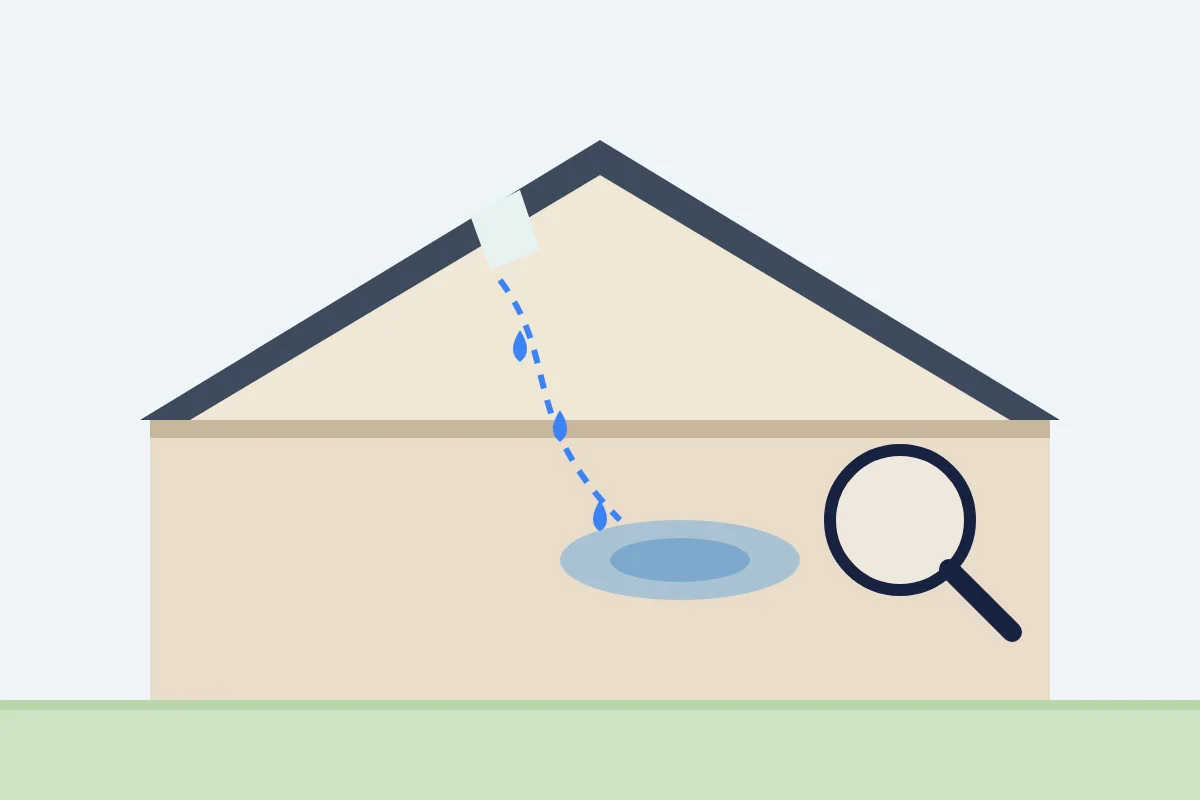
Our job is to find the likely source and tell you. You get a written report with photos showing the likely entry point and the route the water is taking, and recommends what should be done. It gives any roofer a clear brief. We find and report the source, and the repair itself is a separate job. Typical surveys look at leaks below a flat extension roof and a leak that comes and goes with the weather, on rooflights and dormers, flat roof details and slate and tile slopes.
Around Hounsdown, chimneys on older homes are a common source of leaks, through worn flaunching, failed pointing or lifted flashings. Damp on a chimney breast is not always rain from above, which is why it is worth tracing properly. The stack, its flashings and the loft space beside it are all worth checking.
After the visit, you get a photo-illustrated written report, sent by email. It sets out the condition of the leaking roof, any defects and our written recommendations.
- Location
- Hounsdown (SO40)
- Region
- Southampton
- Cost
- From £150 inc. VAT
- Reports
- Written, with photos, emailed to you
- Survey days
- Weekdays and weekends
- Cover
- PI and public liability insurance
- Phone
- 07833 053749
- Updated
- 27 October 2026
Tips that help
Getting the most from a roof leak investigation starts before we arrive and carries on afterwards. Some tips:
- Don’t climb onto the roof to look
- Do not touch fittings that water is reaching
- Keep a photo record of the damp patch
- Tell us about any past repairs to the roof
Standard includes a follow-up consultation to talk the findings through, while Premium includes one in person. It is a chance to ask about anything in the report.
Keep the loft space ventilated. Good airflow reduces condensation, and condensation is a common false alarm. Check insulation does not block airflow at the eaves.
What we look for on each type of roof
Lead flashings
A leak at a flashing often shows some way from the joint. That’s why we check the flashings near a stain, not just the one directly above.
Parapet and box gutters
Parapet and box gutters sit behind walls or inside the roof. When their outlets block, water rises over the lining and runs indoors.
Common roof problems in Hounsdown
Condensation is often mistaken for a leak. Moist air from bathrooms and kitchens condenses on the cold underside of the roof, particularly in lofts with blocked eaves. Drips from nails and damp underlay are typical signs.
A survey can pick up problems such as:
- Stains around a skylight
- Damp walls below an overflowing gutter
- Water dripping from rafters or underlay
- Damp on a chimney breast
The streets around a church like Colbury Christ Church are frequently among the oldest in a place, and if your home is one of the older ones nearby, lead flashings, valleys and old chimneys are typical places for water to get in.
Questions to ask before booking
- Which viewpoints they use to see the roof
- Whether the loft is part of the inspection
- Is VAT included in the price?
- How long the report takes to arrive
For landlords and managing agents
Buyers’ agents can book surveys on behalf of their clients. The report is emailed, so it can go straight to your client, photographs included.
Businesses and commercial landlords can book us too. Larger roofs take longer, and they’re priced for the size.
Roof leak investigations around Hounsdown
The coast is about 2 miles or less from Hounsdown, where sea air brings more salt and stronger wind than inland. In a coastal gale, rain is driven sideways into laps, verges and flashings, and salt air slowly wears metal fixings. The wider area around Hounsdown has a long history of building, with Southampton Tudor House and Garden about 4.1 miles east. Older roofs in the wider area can hide decades of patch repairs, so the detail matters.
If you let a flat or house near Totton station, tracing a leak quickly matters when a tenant is living with it. If you look after a building like Hounsdown School, on a building that size, finding the source of a drip means looking well beyond the stain.
Hounsdown is about 1 mile south of Totton, in Southampton. Hounsdown is one of many places we visit across Southampton, for houses, flats and commercial buildings. Hounsdown is one of the towns and villages in Southampton we cover.
Every address in SO40 is covered for roof leak investigations, from the main roads to the quietest streets. That includes homes and businesses on Main Road, Pound Lane and Chapel Lane and the roads around them. If you are just outside Hounsdown, we cover Ashurst Bridge (1 mile north-west), Totton (1 mile north), Netley Marsh (1 mile north-west), Woodlands (2 miles west) and Winsor (3 miles north-west). Further out, we also cover Southampton (5 miles east), Shirley (3 miles east), Regents Park (3 miles east), Townhill Park (6 miles east), Midanbury (6 miles east) and Thornhill (7 miles east).
Local landmarks in Hounsdown
We work in homes and buildings around Foxhills Infant School and The Forest Inn. Hounsdown’s nearest station is Totton station, roughly 1.1 miles north-east. Other landmarks nearby include National Dairy Museum (0.8 miles south) and Ashurst Hospital (1.4 miles south-west). Open spaces near Hounsdown include Testwood Lakes.
The survey, step by step
Once we have finished looking, we write up our findings as a written report with photos, sent to you by email. As for time on site, most surveys take between one and two hours on an ordinary house, and longer for a large or complex roof. A visit to Hounsdown is planned like any other: the time, the access and where to park are agreed ahead of time. Visits can be on weekdays, Saturdays or Sundays. Let us know about any garages, outbuildings or extensions you want included.
- You get in touch with details of the leak and any photos.
- We look at the stain, the ceiling and the loft above it.
- Outside, we check every likely route in.
- Moisture readings and thermal imaging are used where they help.
- We email a report with photographs, the likely entry point and recommendations.
Getting ready for the survey
- Let us know about parking near the property
- Have any paperwork from past roof work to hand
- Point out any leaks or damp patches
Booking a survey
Getting a price is simple: just call 07833 053749 or drop us an email and give us a few details about the property and we will explain which survey suits. We confirm the price before anything is booked.
Read more
Hounsdown questions
Will you come out to Hounsdown?
Yes, Hounsdown is covered. Our area covers London and South East England, from towns to the smallest villages. The journey is planned ahead, so it helps to know about access.
Does being near the coast affect roofs in Hounsdown?
Yes, coastal weather is harder on roofs: there’s more wind, and more salt in the air. Ridges, verges, flashings and fixings are where it typically shows.
Are you insured?
We hold professional indemnity and public liability insurance, for every survey we carry out.
Is it a leak or condensation?
It is a common question. Leaks tend to follow wet weather and show in one place, while condensation is frequently widespread and worst on cold days. The report explains which it looks like and what to do.
What do I do with the report?
You receive the written report by email, with photos and recommendations. It is yours to share with a seller, insurer, roofer or managing agent, whichever applies.
Do you look in the loft space?
If the survey needs it and the loft space can be reached safely, yes. Please clear anything stored under the hatch.
Will you walk on the roof?
Not always. Some roofs are too steep or fragile to walk on safely. Safe viewpoints, the loft and a drone where it applies let us see the rest, and the report records anything we couldn’t see.