
Hampshire · London and the South East
Storm damage roof report in East End, Hampshire
Wondering about the roof at a property in East End? You can book a storm damage roof report in East End and across Hampshire, with plain-English findings.
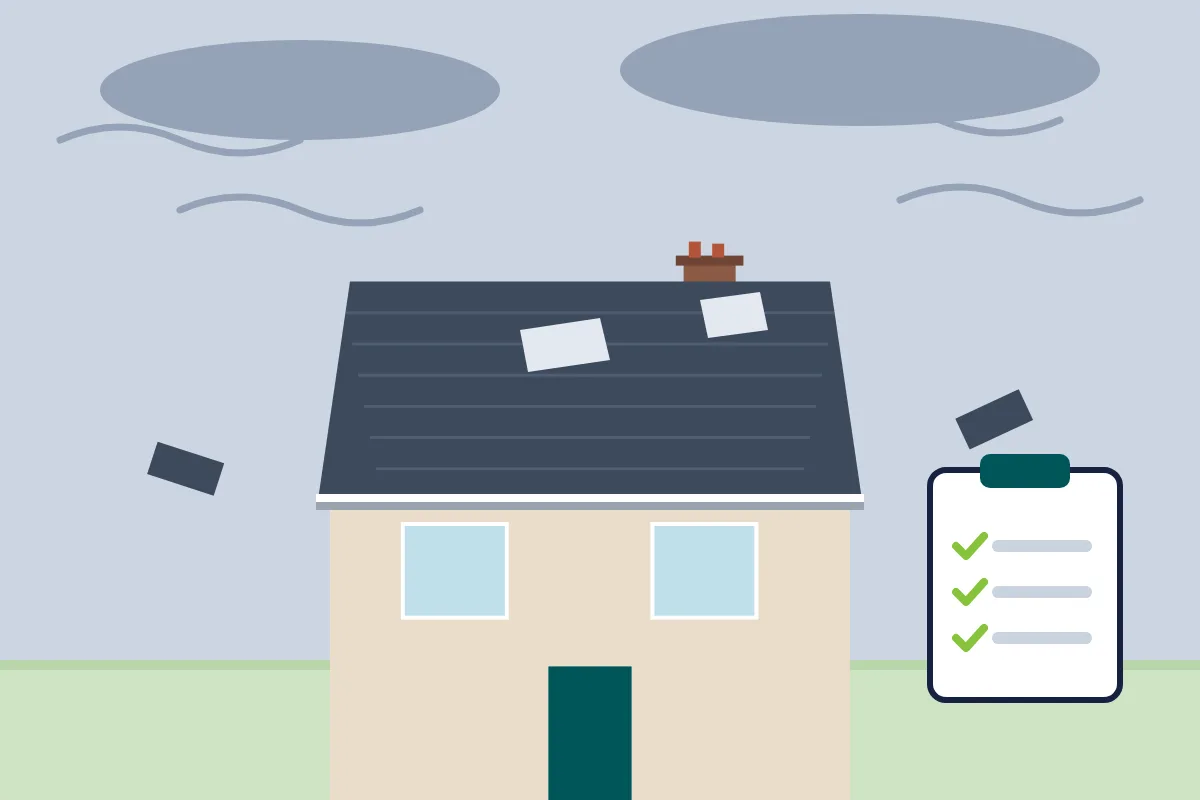
- Roofs hit by falling trees
- Flat roof edges peeled back
- Loose or broken chimney pots and cowls
Can I check my roof myself?
The one thing to avoid is getting up close. Roofs are fragile and slippery, and falls from height are serious. That part is for a survey.
You can learn a lot from the ground. Binoculars help you spot slipped slates or tiles, gaps along the ridge and a leaning stack. Please don’t climb up for a closer look.
About our storm damage roof report in East End
Each roof is looked at from the safest viewpoints available: from the ground, from windows and higher points, from the roof space and from the roof where it is safe. Every area of damage is photographed and described. We note any part we couldn’t see. The report, with photos, is yours to pass to your insurer. Common reasons to book are flat roof edges peeled back and damaged gutters and fascias, on gutters and fascias, flat roofs and chimney stacks.
For a small place like East End, the inspection is the same as anywhere: the journey and access are just planned beforehand. It helps to know where the water appears, in what weather, and what you’ve seen outside, along with any repairs done before. If you have photos of the water coming in, they help as well.
Nothing in the report is left vague: if work is needed, the report says so clearly, and where it can wait, that’s said too.
- Place
- East End (SO41)
- Region
- Hampshire
- Cost
- From £150 inc. VAT
- Reports
- A written report with photos, by email
- Survey days
- Weekdays, Saturdays and Sundays
- Insurance
- PI and public liability insurance
- Phone
- 07833 053749
- Last updated
- 27 October 2026
Questions from East End
Does being near the coast affect roofs in East End?
Places near the sea get more wind and more salt in the air than inland, and both are hard on roofs. Salt is hard on nails, clips and metal flashings, while strong wind lifts anything already loose.
Is my home in East End listed or in a conservation area?
Your council is the best source, with Historic England’s list for listed buildings. Both listing and conservation areas can limit changes of roofing material, and councils can also use Article 4 directions.
Do you cover East End?
Yes, we do. We carry out storm damage roof reports in East End.
Can you tell me if my claim will be paid?
We can’t say whether a claim will be paid. The decision rests with your insurer and its policy. What we provide is an independent record of the damage.
How much is a storm damage roof report?
Our reports start from £150. Larger roofs are quoted for their size. Repair costs are not part of the report.
Can you survey a shared roof?
Yes, as long as access is agreed. Roofs over flats are often shared, so the freeholder or managing agent needs to agree access. We inspect only the parts we are allowed to reach.
How do I arrange a storm damage roof report in East End?
The quickest way is to ring 07833 053749 or drop us an email. Give us the address and a few details about the roof, and we will point you to the right survey. We survey on any day of the week.
Wind, rain and roofs in East End
East End lies within about 1 mile of the sea, and being near the sea means more wind and salt than a roof inland would face. Wind lifts loose slates, tiles and ridge pieces, and driving rain finds any gap they leave. A number of Hampshire villages keep thatched roofs on their older buildings. Slate and clay tile are the usual coverings on older South East houses, with concrete tiles on many later estates. Each of these roof types has its own typical places for water to get in.
Beaulieu Palace House, about 3.5 miles north-east, is one of the historic houses in the wider area around East End. Leaks in period homes nearby often come from lead work and valleys that have been patched before. Landlords with a home close to Lymington Pier station may find that tracing a leak quickly matters when a tenant is living with it.
East End is about 3 miles north-east of Lymington, in Hampshire. Bookings from East End are handled just like any other: a call or an email, a price, then a date. Our Hampshire coverage includes East End and the places around it. For surveys nearby, see our Southampton page.
We work across the SO41 postcode area for storm damage roof reports. That includes homes and businesses on Rowes Lane, Norleywood Road and Lymington Road. If you are just outside East End, we cover Norleywood (1 mile north-west), Thorns Beach (2 miles east), Hamstead (4 miles south-east), Cranmore (5 miles south) and Bouldnor (5 miles south). We also work in nearby towns like Gosport (15 miles east), Eastleigh (15 miles north-east), Fareham (14 miles north-east), Totton (10 miles north), Chandler's Ford (15 miles north) and Hedge End (13 miles north-east).
What’s near East End
The closest station to East End is Lymington Pier station, roughly 2.3 miles south-west. Nearby you will also find Yarmouth Castle (4.7 miles south) and Lymington New Forest Hospital (2.7 miles west). Green spaces nearby include Boldre Foreshore.
Leave it or get it looked at?
Once the storm has passed, damage that looked minor can let water in for months. Getting it recorded and repaired sooner is normally better. Outbuildings and barns around East End are easy to forget, but a failed roof there can spoil what’s stored inside. A quick look before winter can save a lot.
Thermal imaging and drone inspection (where applicable) come with the Premium Survey, from £400 including VAT. We’ll tell you which package suits the questions you have.
Why book us in East End
- Drone and thermal imaging surveys available
- Surveys on weekdays and at weekends
- Packages from £150, including VAT
- 5,000+ surveys completed
Take a look at how roof surveys are priced or what we found on two real jobs.
Towns and villages near East End
What else we do in East End
Signs you need a storm damage roof report in East End
Some people book because a claim has been questioned. You get an independent record of what the roof shows. We can’t say whether the decision will change.
Common reasons to book include:
- Loose or broken chimney pots and cowls
- Damaged ridges and hips
- Torn or lifted flat roof coverings
- Broken or displaced guttering
The streets around a church like Church of St Mary are frequently among the oldest in a place, and if you own one of the older houses nearby, water on an older roof tends to find its way in at the lead, the valleys or the chimney.
Questions to ask before booking
- Whether any drone flown is registered with the CAA
- How they plan to inspect the roof safely
- Is VAT included in the price?
- Which limits apply to the survey
Tips that help
A survey works best with a little help from you, before and after. Some tips:
- Note the date and time you first saw the damage
- Report the damage to your insurer as soon as you can
- Read your policy wording on storm damage
- Get a roofer to make the roof safe if needed
Your insurer may send a loss adjuster to look at the damage. Our report gives you an independent record alongside theirs.
Ask a tree specialist about branches over the roof. They can damage the roof in high winds.
What we look for on each type of roof
Flat roof coverings
On flat roofs, storms can lift edges and tear membranes. We record any damage and where it is.
Clay and concrete tiles
Tiles without fixings can move more easily in wind. We record what we can see of the fixings.
The survey, step by step
Where it is relevant and can be reached safely, the roof space is checked as well as the outside. Inside, we look for staining, damp, gaps and signs of movement. All in, the survey usually takes roughly 1–2 hours for most homes, depending on how much of the roof was hit. Somewhere as small as East End, access is frequently the only tricky part. Let us know about outbuildings, past repairs and any leaks you’ve noticed. Visits can be on weekdays, Saturdays or Sundays.
- First you give us the date of the storm and what you’ve noticed, inside and out.
- The roof is looked at from the ground, from windows and from the roof space where it is safe.
- The damage is recorded with photos, area by area.
- The likely cause is recorded, along with any evidence of older wear.
- The findings are written up with photos for you to share with your insurer.
Before the survey
- Show us where any leaks or stains appear
- Move anything stored under the loft hatch
- Let us know about parking near the property
Booking a survey
We confirm the price for the job before you book, so you know the cost up front. Storm damage roof report starts from £150, including VAT. To book, ring 07833 053749 or use the contact form.