
West Sussex · London and the South East
Storm damage roof report in Goring-by-Sea, West Sussex
We take a careful look at the roof at your property in Goring-by-Sea, with photos and a written report.
- Water coming in after the storm
- Cowls or aerials dislodged in the wind
- Lifted or missing ridge and hip tiles
What this survey can’t tell you
In fairness, a roof survey has limits:
- The outcome of a claim
- Acting for you with the insurer
- Damage hidden under coverings or inside the structure, without opening up
Not sure which survey suits your roof? You can call 07833 053749 or use the contact form and we’ll tell you before booking. What a survey covers and doesn’t.
Roof types and parts we check
- Flashings
- Chimney stacks
- Slate and tile slopes
- Gutters and fascias
- Ridges and hips
- Flat roofs
Storm damage roof report in Goring-by-Sea: what you get
High winds usually affect the parts of a roof that are already exposed or loose. Slates and tiles slip or blow off, ridge and hip tiles lift, flashings pull away and flat roof coverings can tear. Trees and branches can also hit roofs in a storm. We record the damage on your roof and photograph each part. Any older wear we can see is recorded as well. Typical surveys look at lifted or missing ridge and hip tiles and gaps where slates or tiles have gone, across slate and tile slopes, flashings and flat roofs.
Older cottages and houses around Goring-by-Sea may have roofs with little or no underlay. Without a sound underlay, any gap in the coverings lets water straight through. Whether it’s long-term wear or recent damage makes a difference to what happens next. Wet battens and insulation in the loft are often the first clue.
How fast the report arrives depends on the package: the Basic Survey within 48 hours, the Standard Survey in 24 to 48 hours and the Premium Survey on the same day.
- Location
- Goring-by-Sea (BN12, BN99, BN13)
- Region
- West Sussex
- Price
- From £150 inc. VAT
- Your report
- Written, with photos, emailed to you
- Appointments
- Weekdays and weekends
- Insurance
- PI and public liability insurance
- Phone
- 07833 053749
- Last updated
- 27 October 2026
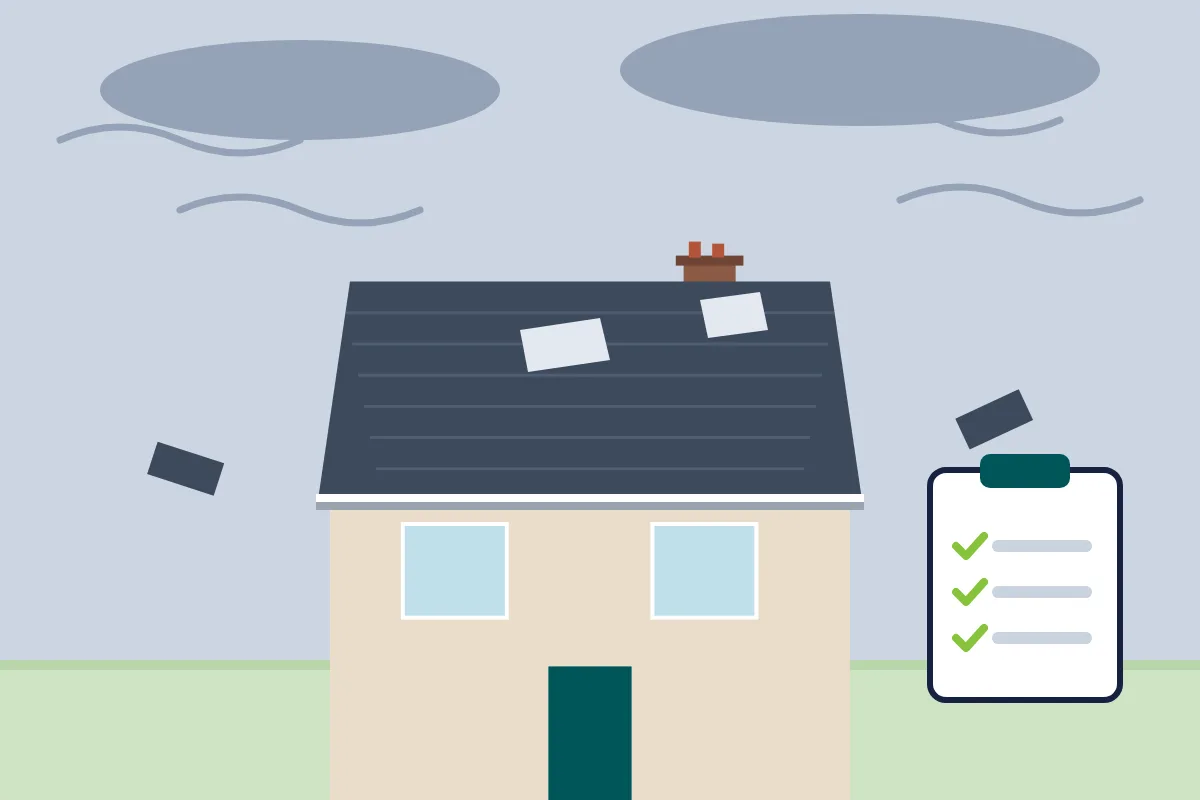
Useful tips for Goring-by-Sea property owners
There is plenty you can do without going near the roof. What helps most:
- Get a roofer to make the roof safe if needed
- Read your policy wording on storm damage
- Keep any slates, tiles or debris that fall, if it’s safe to do so
- Don’t go onto the roof to take pictures
The insurer might appoint a loss adjuster. Our report gives you an independent record alongside theirs.
Keep gutters and outlets clear so heavy rain can drain away. Overflowing gutters can make storm damage worse.
Storm damage roof reports around Goring-by-Sea
The coast is about 1 mile or less from Goring-by-Sea, so storms can arrive with strong gusts off the water. Insurers decide claims on their own policy wording, and many treat gusts of about 55 mph as storm conditions, though it varies. Historic houses such as Ecclesden Manor, about 2.3 miles north-west, show how far back building in the area around Goring-by-Sea goes. On older houses around here, roofs frequently carry the marks of earlier repairs, from replaced slates to new lead, and any change of roofing material on a listed home needs checking with the council first.
If you live near a park such as Durrington Minature Railway, or anywhere with mature trees, autumn leaves can block gutters and valleys, and blocked gutters overflow and soak walls. For site and facilities teams at buildings such as Goring-By-Sea CofE (Aided) Primary School, on a building that size, finding the source of a drip means looking well beyond the stain.
Goring-by-Sea is about 1 mile south-west of Worthing, in West Sussex. If you’re in Goring-by-Sea, booking works exactly as it does anywhere else: a call or an email, a price, then a date. Goring-by-Sea is one of the towns and villages in West Sussex where we work. Brighton is in our area too.
Storm damage roof reports in BN12, BN99 and BN13 are booked the same way as anywhere else. That includes homes and businesses on Sea Lane, Jupp's Lane and Goring Road and the roads around them. Neighbouring places we cover for storm damage roof reports include Ferring (1 mile west), Hangleton (1 mile west), Kingston Gorse (2 miles west), Durrington (2 miles north) and West Kingston (2 miles west). We also work in nearby towns such as Bognor Regis (12 miles west), Littlehampton (5 miles west), Shoreham-by-Sea (7 miles east), Lancing (5 miles east), Rustington (4 miles west) and Storrington (8 miles north).
Near you in Goring-by-Sea
Typical jobs here are in homes near Durrington Minature Railway, Chatsmore Catholic High School and Worthing College and the streets around them. Goring-by-Sea’s nearest station is Goring-By-Sea station, about 0.5 miles north-west of the centre. A little further out are Museum of Sussex Folklore (1.6 miles north-east) and The Acre (1.8 miles east). Open spaces near Goring-by-Sea include Highdown Hill.
What happens on the day
Photographs are taken throughout the visit, so the report shows exactly what we saw. Close-ups come from the safest viewpoint available. A typical visit takes roughly 1–2 hours at a house, and longer if the damage is spread across a large roof. With a bit of garden around a house, as there frequently is around Goring-by-Sea, the roof can be viewed from several angles. Mention any side of the property we cannot get to. The loft, where there’s safe access, completes the picture.
- First we go through when the storm hit and what you’ve noticed.
- The roof is inspected from safe positions.
- Each area of damage is photographed and described.
- We note the likely cause and any signs of older wear.
- We send you the report by email for your insurer.
How to prepare
- Make a note of anything you’d like us to look at
- Check we can get to the back of the property
- If the roof is shared, arrange access with whoever manages the building
Getting a price
Unsure which package suits your roof? It’s easiest to phone 07833 053749 or use the contact form and describe the roof and what’s worrying you. We will explain the options and the price.
Advice
Goring-by-Sea questions
Do you cover smaller places like Goring-by-Sea?
Yes, smaller places are covered as well as towns. Our area covers London and the South East. Just mention lanes, gates or anything else about the route when you book.
How do I find out if my home in Goring-by-Sea is listed?
For listing, use Historic England’s list; for conservation areas, ask the council. It matters most if you’re planning to re-roof in a different material.
How long does the survey take?
Time on site depends on the roof; most visits take between one and two hours at most homes, and more on a big or complicated roof. The report is sent afterwards by email.
Does this replace a RICS home survey?
No. We are experienced roof surveyors, and our survey covers the roof rather than the whole building. If you need a full building survey, you will need a RICS survey as well.
Can you inspect my roof with a drone?
Yes, where it is applicable. Whether we can fly on the day depends on the weather and the airspace rules, and we check for restrictions near airports before flying. We hold a CAA Flyer ID and Operator ID.
Who handles emergency protection after a storm?
Emergency temporary protection is a job for a roofer. If it’s safe, take photos before it goes on. We can record the damage in our report.
How strong does the wind have to be for a storm claim?
Each policy has its own definition. About 55 mph is a common figure in many policies, but your policy sets the actual test.
Places near Goring-by-Sea
More services for Goring-by-Sea
Do you need a storm damage roof report in Goring-by-Sea?
Flat roofs can be damaged too. Wind can lift edges and tear coverings, and blocked outlets can leave water ponding after heavy rain. Our report covers flat and pitched roofs.
A survey can pick up problems such as:
- Slates and tiles blown off the roof
- Flashings pulled away from walls or stacks
- Flat roof edges peeled back
- Ridge tiles that have come loose
Take an older house close to St Mary's Church: old mortar, worn lead and slipped slates are the usual suspects when water gets in.
What to check before booking
- If they fly a drone, whether they hold a CAA Flyer ID and Operator ID
- Whether VAT is added on top
- How long the report takes to arrive
- Is there a chance to talk the report through?
DIY checks: what’s safe
A DIY look is useful, but it isn’t a survey. From the ground, valleys, flashings and the backs of chimneys are often out of sight.
What you cannot do safely is get up close. Roofs are fragile and slippery, and a fall can be serious. That part is for a survey.
What we look for on each type of roof
Slate roofs
Slates often outlast the nails that hold them. We check whether slipped slates suggest storm damage, older wear or both.
Lead flashings
When flashings lift, water can get behind them. The report records the flashing and any damp inside.