
Kent · London and the South East
Storm damage roof report in Sheerness, Kent
Wondering about the roof at a property in Sheerness? You can book a storm damage roof report in Sheerness and across Kent, with plain-English findings.
- Cowls or aerials dislodged in the wind
- Loose or torn flashings
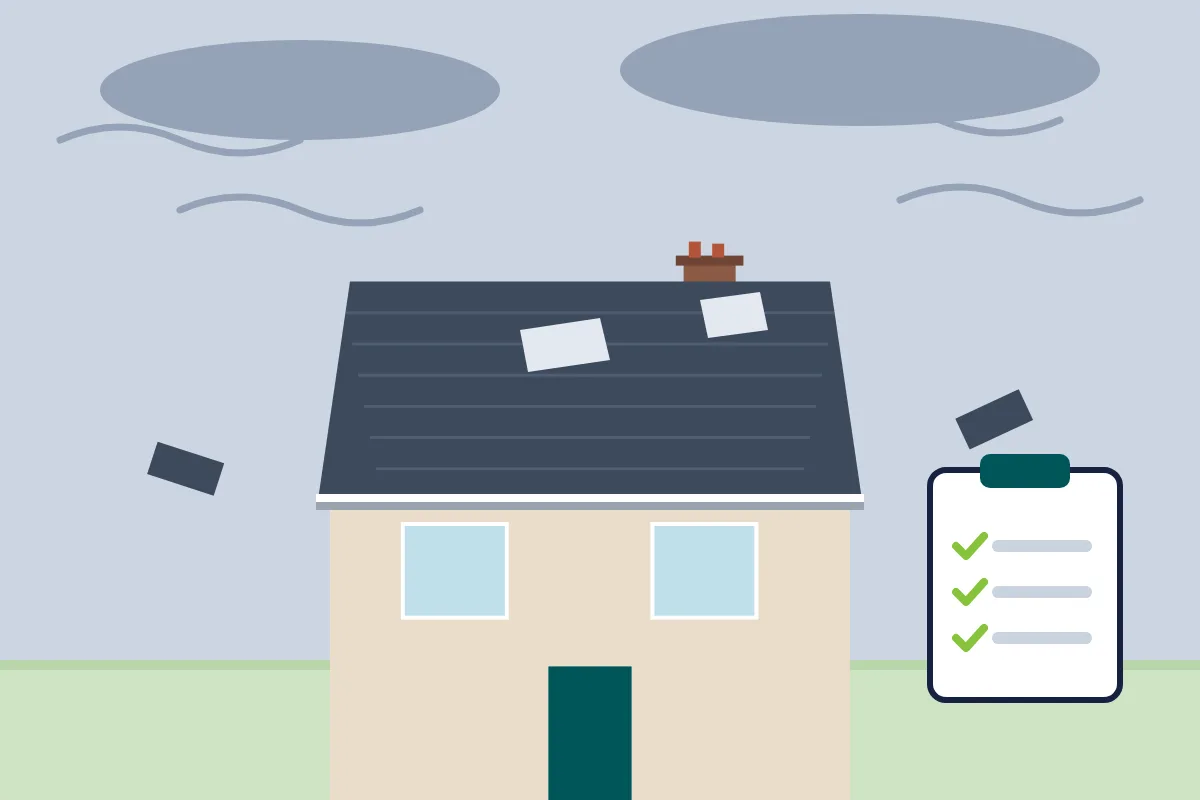
- Slates and tiles blown off the roof
Storm damage roof report in Sheerness: what you get
Each roof is looked at from the safest viewpoints available: the ground, windows and vantage points, the loft where there is access, and the roof itself where that’s safe. We photograph and describe each area of damage. If part of the roof cannot be seen, the report says so. The report, with photos, is yours to pass to your insurer. If you’ve noticed damaged ridges and hips and damaged gutters and fascias, a survey will tell you what’s going on, on flashings, gutters and fascias and chimney stacks alike.
In a smaller place like Sheerness, some roofs face open ground, so wind and driving rain find any weakness in ridges, verges and flashings. If a leak shows only when the wind is in a certain direction, that is a useful clue. It helps to know when and where the water appears. Gutters and downpipes on the exposed side are worth a look as well.
You receive the findings by email, easy to pass on to a roofer, an agent or an insurer. Turnaround is within 48 hours for Basic, 24–48 hours for Standard and same day for Premium.
- Place
- Sheerness (ME12)
- Region
- Kent
- Cost
- From £150 inc. VAT
- Report
- A written report with photos, by email
- When we survey
- Monday to Sunday, daytime
- Insured
- PI and public liability insurance
- Telephone
- 07833 053749
- Page updated
- 27 October 2026
Storm damage roof reports in Sheerness: local notes
The coast is about 1 mile or less from Sheerness, and being near the sea means more wind and salt than a roof inland would face. Driving rain off the sea can be pushed into gaps that stay dry in calmer weather, and salt air slowly wears metal fixings. Older buildings may be listed or sit in a conservation area. To find out, check Historic England’s list and ask the council about conservation areas. In either case, a change of roofing material may need consent.
If you let a flat or house near Sheerness-On-Sea station, a clear finding on where water gets in helps you brief a roofer right away. If you own one of the older houses in the streets near Parish Church of the Holy Trinity, old mortar, worn lead and slipped slates are the usual suspects when water gets in.
Sheerness is about 7 miles north of Sittingbourne, in Kent. Sheerness is part of the area we cover and the surrounding area as part of our work across London and the South East. Sheerness is one of the towns and villages in Kent we cover for storm damage roof reports. We also survey roofs in Maidstone.
Here we cover the ME12 postcode area for storm damage roof reports. We cover properties on High Street, Granville Road and Millennium Way and the roads around them. Being close to the A249 and A250, Sheerness is easy for us to reach. If you’re just outside Sheerness, we cover Blue Town (1 mile north-west), Halfway Houses (1 mile south-east), Queenborough (2 miles south), Rushenden (2 miles south-west) and Grain (2 miles north-west). Within a short drive, we also cover Sittingbourne (7 miles south), Whitstable (13 miles south-east), Faversham (10 miles south-east), Davington (10 miles south-east), Foley Park (15 miles south-west) and Preston (10 miles south-east).
What’s near Sheerness
In Sheerness, that means homes and buildings near Oasis Academy Isle of Sheppey, Barton's Point Coastal Park and The Crown pub and the streets around them. Sheerness has its own railway station: Sheerness-On-Sea station. Well-known places in the area include Rose Street Cottage of Curiosities (under half a mile north).
Also near Sheerness
Other services in Sheerness
Sheerness questions
Will you come out to Sheerness?
We do. Villages and rural addresses get the same survey as a town house, with the route planned beforehand.
Is the coastal weather around Sheerness hard on roofs?
It can do. Within about 1 mile of the sea, as Sheerness is, metal fixings wear faster and gales find any loose ridge or slate.
What’s the best way to book?
It is easiest to ring 07833 053749 or use the contact form. Give us the address and a few details about the roof, and we’ll take it from there. We survey on any day of the week.
What if my insurer declines the claim?
Complain to your insurer first. After that, the Financial Ombudsman Service may be able to look at it. An independent report can add to your evidence, but we can’t say how it will turn out.
Can you tell me if my claim will be paid?
Only your insurer can decide that. Our report records what is damaged, with photos, and the likely cause, for you to give to your insurer.
Is this a RICS survey?
No. Our survey looks at the roof, not the whole building. If you need a full building survey, you will need a RICS survey as well.
Is wear and tear covered by insurance?
Wear and tear is usually excluded from home insurance. Our report records storm damage and any older wear we see, so it is clear what we found. Your insurer decides how its policy applies.
What a storm damage roof report does not cover
Every survey has limits, and we’d rather be clear about that before booking. Keep these in mind:
- Whether your insurer will pay the claim
- Damage hidden under coverings or inside the structure, without opening up
- The work of a loss adjuster appointed by your insurer
If in doubt, phone 07833 053749 or send us an email and we will suggest the right survey before booking. The full list of what we check.
Roofs we survey in Sheerness
- Flat roofs
- Ridges and hips
- Chimney stacks
- Gutters and fascias
- Slate and tile slopes
- Flashings
What we do, step by step
The aim of the visit is simple: to see as much of the roof as can be seen safely and record it clearly. Notes and photos go into the written report. The visit typically takes between one and two hours for a house, rising to roughly 3–4 hours on a commercial building. Being in a smaller place like Sheerness doesn’t change how the visit works: outside, inside and from any safe vantage point, in that order. Point out any stains, cracks or loose pieces you’ve spotted.
- First we go through when the storm hit and what you’ve noticed.
- The roof is inspected from safe positions.
- Each area of damage is photographed and described.
- We note the likely cause and any signs of older wear.
- You get a written report to pass to your insurer.
Getting ready for the survey
- Make a note of anything you’d like us to look at
- Keep pets inside or away from the areas we’re looking at
- Have any paperwork from past roof work to hand
Getting a price
We confirm the price for your survey before you book, so you know the cost up front. Storm damage roof report starts from £150, including VAT. For a price for your roof, ring 07833 053749 or send us an email.
Advice
Useful tips for Sheerness property owners
Getting the most from a storm damage roof report starts before we arrive and carries on afterwards. Some tips:
- Keep invoices for temporary repairs
- Do not go onto the roof to take pictures
- Keep a note of the date of the storm
- Tell your insurer about the damage promptly
Questions about the findings are always welcome. The Standard Survey includes a follow-up consultation and the Premium Survey an in-person consultation.
Keep the roof in good order between storms. Have loose slates, tiles and flashings seen to promptly.
Do you need a storm damage roof report in Sheerness?
Landlords and managing agents book reports to keep a record for owners and insurers. It helps when explaining damage to a building owner or insurer.
A survey can pick up problems like:
- Water coming in after the storm
- Damage from fallen branches or debris
- Torn or lifted flat roof coverings
- Damaged gutters and fascias
If you look after a building such as Rose Street Primary School, a leak through a large roof is often found some distance from where the water shows inside.
Choosing a roof surveyor
- What exactly goes into their report
- Which parts of the roof they’ll actually see
- When you will get the report
- If they fly a drone, whether they hold a CAA Flyer ID and Operator ID
Surveys for landlords and agents in Sheerness
We survey roofs for landlords and letting agents as well as householders. A written report with photos gives you a clear record of the roof.
Roof problems in a rented home affect tenants as well as the building. A survey shows what needs attention, so you can plan the work with less disruption.
Should I look at the roof myself first?
A lot can be seen from the ground. Binoculars help you spot slipped slates or tiles, gaps along the ridge and a leaning stack. Never climb onto the roof to look.
Your own check is a good start, but it isn’t a survey. From the ground, valleys, flashings and the backs of chimneys are often out of sight, and those are details a survey looks at closely.