
Wokingham · London and the South East
Reading Gutter Survey
A careful look at the gutter at your property in Reading, and put it all in a written report with photographs.
- Choked outlets or hopper heads
- Cracked or loose downpipes
- Valley or box gutters that overflow inside
About our gutter survey in Reading
We look at the rainwater system above ground level: gutters, outlets, hoppers, downpipes and overflows. It is not a CCTV drain survey, so we can’t see inside underground pipes. If the problem looks like a blocked or broken drain below ground, we will say so in the report, so you can get the drains checked separately. Anything we find above ground, such as a split hopper or a leaking downpipe, is photographed and recorded. We survey parapet and box gutters, eaves gutters and downpipes, and people most often book us about blocked outlets and hoppers and sagging gutters and loose brackets.
In a place the size of Reading, street trees and gardens shed leaves into gutters every autumn, and once a gutter blocks, water spills down the wall. Hidden valley and parapet gutters can overflow into the house itself. Water from one part of a roof often ends up showing somewhere else entirely. Late autumn, once the leaves are down, is a sensible time to check gutters and outlets.
You can share the report with anyone who needs it: a seller or estate agent, an insurer, a roofer, a builder or a managing agent.
- Place
- Reading (RG6, RG31, RG1, RG30)
- Region
- Wokingham
- Price
- From £150 inc. VAT
- Your report
- A written report with photos, by email
- Appointments
- Weekdays and weekends
- Insurance
- PI and public liability insurance
- Telephone
- 07833 053749
- Updated
- 27 October 2026
How the survey changes by roof type
Aluminium and other metal gutters
Metal gutters are common on commercial buildings and some homes. Their joints and outlets still need checking.
Cast iron gutters
Rust at joints and brackets is the usual weak point on cast iron. Cracks, rust and leaks are recorded as far as we can see them.
Towns and villages near Reading
What else we do in Reading
What a gutter survey looks like in Reading
In this part of the South East, older roofs are mostly slate or clay tile and many newer ones concrete tile, with flat-roofed extensions, dormers and garages common everywhere. On roofs like these, good slates or tiles can outlast the nails, battens, lead and mortar around them. Mapledurham House, about 3.6 miles north-west, is one of the historic houses in the wider area around Reading. On older houses around here, roofs frequently carry the marks of earlier repairs, from replaced slates to new lead, and a listed home or one in a conservation area may need consent for changes of material.
The streets around a church like All Nations Christian Centre are often among the oldest in a place, and if yours is one of the older homes nearby, its roof may have old fixings, lead flashings and chimneys that need a closer look. If you own a rental within reach of Reading West station, knowing the condition of the roof, chimneys and gutters helps you plan work rather than react to complaints.
Reading is about 38 miles west of London, in Wokingham. We survey roofs in Reading and the rest of Wokingham. Reading is one of the towns and villages in Wokingham where we work.
Here we cover the RG6, RG31, RG1 and RG30 postcode area for gutter surveys. If you need a gutter survey at a property on Downshire Square, Market Way and Market Place or a nearby road, we can help. Being close to the A4 and A33, Reading is easy for us to reach. Other places close to Reading include Coley Park (1 mile south-west), West Reading (1 mile north-west), Newtown (1 mile east), Lower Caversham (1 mile north-east) and Whitley (2 miles south-east). Within a short drive, we also cover Wokingham (6 miles south-east), Woodley (3 miles east), Crowthorne (9 miles south-east), Lower Earley (3 miles south-east), Winnersh (4 miles east) and Woosehill (6 miles south-east). Reading is one of the larger places we cover in Wokingham.
Around Reading
Around Reading, our work takes us to homes and buildings near Former Kennet Arms, Eldon Square and Kendrick School and the streets around them. You’ll also find University of Reading library (1.5 miles south-east) and Eurospeak Language School (0.5 miles north). The nearest railway station is Reading West station, roughly 0.7 miles north-west. Other landmarks nearby include The Oracle (under half a mile north-east) and Berkshire Medical Heritage Centre Museum (0.8 miles east). The countryside around Reading includes Sonning Hill and Longwater.
Reading: your questions answered
Is my home in Reading listed or in a conservation area?
Your council is the best source, with Historic England’s list for listed buildings. A change of roofing material may need consent in either case, and councils can also use Article 4 directions.
Do you cover Reading?
Yes, Reading is within the area we cover. Our area covers London and South East England. Just ring 07833 053749 or use the contact form and tell us about the property.
How much time does the visit need?
A visit normally takes roughly 1–2 hours at a house, depending on how many gutter runs and downpipes there are. You’ll know roughly how long when we arrange the visit.
Does this replace a RICS home survey?
No. We are experienced roof surveyors, and our survey covers the roof rather than the whole building. For the rest of the building, a RICS home survey is a separate job.
What happens next?
You’ll receive the report by email, and what you do next is up to you: raise it with a seller, send it to an insurer, brief a roofer or share it with a managing agent.
Does someone need to be in?
It depends on what we need to see. Inside the building and in the loft, we need someone to let us in; we will agree the details as you book.
Will you check if gutters are causing damp inside?
Leaking gutters and downpipes are a common cause of damp walls, and we check for exactly that. If the evidence points elsewhere, we will say so, based on what we can see.
Common roof problems in Reading
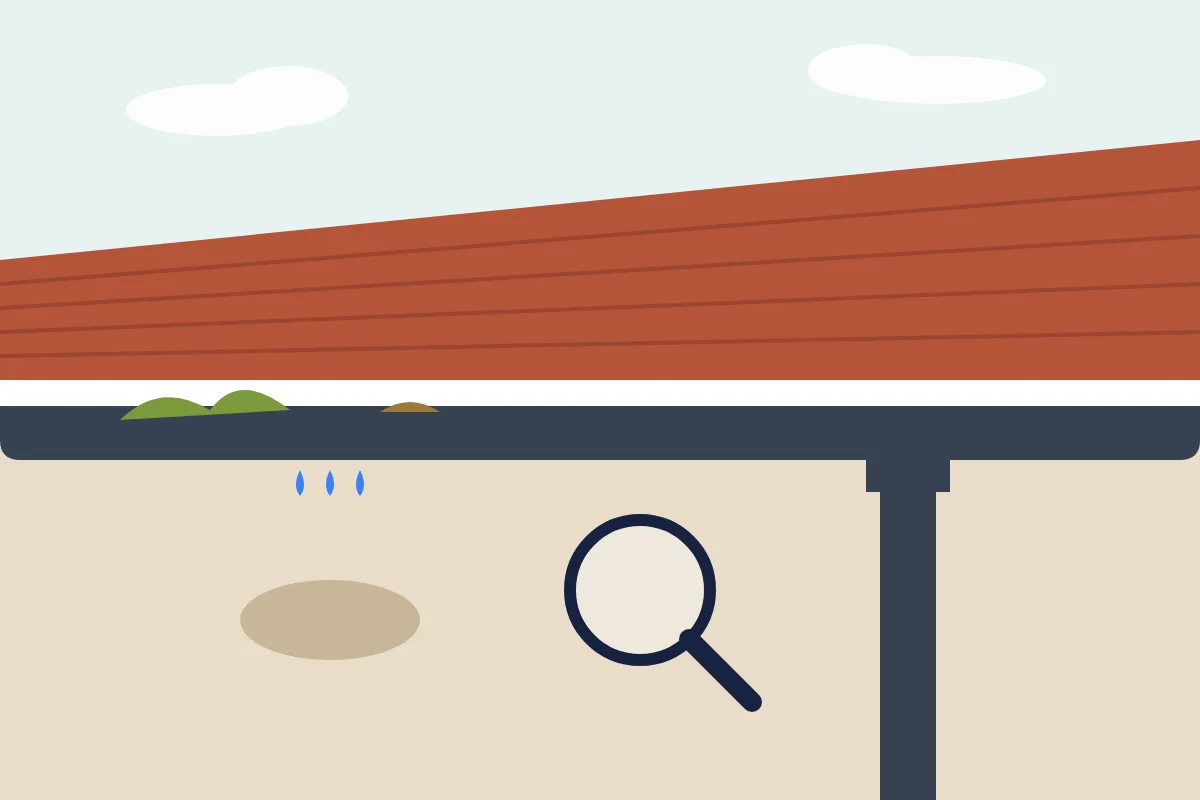
Falling leaves are the most common cause of blocked gutters. Nearby trees drop leaves, twigs and seeds into gutters every autumn, and they collect at the outlets. Once an outlet is choked, the gutter fills and overflows.
Things that frequently lead to a survey include:
- Overflowing eaves gutters
- Downpipes that are split or coming away
- Valley or box gutters that overflow inside
- Leaves and moss blocking gutters
If you look after a shop, office or commercial unit, for example near The Oracle, knowing the roof’s condition lets you budget for work rather than pay for emergencies.
Questions to ask before you book
- Whether the inside of the roof is included
- Whether you can ask questions once you have the report
- Which limits apply to the survey
- Whether the price includes VAT
What affects the cost of gutter surveys
Every roof is different, so prices are confirmed before booking. This is what makes a difference:
- The use of thermal imaging or a drone
- How big the roof is
- Chimneys, valleys, parapets and other details
- Commercial roofs and larger buildings
What a survey costs comes down to the roof itself: how big it is, how high it is, the number of separate roofs and how it can be reached and seen safely. Gutter survey starts from £150, including VAT.
What to tell us when you contact us
You do not need to know any roofing terms. Just let us know:
- The property’s address and postcode
- Any photos you have, taken from ground level or a window
- Where water is showing inside, if it is
- Dates you’re working to, such as exchange
We survey roofs seven days a week. To find a date that works for you, ring 07833 053749 or use the contact form with the address and the days you’d prefer.
How it works
Expect us to ask a few questions before we start, like when any problem began and what work has been done before. Then the inspection itself takes between one and two hours for most homes, and longer where there are parapet, valley or box gutters to follow. Town-centre streets in Reading can mean pay-and-display or permit parking, so a word about where to park saves time. We’ll want to see the loft, if there is one, and any ceiling or wall showing damp. Outside, we work round the building to find the safe viewpoints.
- First, you tell us what you’ve seen, like overflows or damp.
- We look along the gutters, downpipes and fascias from the ground and from windows.
- We check hidden gutters, like valleys and parapets, where it is safe to see them.
- Where the loft can be reached safely, we check it for staining or damp.
- The findings are written up with photos and recommendations.
Preparing for the visit
- Clear the way to the loft hatch
- Point out any leaks or damp patches
- Have any questions written down, so nothing gets missed
Getting a price
Our price is from £150, including VAT. The exact figure depends on the roof and the package, so phone 07833 053749 or drop us an email with the details.
Read more
Practical tips
Small things make a difference. Our tips:
- Ask for valleys and parapet gutters to be cleared too
- Have overhanging branches cut back
- Look for downpipes coming loose
- Look for green streaks or damp patches on walls
Where the evidence points to drains below ground, the report says so, so you can arrange a drain survey. Anything else we notice on the roof, as far as we can see it, is noted too.
Don’t forget valley, parapet and box gutters. They block in the same way as the gutters you can see but they’re much harder to spot, so ask for them to be included when gutters are cleared.
Checking the roof from the ground
Look up at the roof after a storm, from the ground: pieces of tile or slate on the ground, a gap in the ridge or a lifted flashing are all worth noting. Don’t go up yourself.
A DIY look is useful, but it isn’t a survey. You will not see flashings, valleys or the backs of chimneys properly from the ground, and those are details a survey looks at closely.