
Hampshire · London and the South East
Warnford Drone Roof Survey
Drone roof surveys across Warnford, with over 20 years’ experience behind it. You get a clear report with photos.
- Cracked mortar along the ridge
- Chimney tops in poor condition
- Damage after a storm that can’t be seen from below
What happens if roof problems are left?
Faults on high roofs tend to be found late. By that stage the damage has spread inside. A drone survey finds them sooner. Outbuildings and barns around Warnford are easy to forget, but a failed roof there can spoil what’s stored inside. A quick look before winter can save a lot.
Thermal imaging and drone inspection (where applicable) come with the Premium Survey, which starts from £400, including VAT. We can help you choose the package that fits what you’d like to know.
Why choose Independent Roof Survey in Warnford
- 5,000+ roofs surveyed
- Customer satisfaction of 98%
- Drones and thermal imaging where it applies
- We hold a CAA Flyer ID and Operator ID
Read what a roof survey costs or what we found on two real jobs.
How a drone roof survey works in Warnford
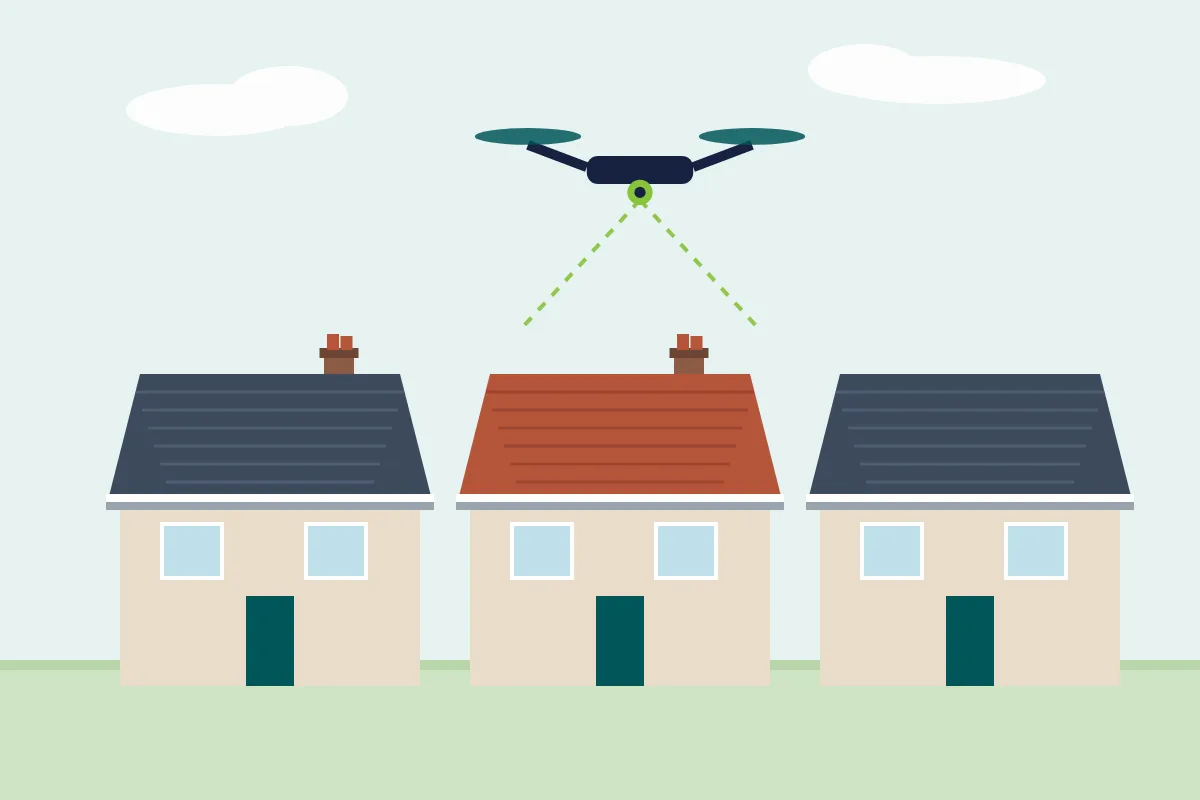
They suit tall buildings, steep or large roofs and roofs that are hard to see from the ground. They also suit fragile roofs that nobody should walk on. You get close-up views without anyone setting foot on the roof. We check the airspace for your address ahead of the visit. If a drone is not the right tool, we’ll say so. If you are worried about slipped or missing slates on a high roof and blocked valleys and parapet gutters, we can find out what’s behind it, on valleys and parapet gutters, large and complex roofs and fragile roofs alike.
Villages like Warnford frequently stand in open country, where wind can be strong. Strong wind or heavy rain stops a small drone flying, and calm conditions also suit thermal imaging best. We plan the journey, access and timing around the weather. If the day turns windy or wet, the visit can be moved.
With the Standard Survey, you also get moisture detection, a structural check and a follow-up consultation. The Premium Survey goes further, with thermal imaging, drone inspection where it applies, structural analysis and an in-person consultation.
- Where
- Warnford (SO32)
- Region
- Hampshire
- Prices
- From £400 inc. VAT
- Reports
- A written report with photos, by email
- Appointments
- Monday to Sunday, daytime
- Insured
- Professional indemnity and public liability
- Telephone
- 07833 053749
- Last updated
- 27 October 2026
Common questions in Warnford
Will you come out to Warnford?
Yes, smaller places are covered as well as towns. We work right across London and the South East. Let us know about access, parking and anything unusual about getting there as you book.
Does a conservation area affect roof work in Warnford?
Historic England’s list shows listed buildings, and the local council can tell you about conservation areas. If a home is listed, changes that affect its special interest need listed building consent, and in a conservation area re-roofing in different materials may need permission.
What happens after the survey?
You receive the written report by email, with photos and recommendations. You can use it to talk to a seller, an insurer, a roofer or a managing agent, whichever applies.
Can you survey at the weekend?
Surveys run on weekdays, Saturdays and Sundays. To arrange a date, ring 07833 053749 or use the contact form.
Is a drone roof survey a thermal survey?
The drone gives you detailed photos of the outside of the roof. Thermal imaging comes with the Premium Survey.
Can a drone see inside my loft?
No. The drone photographs the outer surfaces, but not the loft or the underside. We look in the loft from inside where it is safe.
Is it a structural engineer’s report?
No. Our survey isn’t a structural engineer’s report. We will recommend an engineer if we see signs that call for one.
How the survey changes by roof type
Ridges and hips
Ridges may be bedded in mortar or mechanically fixed. Their condition is noted in the report.
Flat roofs on tall buildings
Outlets, edges and roof plant are common problem areas. We photograph them closely.
What we do, step by step
Photos are taken throughout the visit, so you can see in the report what we found and where. Close-ups come from the safest viewpoint available. A typical visit takes roughly 1–2 hours at a house, including the airspace and weather checks before take-off. Around Warnford, older homes can have small or awkward roof spaces, so let us know about the loft hatch and any ladder. We only go where it’s safe.
- First, we check the address for flight restrictions.
- Where a flight restriction zone or restricted area applies, we seek permission first.
- On the day, we check the weather and the site before flying.
- We fly the drone close to the roof to photograph it in detail, always in sight.
- You receive a written report with photos and recommendations.
Getting ready for the survey
- Have any paperwork from past roof work to hand
- For a flat or shared roof, check access with whoever owns or manages the building
- Leave side gates unlocked
How to book
Not sure which survey you need? It’s easiest to ring 07833 053749 or send us an email and describe the roof and what’s worrying you. We’ll explain the options and the price.
Advice
Common roof problems in Warnford
The top of a stack is the most exposed part of many roofs. From ground level, you rarely see cracked flaunching or loose pots. A drone gets close enough to see them in detail.
Problems we come across frequently include:
- Cracked mortar along the ridge
- Damage after a storm that can’t be seen from below
- Cracked flaunching or loose chimney pots
- Lead work pulling away at abutments
If you live in an older home near Church of Our Lady, tall stacks and steep slopes are easier to judge with close-up aerial photos than from the pavement.
Choosing a roof surveyor
- Whether the inside of the roof is included
- How much experience they have with roofs like yours
- If they fly a drone, whether they hold a CAA Flyer ID and Operator ID
- Whether you can ask questions once you have the report
Drone roof surveys in Warnford: local notes
The drone we use is under 250g, flown by a CAA-registered operator with a Flyer ID and Operator ID. Open category rules keep flights below 120 m (400 ft) and the drone within sight at all times. The wider area around Warnford has a long history of building, with Hinton Ampner House about 3.1 miles north-west. Older homes in the wider area frequently have features worth a closer look, such as lead valleys, tall stacks and roofs that have been patched over the years.
Warnford is about 8 miles west of Petersfield, in Hampshire. Surveys in Warnford work the same way as everywhere we cover: a careful look at what can be seen safely, photos and a clear written report. Across Hampshire, we cover Warnford. We also survey roofs in Southampton.
Drone roof surveys in SO32 are booked the same way as anywhere else. Close by, we survey roofs in Bramdean (3 miles north), Hinton Ampner (3 miles north-west), Beauworth (3 miles north-west), Cheriton (4 miles north-west) and Bishop's Sutton (5 miles north). Further out, we also cover Winchester (10 miles west), Gosport (14 miles south), Havant (11 miles south-east), Eastleigh (11 miles west), Fareham (11 miles south) and Horndean (8 miles south-east).
Around Warnford
Locally, jobs take us to homes and businesses close to The George And Falcon Inn. Not far away are Shutts Copse and Beacon Hill.
What a drone roof survey doesn’t cover
This is not a RICS building survey, a structural engineer’s report or an asbestos survey. Other limits to bear in mind:
- Photos in conditions too poor to fly
- Flights in a restricted zone without permission
- Roofs and gardens beyond the one we’re surveying
If you are not sure which survey you need, call 07833 053749 or drop us an email and we’ll give you a straight answer. The full list of what we check.
What we look at
- Flat roofs on upper floors
- Chimney stacks
- Fragile roofs
- Tall and steep roofs
- Large and complex roofs
- Valleys and parapet gutters
Should I look at the roof myself first?
Look up at the roof after a storm, from the ground: pieces of tile or slate on the ground, a gap in the ridge or a lifted flashing are all worth noting. Do not go up yourself.
Your own check is a good start, but it is not a survey. From ground level, valleys, flashings and the backs of chimneys are frequently out of sight.